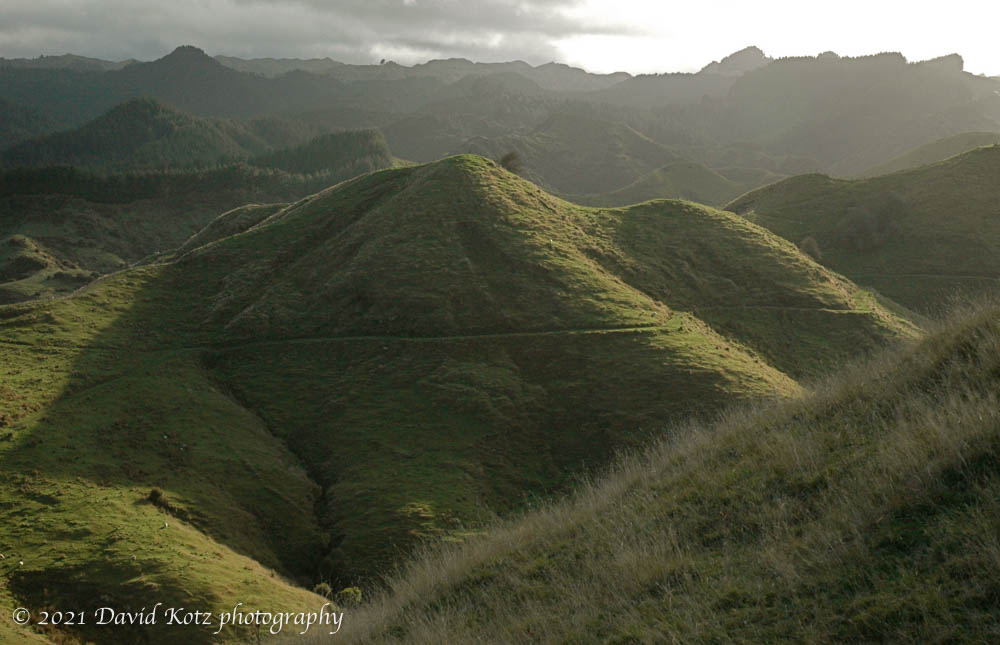
Our drive up the western side of the north island involved a lot of beautiful green countryside, with rolling hills and sheep pasture like this one.
We completed our tour of the south island with another visit to Blenheim, in the north-east corner [location]. In the morning we quickly toured some of the local vineyards – and it seems there are dozens in this area, known as Marlborough. We found excellent wines at Cloudy Bay, Spy Valley, and Villa Maria. I understand that Villa Maria is readily available in the US. Read on!
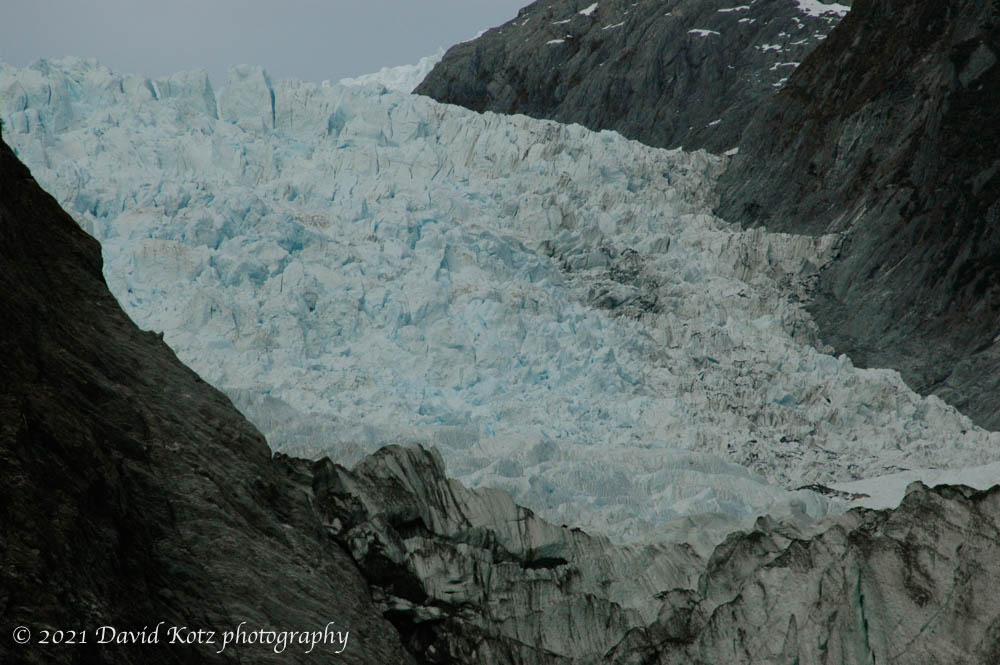
Early on this winter’s morning we took a hike to a glacier. The Franz Josef glacier (named by an Austrian explorer for the then emperor of Austria) is one of the most accessible and indeed very impressive glaciers on the west slope of the southern alps. [location] Read on!
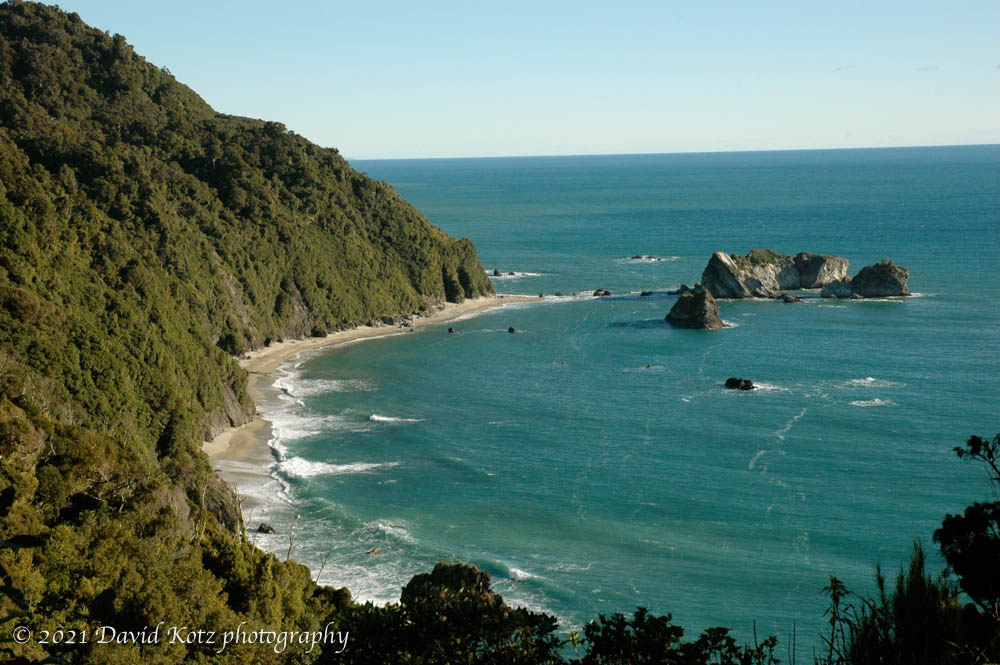
The west coast of the south island is rugged and beautiful.
We drove, in parts of three days, up the west coast of the south island. Or those parts that are drivable, anyway, because the southwest corner (Fiordland) is roadless, and the northwest corner (Abel Tasman park) is remote with few roads. The southern alps loom close at hand on your right, and the hills drop steeply into the sea on your left. At times the road was winding and twisting along these hillsides. Rarely, we encountered a beach made of smooth rounded stones. All in all, it was beautiful. Check out those photos and read on for more photos!
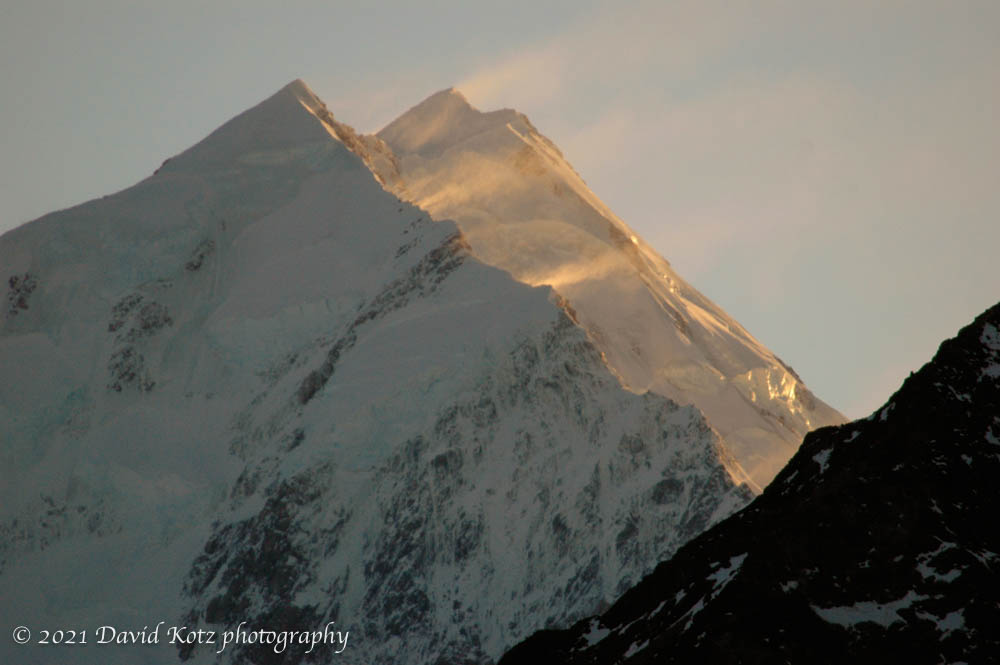
Aoraki is the highest peak in New Zealand, at 3754m.
Aoraki, the Maori name for Mt. Cook, is 3754m and the highest point in New Zealand [location]. Aoraki means “cloud piercer”, and it was living up to its name as we arrived late Sunday afternoon to stay for a night in the valley. “Spectacular” only begins to describe the drive in, and the mountains surrounding this gorgeous valley. Read on!
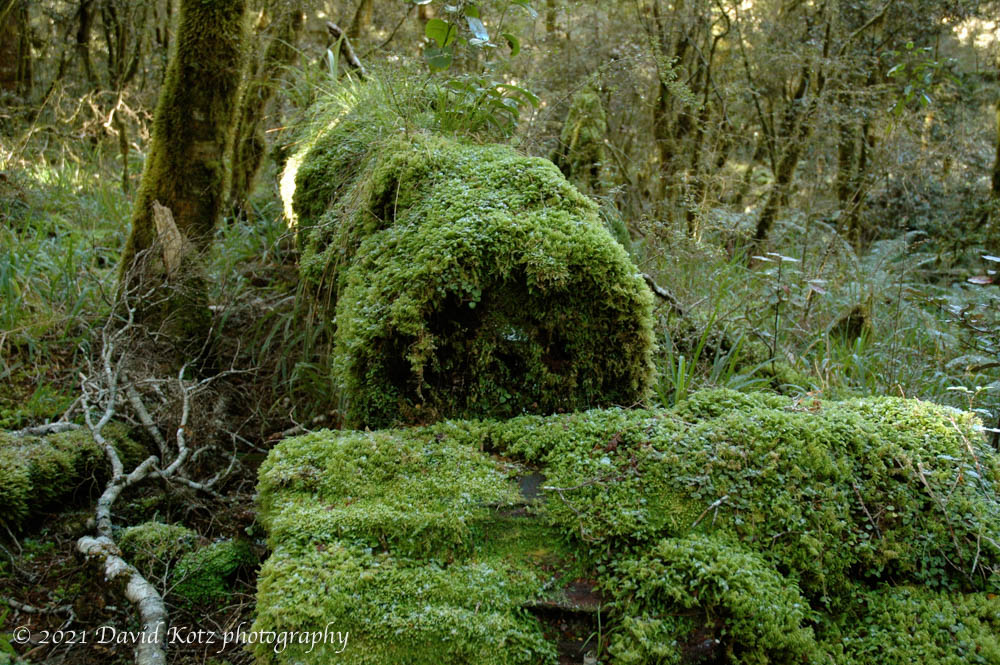
We leave the dry eastern slopes and encounter the rainforest of the west coast.
We finished our hike at Aoraki around noon and drove south along the alps until we reached Wanaka [location]. This is the route to the west coast, indeed, the only route this far south, but nonetheless we bypass the entire Fiordland and Southland regions. They are gorgeous, I’m told, but with our limited time (and a severe weather warning for deep snow in that region) we skipped it on this trip. Read on!
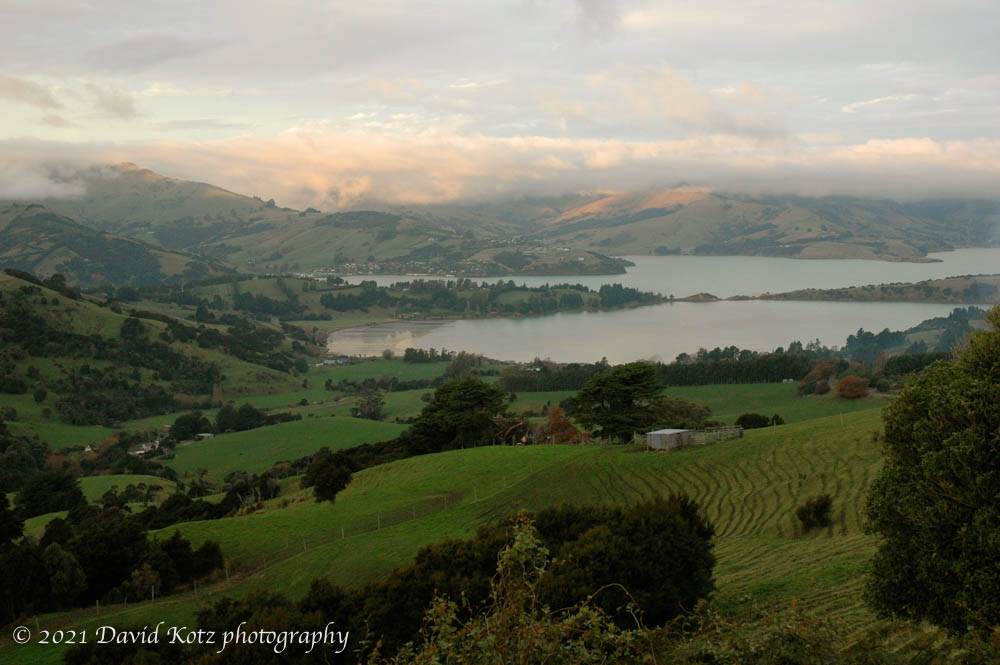
Akaroa, outside Christchurch on the east coast of the south island.
We stayed in Christchurch [location] two nights, mainly so that we could spend a day driving to Akaroa, on the beautiful Banks Peninsula on the east coast of the south island. It is tempting to call Akaroa an “island”, and indeed Captain Cook once thought it was an island. It is actually a peninsula, rugged and hilly and gorgeous, with neat villages snuggled in the many bays and inlets. Read on!
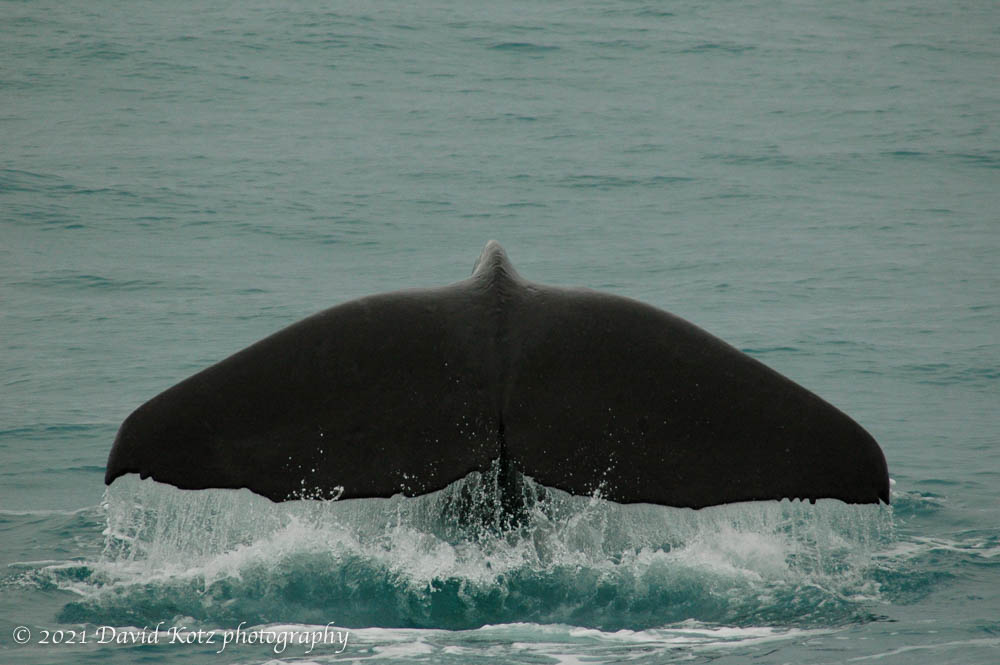
New Zealand is on a major whale highway, and we took this opportunity to get out and see some whales. In our 3-hour tour of the deep waters just off the coast of Kaikoura, on the east coast of the South Island [location], we had four sperm-whale sightings. Twice we spotted a local resident, whose name escapes me, and twice we spotted different non-resident sperm whales. Read on and check out the photo gallery!
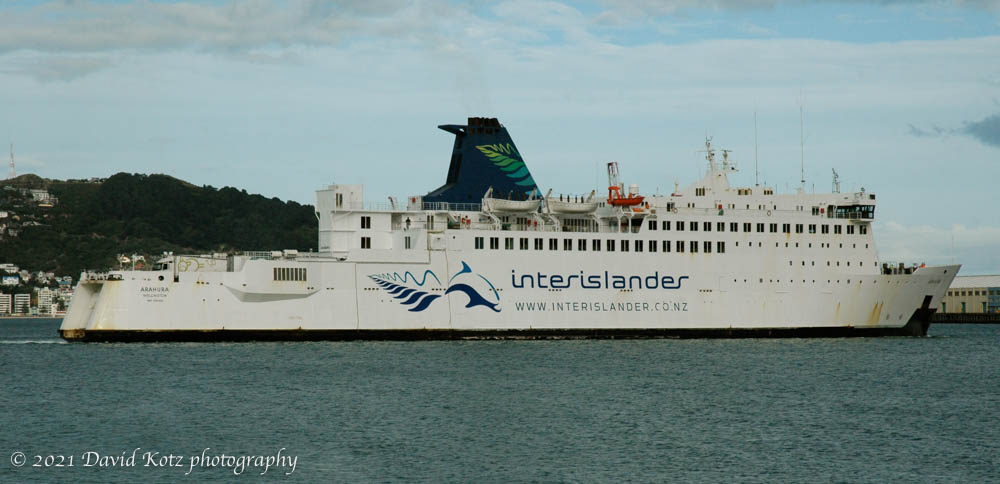
The Cook Strait separates the North Island from the South, and can be a wild and rough passage.
We drove straight through from Rotorua southward to Wellington, at the southern tip of the North Island; although it was a cloudy and drizzly day I did get some nice photos. We stopped to meet an old friend for dinner, in the little town of Featherston a bit north of Wellington. Read on for our ferry ride across the Cook Strait.
A few weeks after we arrived in India I posted an entry in which I described the things that each of us missed about home. Now, about four weeks after departing India we are all missing many things about India. Here are some things that come immediately to mind.
David: colleagues; dosas, dal, and fresh mangoes!
Pam: friendly people, fresh mangoes
Mara; friends
John: friends, the food
Andy: friends, Indian music, gatorade
And the beautiful IISc campus.
Andy discovers the wonders of fresh mangoes.
This post was transferred from MobileMe to WordPress in 2021, with an effort to retain the content as close to the original as possible; I recognize that some comments may now seem dated or some links may now be broken.
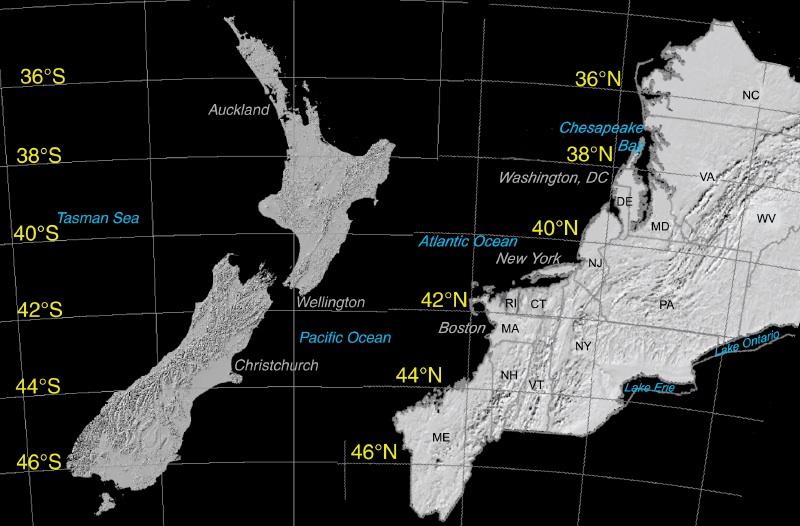
New Zealand and New Hampshire are the same latitude!
I have always understood that New Zealand is south of the equator, but I’ve never really recognized how it compares with familiar places north of the equator. Thanks to my friend Troy Baisden, who supplied this handy graphic, it’s easy to see that New Zealand spans roughly the same latitudes as North Carolina to Maine, and even a bit of Canada.
Coincidentally, Aoraki (Mt. Cook) is almost exactly as far south of the equator as Dartmouth is north of the equator. Dartmouth (Baker Tower) is at approximately 43.7 degrees north; Aoraki is at approximately 43.6 degrees south [map].
This post was transferred from MobileMe to WordPress in 2021, with an effort to retain the content as close to the original as possible; I recognize that some comments may now seem dated or some links may now be broken.