Well, today is our last day in India; tonight we fly to Australia for the next leg of our journey.
I am sad to be leaving, and will surely miss many wonderful things about life here. Number one, the food! Second, the people, who I have found to be almost universally friendly, warm, and welcoming. Third, the weather, which in Bangalore at least is usually very nice. Finally, the chance to travel and learn about a incredibly beautiful country with diverse and deeply interesting cultures. I surely hope to come back sometime soon.
I am grateful to many people. To the staff at Fulbright offices in Delhi and Chennai, and the team at CIES, who helped with all the details of getting us here and helping us get established. To Prof. Anurag Kumar and Chandrika Sridhar, who helped in so many ways to ease my transition into IISc and to help us set up household here. To Vittal Kini, Kumar Ranganathan, Satish Rath, Amit Baxi, and Sasi Avancha at Intel, who enabled me to collaborate on a great project. And last but not least, to my family, who have made this year a fun exploration of life.
Below, I am with Prof. Anurag Kumar, right, who was my host during my stay at IISc, and Shrirang Mare, a project assistant we hired to work with us on a research project. I really enjoyed working with them both!
David at IISc with Shrirang (programmer) and Anurag Kumar (professor and host).
I’ve posted a few final photos from IISc/Bangalore.
This post was transferred from MobileMe to WordPress in 2020, with an effort to retain the content as close to the original as possible; I recognize that some comments may now seem dated or some links may now be broken.
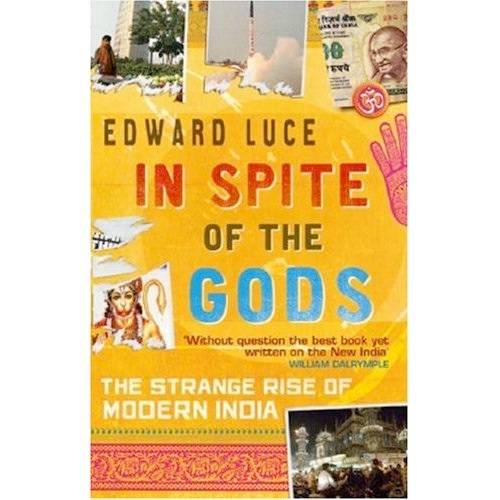
I just finished reading Nandan Nilekani’s new book,Imagining India. It is a wonderful look at the state of India, and how it got here, but more importantly it is an optimistic look forward at where India can go.
Nilekani is most famous as the co-founder of Infosys, the IT juggernaut that arguably led India’s outsourcing boom. He is also known as the man who inspired Tom Friedman with the idea that the World is Flat. I was honored to meet him at a conference in January, and was able to get my copy of the book autographed. Read on for a summary.
Kanyakumari street children, Tamil Nadu. December 2008.
After spending nine months in India we have grown attached to the place. India is a beautiful country filled with wonderful people. It is full of success stories – like the IT boom in the past decade – but it is also full of many challenges. Nearly a third of the people are in poverty, there is little care for the environment, and the educational system largely fails its children. We are planning to donate substantially to several charities that serve the children and environment in India. After asking around, here are some of the charities recommended by colleagues:
* These can take donations from the US, in US dollars, and are tax-deductible in the US. It may also be possible to donate to the others via wire transfer, but I’m not sure whether they are tax-deductible in the US.
This post was transferred from MobileMe to WordPress in 2020, with an effort to retain the content as close to the original as possible; I recognize that some comments may now seem dated or some links may now be broken.
India’s big trucks – “goods carriers” – are always colorfully painted and usually say something like “HORN OK”. But occasionally I see a social message, like “One is best” or “We two ours one”.
“One is best”, an old slogan, painted on a truck in Maharashtra, India.
India has long struggled with poverty and a rapidly growing population. Decades ago, the government launched aggressive campaigns for family planning and even sterilization. (Nandan Nilekani’s book has a searing indictment of those programs, which often led to abuse when some health workers sought to meet their monthly sterilization quota.)
I still see the occasional sign or message referring back to this campaign, like the truck below that refers to “We two ours one.” I asked the taxi driver what it meant, and he explained to me that it referred to a married couple (two) who were to be encouraged to have just one child.
“We too ours one”, an old slogan, painted on a truck in Maharashtra, India.
This post was transferred from MobileMe to WordPress in 2020, with an effort to retain the content as close to the original as possible; I recognize that some comments may now seem dated or some links may now be broken.
Cellular telephony is spreading rapidly across India.
Recently, it was widely reported in the US media that cellphone-only households (20.2%) outnumber homes with only a landline [SF Chronicle].
In India, on the other hand, “There are 65 times more cellphone connections than broadband Internet links, and the gap is widening” [NYT]. India is a very young country – the median age is something like 20 years – and they are adopting mobile technology rapidly.
India has been voting, in phases, over the past two months. This process is amazing – it is the largest democracy in the world, and it is conducted 100% with electronic voting machines. Turnout was high; indeed, more people in India voted than the entire population of the US.
Manmohan Singh will serve another term as Prime Minister. (Photo from the Times of India.)
The voting proceeded for weeks, during which exit polls indicated an extremely close race between the incumbent UPA coalition (led by the Congress party) and the NDA coalition (led by the BJP).
Photo by Times of India.
Today, the election results were announced. The results are surprising: not only did the UPA retain power, but the Congress party itself swept 201 seats – the most any party has received in over 25 years. Thus, it seems, Congress will be able to lead without needing to compromise so often with smaller coalition parties. It appears that India has chosen stability over change.
Manmohan Singh will return as Prime Minister, the first person since Nehru to return after completing a five-year term. Singh, an economist and one-time professor, is widely credited as responsible for the 1991 reforms that led to India’s IT and BPO boom, and more recently, to its relative fiscal stability in the face of the world economic recession.
This post was transferred from MobileMe to WordPress in 2020, with an effort to retain the content as close to the original as possible; I recognize that some comments may now seem dated or some links may now be broken.
An incredible spectacle, encountered by coincidence.
It’s 6:30am and I’m standing barefoot in the middle of the street. Men dressed in wild, colorful costumes dance and flow around me, as others with drums and trumpets pound out a mesmerizing beat. I’m photographing as fast as the camera will go, and the men smile and are thrilled. This morning, and this evening, are possibly the most sensory experience I’ve had in India – incredibly visual, with vibrant costumes and crowds of revelers, pulsing music from roaming bands of drummers, smells of flowers and incense, and the overwhelming crowds, heat, and humidity. Read on and do not miss the photo gallery!
I’m not sure that I have ever visited a more inspiring and impressive place. Inspiring, because the Aravind Eye Hospital mission is “to eliminate needless blindness by providing appropriate, compassionate and high quality eye care to all” – and they actually do it, for thousands upon thousands of patients, most of whom can barely afford bus fare to the hospital, let alone cataract surgery. Their task is incredible, because India has over a quarter of the world’s blind people, and much of that blindness are curable or preventable. Their vision is audacious, because they have 5 hospitals today and aim for 100 hospitals within 10 years. Read on! and check out the photo gallery.
We have been blessed with wonderful staff to help us in our household here at IISc.
Our family with our IISc apartment staff:
Venkatama, Vijayalakshmi, and Geetha.
Geetha comes daily (except Sundays) to clean the floors and bathrooms, and wash the dishes. Sometimes her mother, Venkatama, comes to help.
Venkatama, Vijayalakshmi, and Geetha.
Vijayalakshmi cooks dinner for us 5-6 days per week, and speaks workable English. Her food is excellent, local South Indian veg cuisine, a variety of curries and dals and soups. Every now and then they make chapatis, as shown below.
Vijayalakshmi and Venkatama making chapattis on the floor.
This post was transferred from MobileMe to WordPress in 2020, with an effort to retain the content as close to the original as possible; I recognize that some comments may now seem dated or some links may now be broken.
The Indian Institute of Science turned 100 this year. Although not the oldest university in India, most universities were founded within the past 100 years, and indeed, most within the 62 years since independence. I’ve had many interesting conversations with professors during my travels around academia in India. In addition to meeting faculty from several departments at IISc, I have visited IIT Kanpur, IIT Kharagpur, IIT Madras, IIT Bombay, IIT Delhi, IIT Guwahati, MIT at Anna University, the National Degree College, and the REVA Institute of Technology.
Most of these universities are primarily focused on undergraduate education, and indeed the IIT system is legendary in the US because we get so many of our great graduate students from IIT. (Or, at least, we used to, before India’s technology boom started luring many of those same students into staying home for lucrative jobs, instead of going to graduate school). But IISc is graduate-only, and the IITs also have a limited number of MS and PhD students.
IISc conducts world-class research in many fields. The IITs struggle, however, to attract strong graduate students. (Their best undergrads go to graduate school in the US, Europe, or perhaps IISc, but rarely to an IIT.) Unlike the US, federal grant money is plentiful. As I hear it, if you submit a decent proposal for a good idea, you’ll get a grant. The hard part is spending the money: grad students already receive stipends, faculty already receive their salaries, and most IT projects need little equipment. Their real limitation is a lack of smart students and good staff. Since pay for tech staff is limited by government pay scales, it is hard to attract and retain strong technical staff… once they learn the skills, they tend to leave for lucrative industry jobs. Still, there is strong demand for these positions; there may be dozens of applicants for a single programmer position. They give out written exams to weed out the skilled applicants, because a degree from an IT-oriented school does not necessarily mean the student really knows their stuff.
The government is about to double the size of the IIT system. There are five classic IITs; within the past 10 years they built a brand-new campus to found IIT Guwahati, and upgraded an existing university to IIT status in Roorkee. Thus, there are seven established IITs. Now, in the space of a few years, the government is opening 9 new IITs around the country.
This expansion is dramatic and, frankly, somewhat overwhelming. I’m told that there is already a shortage of 700 faculty in science and engineering, within the IISc and IIT system (although that number may also include the IIITs, I’m not sure). To establish 9 new universities at the same time, when it is already hard to recruit good science and engineering faculty, is a daunting task: there is 5x-10x pay difference between IIT salaries and corporate salaries. (That’s 5-10 times, not 5-10 per cent!)
Apparently, faculty are paid on the same government pay scale as police or military or whatever. A sort of tenure comes after a year or two, and pay raises are based on time in the job and not on merit. Thus, there is not a lot of incentive to go into academics, or to excel if you do. (That said, I’ve met many very smart, very skilled, very motivated faculty!)
Where would all these new faculty come from? There is no shortage of engineering schools; I heard that there are hundreds in Tamil Nadu alone. Thus, there are plenty of graduates. The problem is that the vast majority of such graduates are not well qualified, despite their degree. The very best undergrads go to IIT, the best graduate students go to IISc or Europe or North America; the quality of the grad students going to IITs is thus highly mixed. Although there are highly motivated, bright Indians – as grad students, junior faculty, or employees – many may need remedial coursework and time, to learn the background needed for graduate work, and need to learn research skills. Few are ready to be self-starters in grad school. Even Infosys, which hires 25,000+ engineers every year, has its own internal school system teaching 1,000 courses to over 30,000 employees a year, to polish the skills of its new-hires and to continually retrain its existing employees.
There is thus a shortage of PhDs produced in India. As a result, the faculty that staff these hundreds of universities are not, as a whole, well qualified. So the need is not so great to increase the quantity of graduates, but to improve the quality of education in the existing schools.
India needs to produce more PhDs and to retain more of their quality PhDs as faculty. All of the IIT, IIIT, IISc (combined) have 250 professors and only 350 PhD students (December 2008). Per Raghavan published article in Forbes magazine, 2007, about PhD production in CS, CE, IT: US 1400/year, India only 40/year. France and Germany are at about 80/year, so India has some catching up to do.
These observations are based on conversations with many other faculty and do not necessarily represent my own opinion and certainly not the opinion of all faculty in India. Furthermore, I have not been able to verify all the facts above.
This post was transferred from MobileMe to WordPress in 2020, with an effort to retain the content as close to the original as possible; I recognize that some comments may now seem dated or some links may now be broken.