We’re just back from ten lovely days in South Carolina on the shores of Kiawah Island near Charleston. With lots of family nearby and abundant greenspace around the island, I had plenty of interesting opportunities for photography.
A general photo collection, including wildlife, family, and the launch of Chinese lanterns on New Year’s Eve: [smugmug].
A surprise encounter with bottlenose dolphins in the straights next to Kiawah Island, while they were strand feeding: [smugmug].
An attempt at dark-sky photography of the new crescent moon, Orion, and the Milky Way: [smugmug].
I was in Seattle for a visit to the University of Washington, and decided to extend the trip for a day so I could take advantage of the wonderful hiking opportunities nearby. Overwhelmed by the number and variety of hikes in range of Seattle, I settled on a classic choice: Mount Si. According to the statistics on that site, I was probably the 99,999th person to hike the trail this year. Still, on a drizzly Friday in the off season, I figured it couldn’t be too crowded.
I left Seattle before sunrise, drove through a light drizzle (which, I gather, is the norm for Seattle) and reached the trailhead around 8am. With 3,100′ of gain in four miles, this is no little walk in the woods – but it’s actually comparable to my benchmark, the Glencliff trail on Mount Moosilauke. In fact, Mount Si barely tops 4,000′, shorter than Moosilauke.
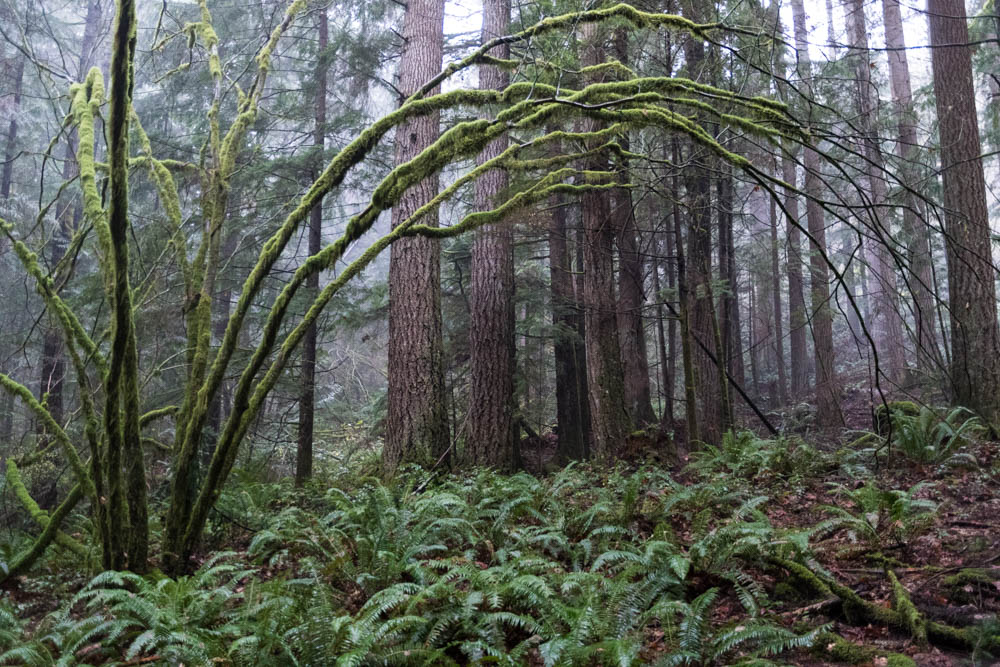
An eery rainforest of moss and epiphytes covers the lower elevations.
In the mist and drizzle, the low-elevation forest was was verdant. Moss and epiphytes covered every branch, and trapped the mist so it could drip on me as I made my way up the trail. The trail is well-built and well-maintained, generally steady going. Numerous switchbacks meant the trail was never very steep.
The air cooled as I climbed and I finally started seeing patches of fresh (though wet) snow at around 3,800′. I popped out into a clearing, where a large black Raven awaited me. Clearly he had been there earlier, when today’s three early hikers paused to snack and turn around, and he was hopeful that I brought more goodies.
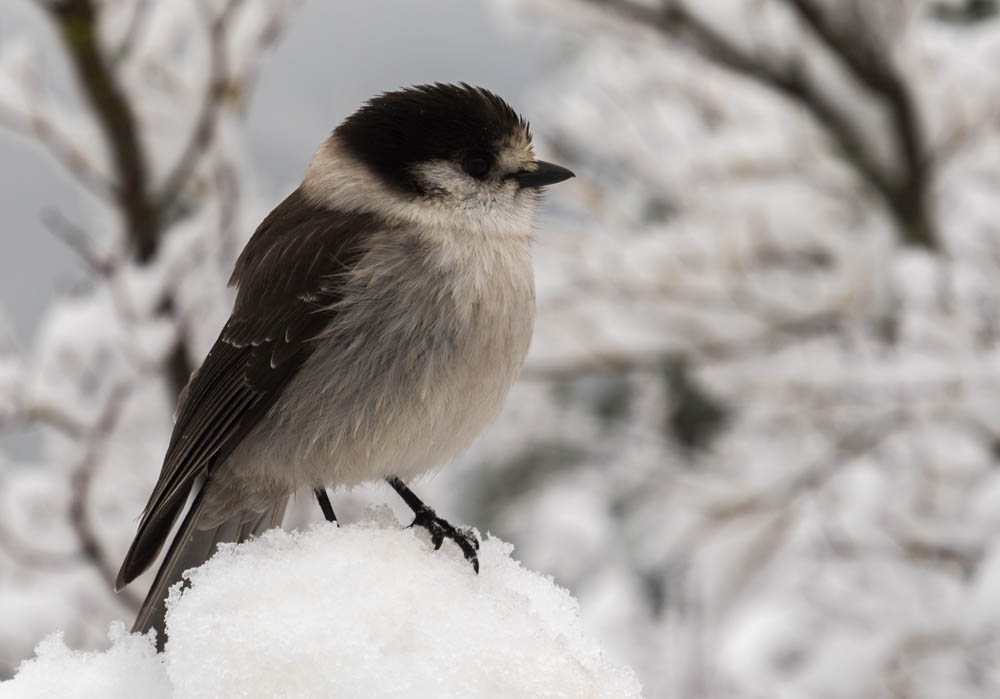
Gray Jays are an ever-present companion at snack stops at higher elevation.
Four or five Gray Jays quickly detected my presence and snuggled together on snow-covered branches, ready at a moment’s notice for a dropped raisin or bagel crumb.
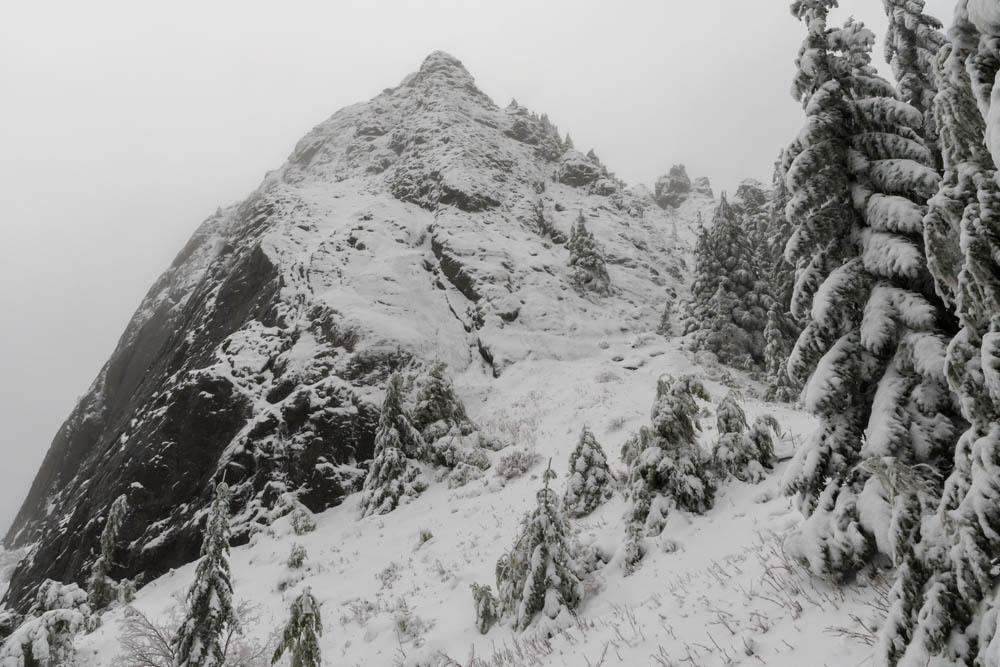
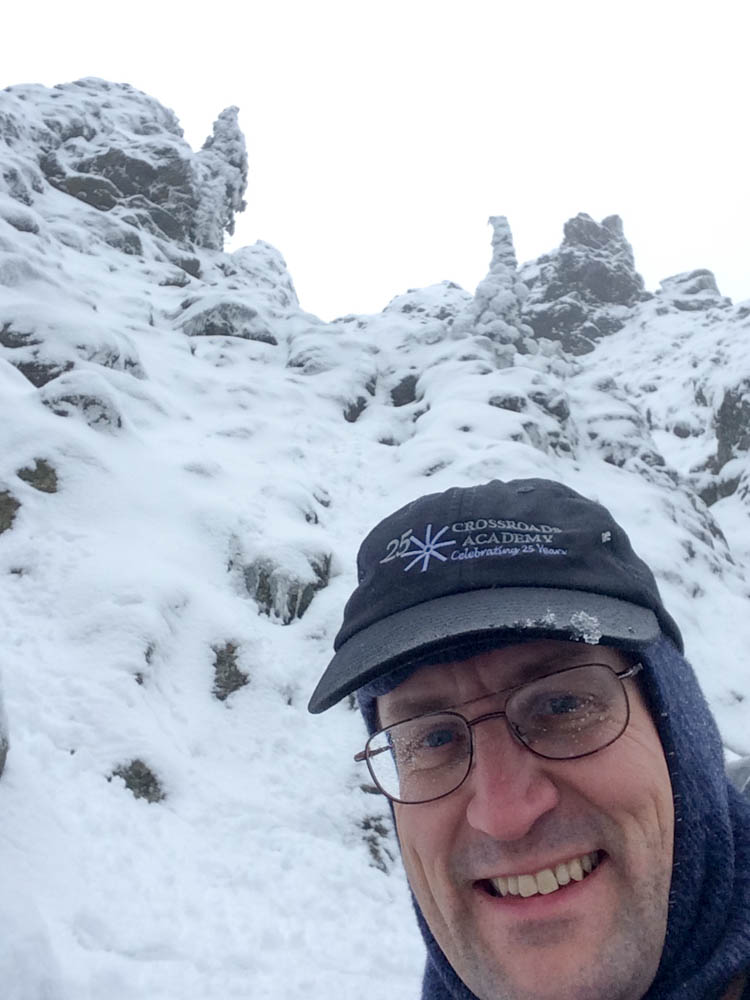
Here there was consistent snow cover, just an inch or two, and rather slushy. In the clouds now, the viewpoint offered me nothing – but at least the precipitation stopped. I pressed on, up and over a rocky outcrop, toward the true summit – a sheer cap called the “haystack” (shown above). Remarkably, though I climbed only another hundred feet, the snow became deeper and more firm, as much as 6-18″ deep in the sheltered spots. The snow line from recent weather must have been close to this elevation.
I turn back from the near-vertical gully filled with snow and ice, and lots of exposure.
I followed old tracks, covered in this morning’s snow, around the base of the Haystack. The footsteps disappeared at the base of a steep gully, where tiny avalanches caused golf-balls of snow to roll down toward me. Gosh, this gully is steep, and extremely exposed. I picked a line and tentatively began to climb, but thought better of it after a dozen yards. I retreated and picked another line. Going upward was easy, kicking steps in the wet snowpack. About halfway up, though, I reconsidered the exposure. A slip here would mean a long slide down the gully, ricocheting off the boulders. Hiking solo, and with few other hikers visiting the Haystack today, I decided it’d be best left for another day.
The trip down was a cruise, back and forth on the switchbacks. I quickly left winter behind, and emerged again into a verdant rain forest, pausing often to attempt to capture this magical place in photographs. I can see why this mountain is so popular, and really need to return when the sky is clear.
After my trek on Kilimanjaro I had to attend the MobiSys conference in Singapore, so I sent my trekking gear westward with Ken while I headed east. While planning the trip I realized that Cambodia and the famous ruins of Angkor Wat were a short hop away, so I extended the trip with a quick visit there. What a contrast with Kilimanjaro and Tanzania – but what a great opportunity!
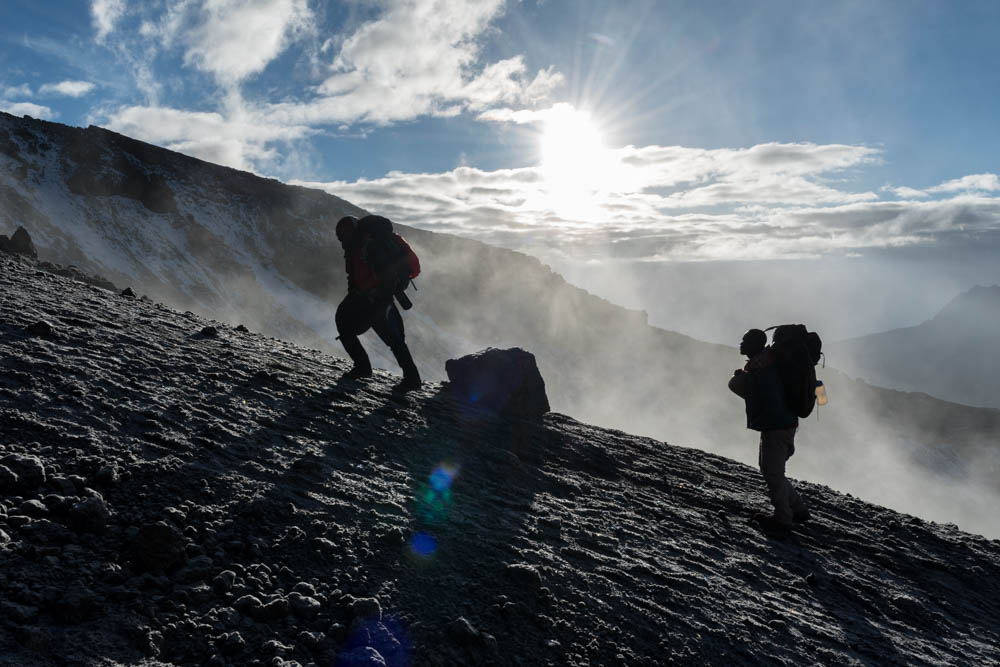
With the rising of the equatorial sun, the undercast clouds climbed the slopes of Kilimanjaro and slowly enveloped us in an eery mist. We had begun our summit push about an hour before dawn, a line of bobbing headlamps weaving through the sleeping camp at Barafu, 15,200′ above sea level. Now, as we ascended past 17,000′, pole pole (slowly, slowly), I was beginning to really feel the altitude. Despite six days of acclimatization and hiking along the Lemosho Route, all five of us were quietly focused on each slow step along the steep and winding switchbacks up toward the rim of Kilimanjaro’s volcanic crater; step, breathe, step, breathe. A few trekkers were already descending – those who rose at midnight to make their entire summit push during the moonlit night, jubilant from reaching the summit – and those who looked quite pale and were gingerly being led down by a guide holding each elbow. The altitude affects everyone differently, and the sick have to descend quickly. We pushed on, hoping for clear skies at the summit and for weather good enough to stay overnight in the crater as planned.
But I get ahead of myself. This 11-day trip, including 9 days on the mountain, is a long story. As you read the trip description below, be sure to check out the photo galleries of the trek, of our two days pre-trek, of the flora and fauna, and of night skies on the mountain.
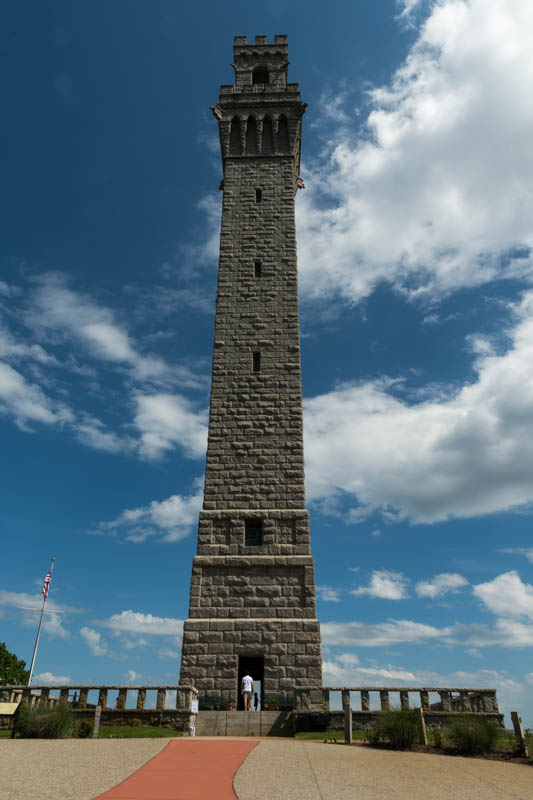
We spent our 25th wedding anniversary on Cape Cod, mostly in Provincetown. Beautiful weather, a nice bike ride, and a chance to explore the town. Plus a stop at the historic Marconi wireless telegraph station; see the photo gallery.
I was in LA for business all week, in a high-rise office with a great view of the distant mountains. I stayed an extra day and headed out through the Simi Valley to the Santa Monica mountains to hike Sandstone Peak. A thoroughly enjoyable 6.5-mile loop, open to views most of the way! The views to the south passed over the foothills and into the Pacific Ocean, so I drove the winding road down from the trailhead, came around a bend, and ended right at the beachfront! Drove back along the coast through Malibu. A great day for a hike and drive through pretty countryside! Check out the photos.
Sandstone Peak in sight – the high point of the hike ahead – with a group of hikers on the bump in middle ground.
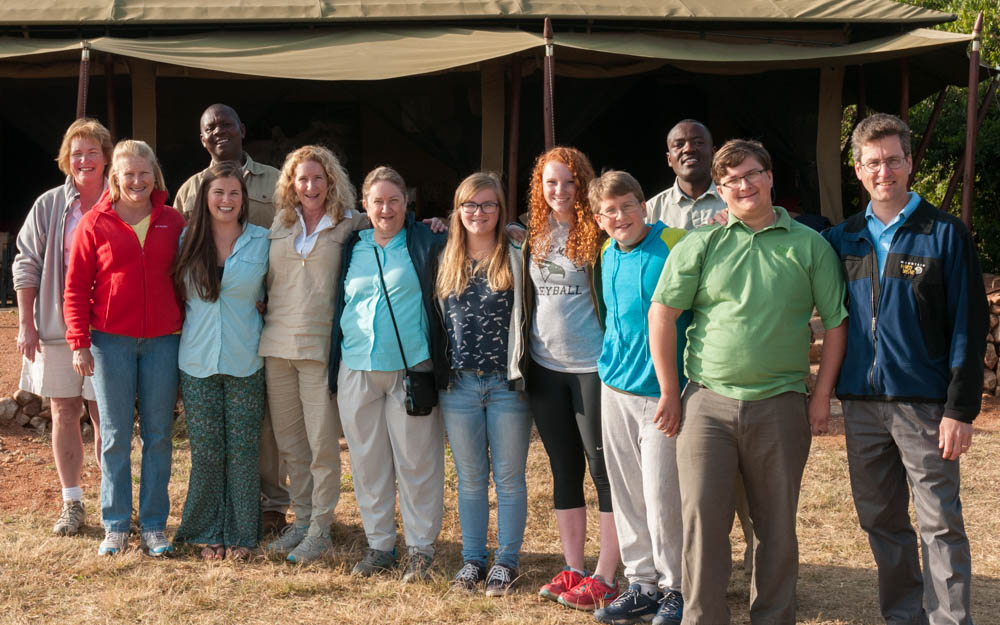
Safari group photo: Peggy, Amy, Erin, Doe, Pam, Mara, Isabel, Andy, John, David; with guides Robert and Freddy in back. At Serengeti East nyumba, Enashiva Reserve, last morning of the safari.
Our final safari dinner, at the Enashiva nyumba, was Tanzania style food. Finally! although the food at all the restaurants and nyumbas was wonderful, it was basically western-style food. I was pleased to finally have a chance to sample some of the local food, including ugali and stew.
Safari group photo: Peggy, Amy, Erin, Doe, Pam, Mara, Isabel, Andy, John, David; with guides Robert and Freddy in back. At Serengeti East nyumba, Enashiva Reserve, last morning of the safari.
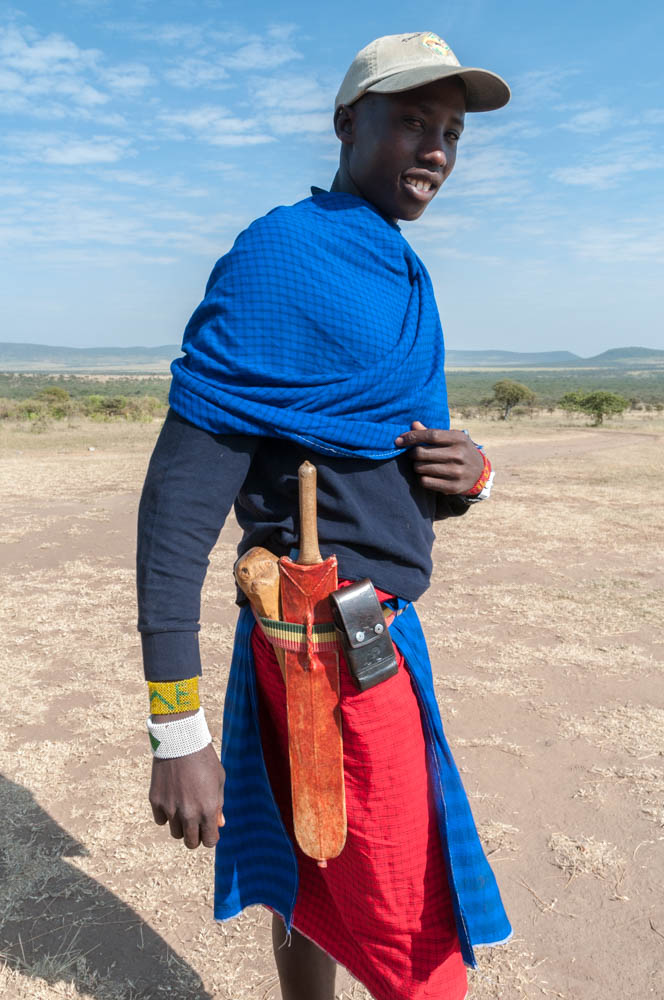
The waistbelt of a modern Maasai warrior/ranger includes a wooden club, a machete, and a cellphone. Enashiva reserve, Tanzania.
Day 9 was an opportunity to experience a tiny slice of the local culture, at least, of the Maasai culture. We started with an early-morning walk, before breakfast, strolling through the nearby meadows to see wildlife during this particularly active time of day. I was particularly interested in our Maasai guide, one of the rangers hired by Thomson to patrol the reserve. On his waistband he wore two items traditional for every Maasai warrior – a wooden club and a large machete-like knife, along with a cellphone. The old meets the new; the three essentials of any warrior strolling the hills of Maasai country! The knife has many practical uses, of course, and the cellphone provides connectivity even in these remote locations. The wooden club was a bit of a mystery; it had a natural bulb-shaped head, a burl or knot selected carefully from just the right stick. The shaft was whittled to a point. He explained that this club was important for self-defense, during his patrols, if he needed to protect himself he could swing or throw the club at an animal. Continue reading “Maasai”
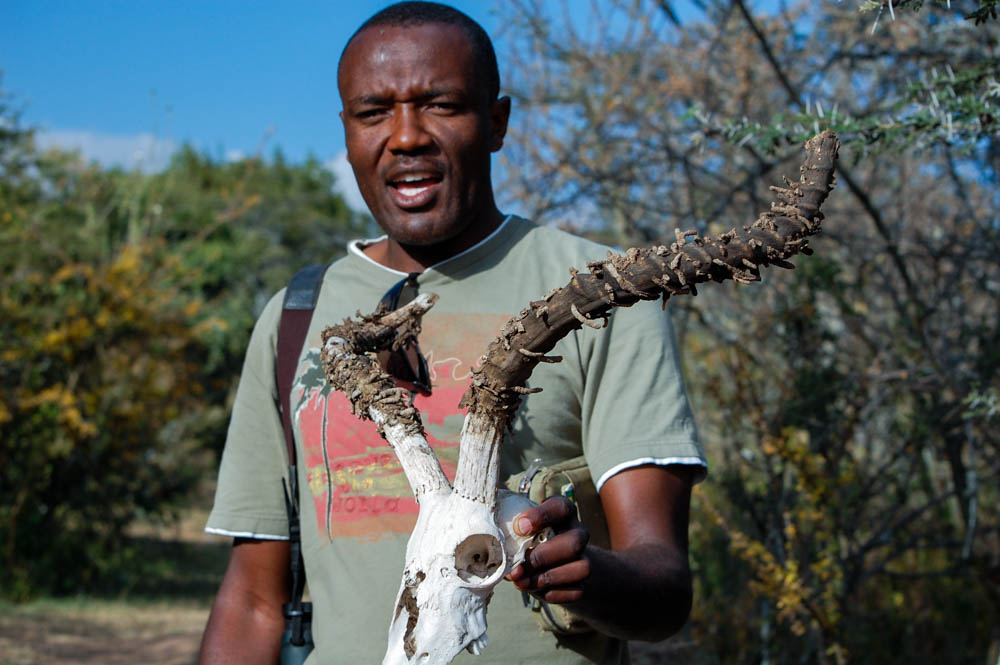
Our guide, Freddy, describes an impala scull we found during our nature walk at Enashiva wildlife reserve, Tanzania. Photo by Amy Jenkins.
Before lunch on Day 8 we passed through a couple of Maasai villages and turned left at the school (built for the community by Thomson) before entering the Enashiva wildlife conservation area. Formerly owned by one of Tanzania’s largest beer manufacturers, this land had failed as a farm. Fields of hops and barley were trampled and grazed by migrating wildebeest, zebra, giraffe, and all manner of wildlife. It was a losing battle, and the company auctioned the land with the understanding that the buyer would put the land into conservation. Thomson Safaris bought the land, hired local Maasai as rangers to patrol the land, and established a nyumba for use by its safari guests. More recently, Thomson’s non-profit affiliate built a school and a health clinic nearby, on land provided by the town, in support of the local community. We now had the opportunity to experience the wildlife in this reserve, and to meet the local community. Continue reading “Enashiva”



 David Kotz