Another interesting Röthlisberger statue about an important village role in 19th- and early 20th-century Switzerland.

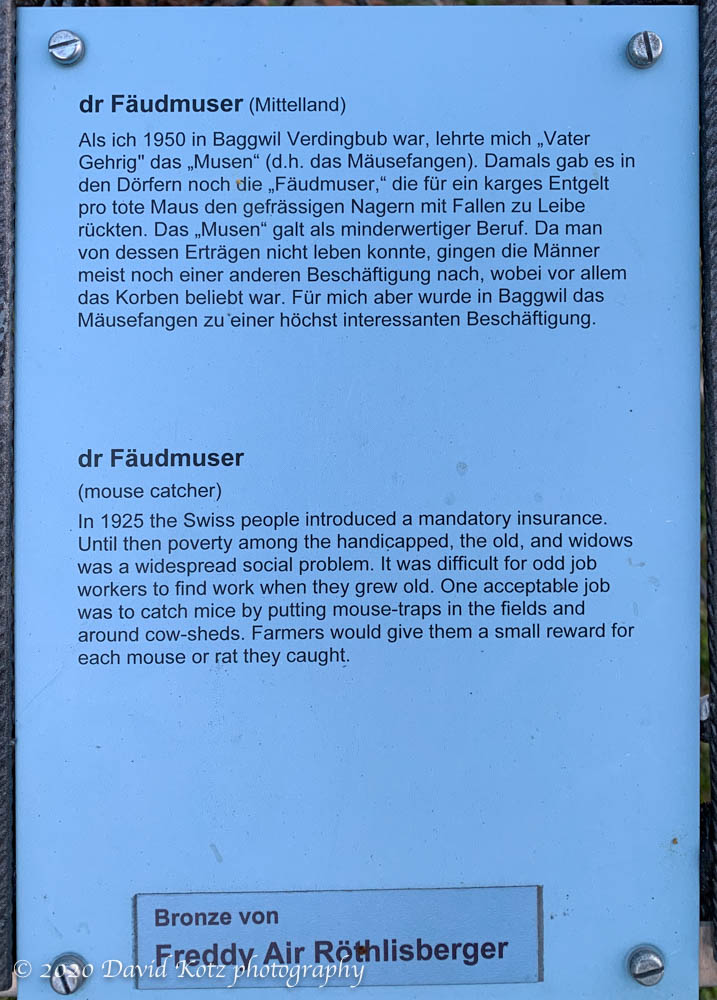
Another interesting Röthlisberger statue.
Another interesting Röthlisberger statue about an important village role in 19th- and early 20th-century Switzerland.
A curious statue of Zwingli.
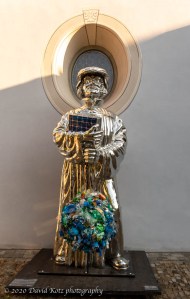 The streets were nearly deserted during my early-morning walk about the old district of Zürich. Churches, normally busy on a beautiful Easter morning like this one, were all closed due to coronavirus. At one point I stepped into a tiny courtyard on the backside of St. Peter Church and encountered this rather unusual statue of a local notable.
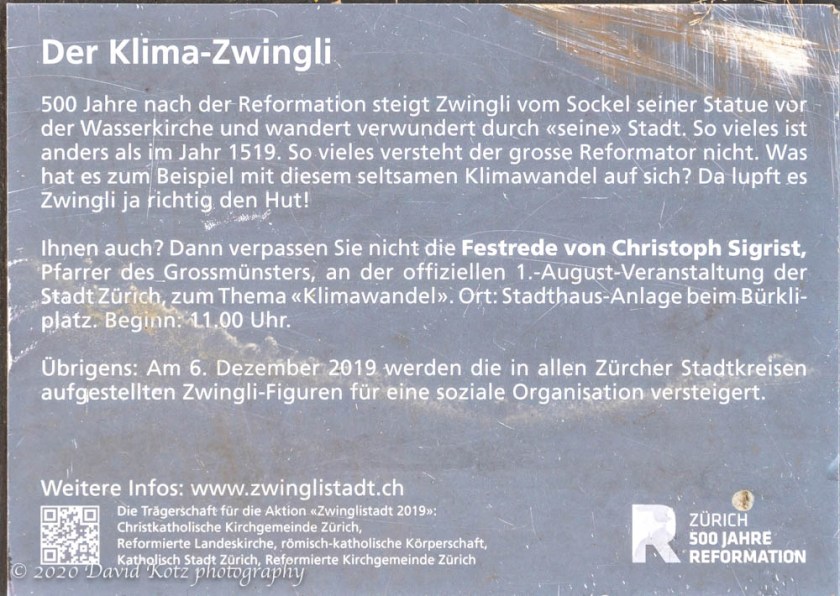
Ulrich Zwingli founded the Reformation in Switzerland in Zürich; it and many other Swiss cantons rejected Catholicism and “reformed” their churches into Protestant churches. The year was 1519, exactly 500 years ago. Zürich celebrated the 500th anniversary of the Reformation throughout 2019 [website], including (it appears) the commission, display, and later auction of a set of statues of Zwingli. In this one, according to the sign, Zwingli is puzzled by climate change and bemoans the amount of waste. He is holding, by a chain, a ball of waste plastics and electronics.
St. Peter itself has a very interesting history. Among other things, St. Peter has the largest tower clock face in Europe. [Wikipedia]

I was sad to miss the opportunity to witness one of Zürich’s most curious traditions, as it was cancelled this year.
I’ve read that Switzerland has many unusual Easter traditions, but I was particularly looking forward to Zwänzgerle, a Zürich tradition that dates back to the 18th century.

Held every year on “Easter Monday” (the day after Easter), people gather in the old-town vicinity of Rüdenplatz to play this game. As noted by the city’s tourism web site, “adults throw 20-cent coins at hard-boiled eggs held out by children with the aim of making them lodge in the shell. If they succeed, the thrower keeps the egg and the coin. An almost impossible task – much to the delight of the children, as every coin that falls to the ground instead of sticking in the egg belongs to them.”
I have no photos (of my own) to share – but that tourism page (now gone) has a few brief video clips, and an Aargau newspaper posted a cute video a couple years ago (now removed). Wikipedia has a few more details [in German] about this fun tradition related to “egg tapping” practiced elsewhere.
Happy Zwänzgerle!

A beautiful – though quiet – Easter morning on the streets of Zürich.
Easter is a major four-day holiday weekend in Switzerland, and in Zürich. With dozens of churches and cathedrals dotting the old city, one might normally expect to encounter hundreds of churchgoers during a stroll around altstadt on Easter morning… but this year is anything but typical. Nonetheless, it was a beautiful morning to wander the streets and take photographs – low morning light, blue skies, and virtually no pedestrians or traffic.
St. Peter’s church was closed, as with all the others, but one lone woman sat quietly in the square, facing the church, enjoying her own silent Easter mass.

Our flat is neighbor to the Liebfrauen church, whose bells rang for 15 minutes this morning [15sec video]. Come to think of it, they do that every morning and every evening.
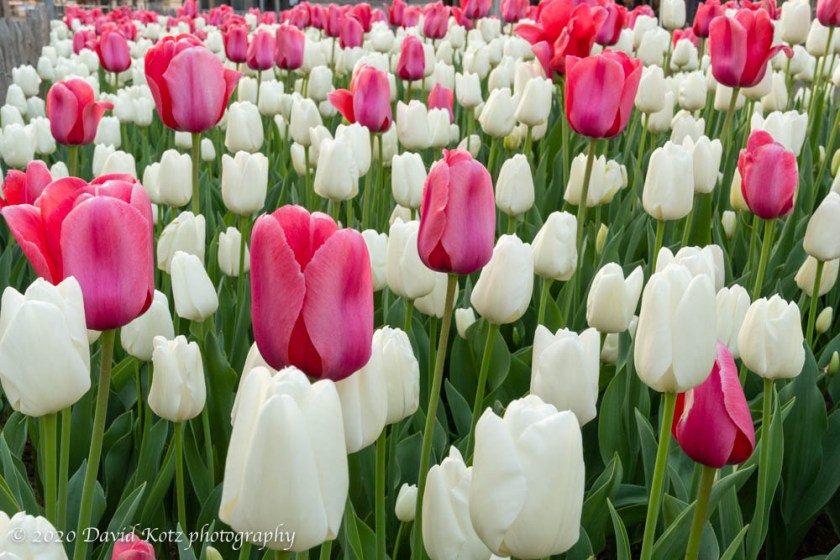
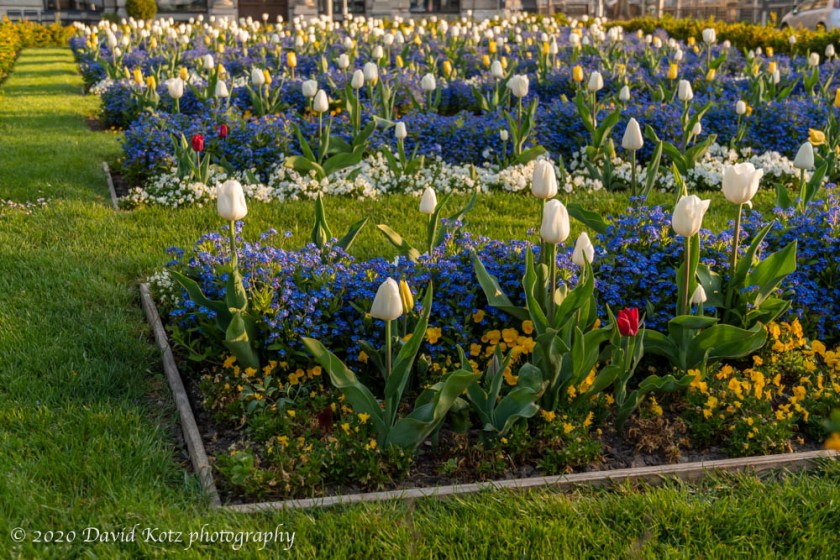
Meanwhile, the tulips are in peak bloom throughout the city gardens.
May peace be with you, and the world.
The one Röthlisberger statue focused on a contemporary figure.
Today’s visit to the Röthlisberger statues, on Zürichberg, includes a photo taken just 12 days ago. With afternoon temperatures now balmy in the low 20sºC (72ºF yesterday), it’s hard to remember that it snowed just 12 mornings ago.
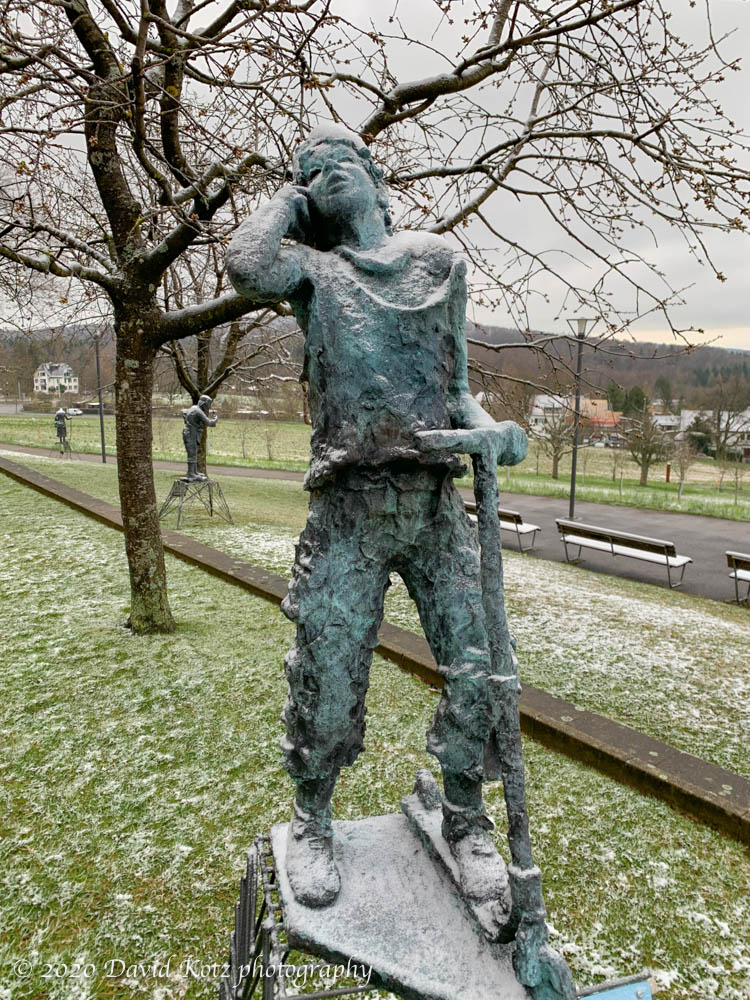

Another in my series of Röthlisberger statues from Zürichberg.
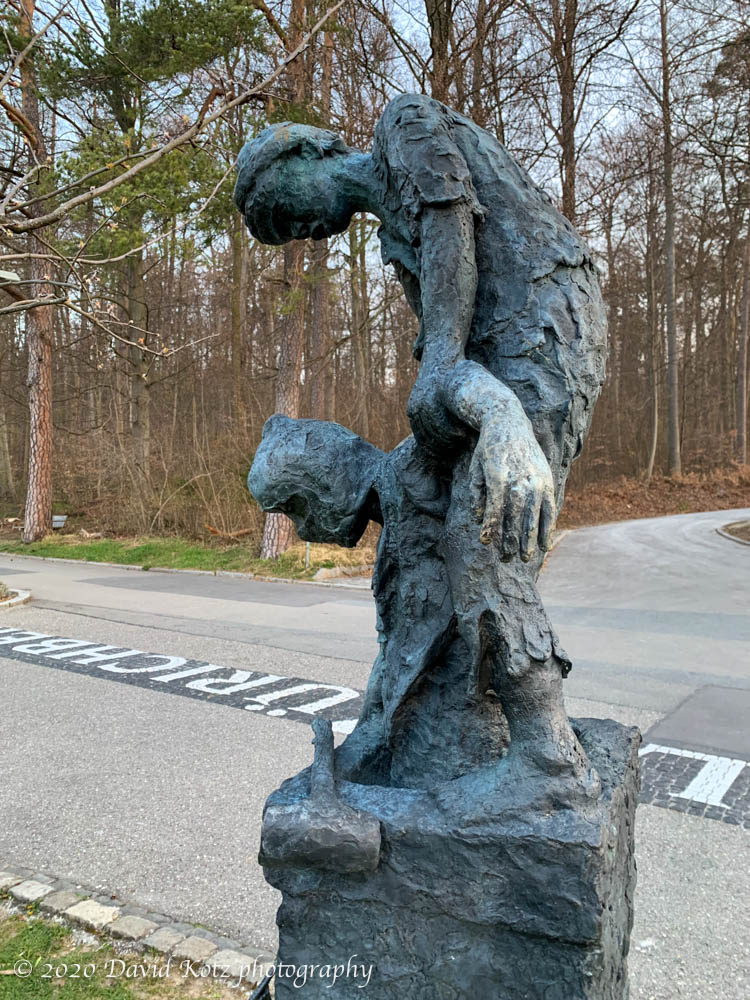
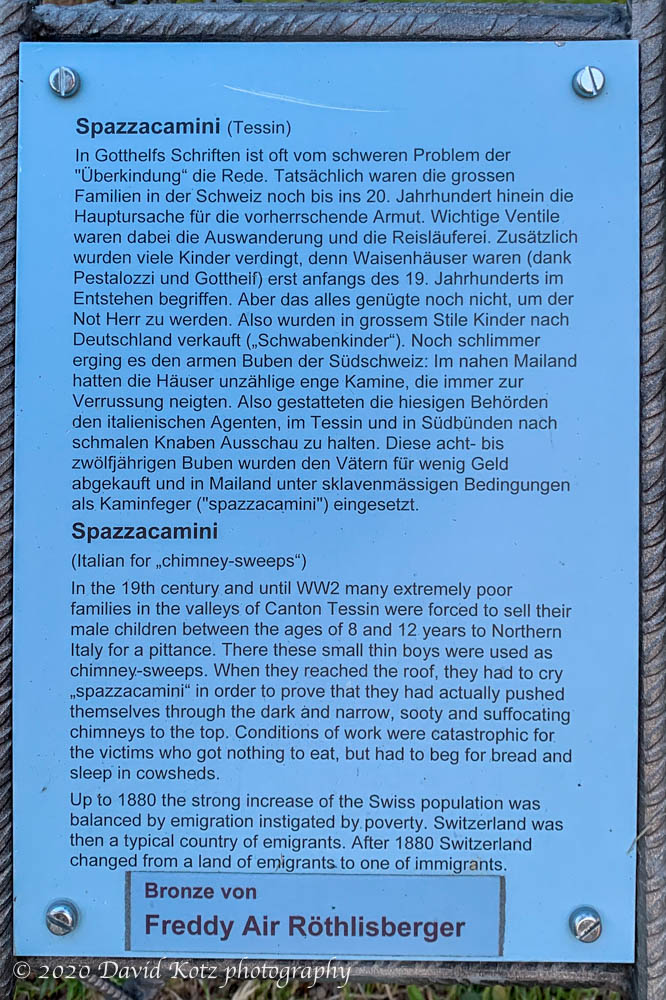
As I noted earlier, I am captivated by the set of Röthlisberger bronze statues on Zürichberg, each with an explanatory note – often of historical interest. In this case, a sad reference to the 19th-century Ticino practice of selling children to work as slaves in Italy – as chimneysweeps.
Even in the richest country in the world, there are homeless people.
We live in a rented flat on the edge of the richest neighborhood (Oberstrass) in the richest city (Zürich) in the richest country in the world (Switzerland). Everything is neat and orderly. The Swiss run the country like the clockwork for which they are duly famous. And the social safety net is strong, as I’ve heard from Swiss colleagues who have explained the systems for education, healthcare, disability, retirement, and unemployment. Even in the tiny rural villages through which I’ve hiked, the homes are tidy and the farms are clean and organized.
Nonetheless, there are homeless people in Switzerland.
Indeed, when the international aid organization Doctors Without Borders recently set up field hospitals near Geneva, one of their explicit goals was to support the homeless. “Between 3,000 to 5,000 homeless people and at-risk migrants are believed to live in the canton of Geneva”, according to an article in TheLocal. As the organization noted, “people living in overcrowded conditions, on the streets, in makeshift camps or in substandard housing are at particular risk (from the corona virus)”.
Those numbers surprised me, because until recently I held the illusion that there were no homeless people in Switzerland. Indeed, at least two Swiss colleagues in my office told me, independently, how shocked they were when they went to a meeting in California and found the streets littered with homeless people. Such sights were totally unfamiliar to them, and also surprising. They expected to see such things in third-world countries, they said, but not in the purportedly great United States. (Sadly, as we from the U.S. know all too well, America does an embarrassingly poor job assisting its homeless.)
In recent months, however, I’ve noticed two homeless people in the heart of Zürich. I recently walked down Bahnhofstrasse, reputedly the most expensive retail real estate in the world (perhaps second only to New York’s Fifth Avenue), normally bustling with shoppers but deserted on this corona-tinged Saturday morning. There, in the entryway for Läderach chocolate (closed, like all the other shops on Bahnhofstrasse) was a person sleeping, bundled against the cold – likely the same homeless man I’d seen on this block well before the corona situation. The contrast was stark, between this poor fellow and this high-end chocolatier targeting the 1% of chocolate shoppers. It made me wonder about those vaunted Swiss systems for assisting such people, and how this fellow slipped through the cracks.

For the past two weeks I’ve encountered an older man at the edge of the woods, where the posh Oberstrass neighborhood meets the hilltop forest. Each time I see him, early in the morning, he is carrying a bedroll and some bags of provisions, and appears to be on the move. Today, it appears he is camping at a popular picnic spot; as I passed this morning, his overnight fire was still smoldering next to his cookpot and other provisions.

Again, I do not know why this man is sleeping outdoors. Did he lose his job and his home, perhaps due to the corona situation? Or perhaps he is infected, and chooses to sleep outdoors to protect others in his home? Or perhaps his partner is a medical professional and he has left home to protect himself from potential infection? Or perhaps he is a medical professional, working days at the hospital and sleeping nights in the park, to protect his family? Or perhaps he is a long-time homeless person, who just happened to move into my neck of the woods this month. I doubt I will ever know.
Anyway, I am generally impressed by the Swiss and by Switzerland, yet remain curious how they address the challenge of tending to the most needy, especially in times of crisis.
Röthlisberger statue on Zurichberg.
The high point of my morning walk is a viewpoint on Zürichberg that overlooks the city, the lake, and the hills and Alpine mountains beyond. But I often walk further, following the path south along the slope. Within a few hundred meters I pass a pleasant little park that currently includes an installation of bronze statues by Zürich artist Freddy Air Röthlisberger. I find these pieces captivating, in part because each comes with a brief explanation that provides a tidbit of Swiss history. I’ll post them in a series. The first tidbit is particularly tasty :-).


A pretty morning view across the Limmat toward old Zurich.
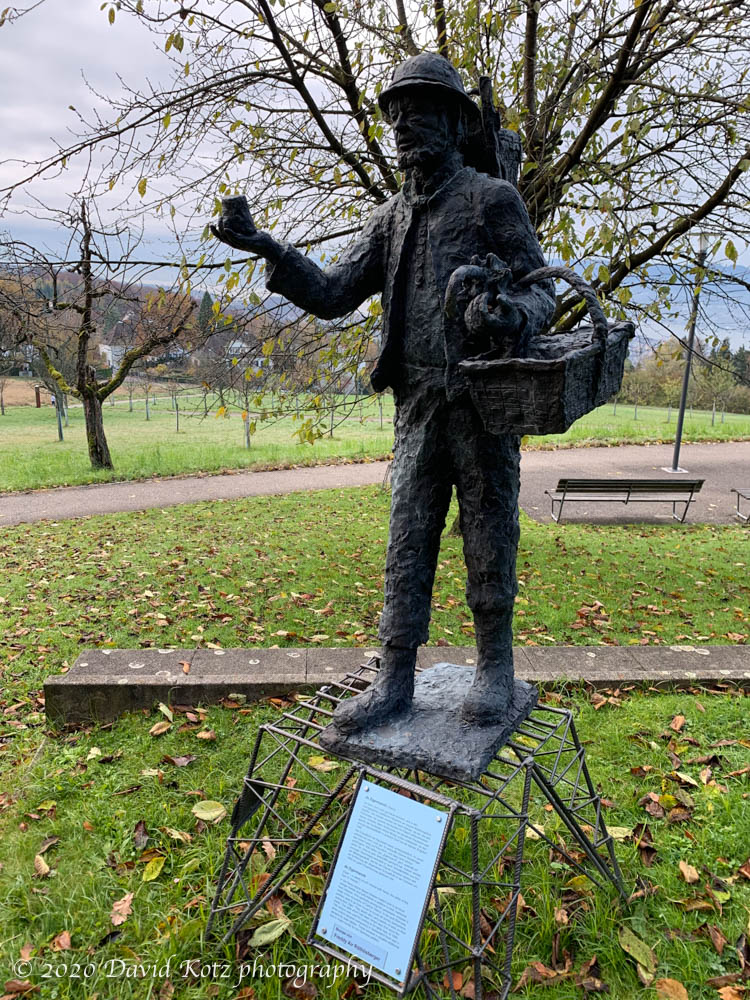
Today my morning walk took me downhill, along the Limmat river to the edge of the lake, and back through old town. The early morning light was nicely illuminating old-town Zürich across the Limmat river.

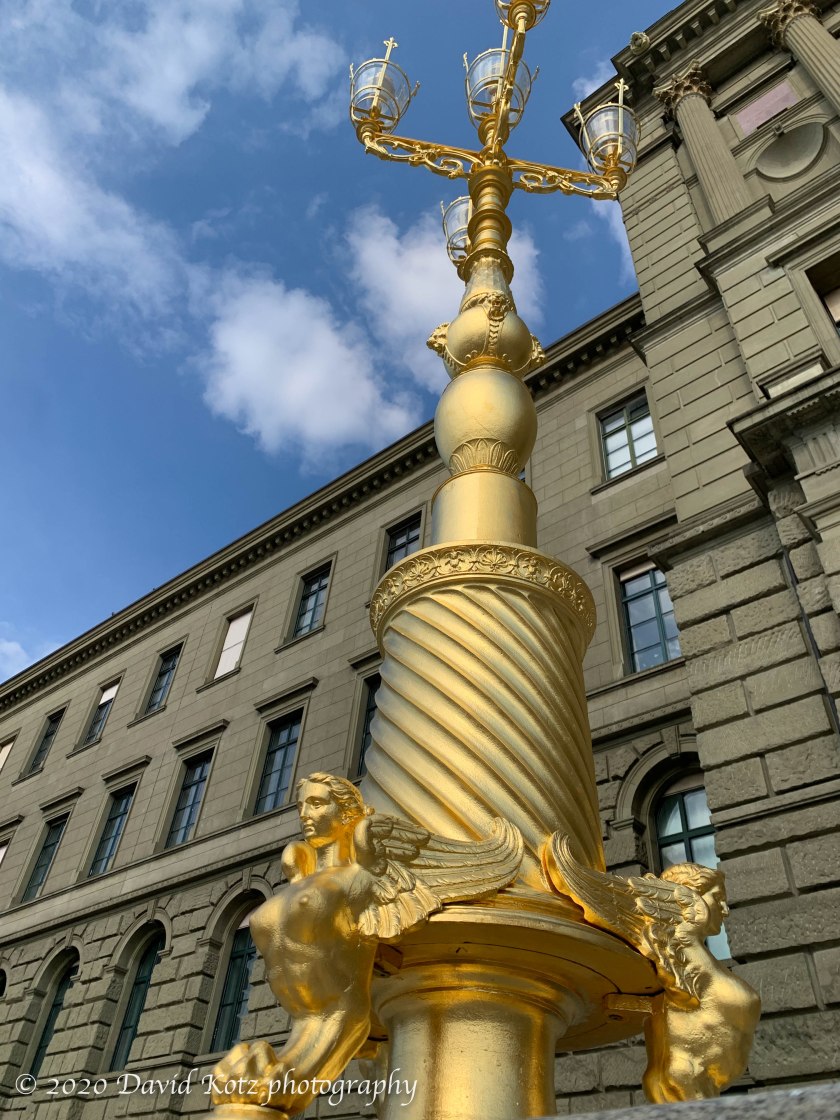
A mysterious pair of lamps outside the ETH main building.
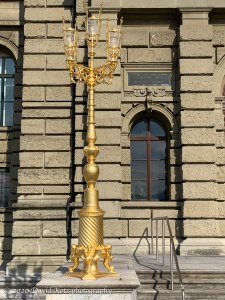 On sunny days it can be nice to walk past the west side the ETH main building – where there is an expansive stone courtyard with spectacular views across the city and to the distant Alps. It’s long struck me as odd that the west entrance to this classical-style building, in rather drab grey stone, is flanked by a pair of golden lampposts.
Surely they are not made of gold, or even painted with gold paint, but on a sunny day they are nonetheless brilliant in their contrast with the surroundings. Each is supported with three legs, each of which is a buxom one-legged sphinx character. Apparently sphinx icons were quite popular in Europe during the Rennaissance.
I can find no online explanation for the ETH lamps, nor any nearby signage to indicate the meaning or import of these lamps and their golden paint. The base of each lamp indicates the name of its foundry, in nearby Winterthur, but no more. Perhaps they are a warning to the students who enter ETH, based on the traditional Greek origin of the sphinx: “She is mythicised as treacherous and merciless. Those who cannot answer her riddle suffer a fate typical in such mythological stories, as they are killed and eaten by this ravenous monster.” [Wikipedia]