For nearly thirty years I’ve wanted to climb Moosilauke via Tunnel Brook Ravine, a classic bushwhacking route through a deep ravine on the west side of the mountain. I have fond memories of a solo bushwhack up Gorge Brook, past Last Water and the Pleiades, following the brook until it petered out and I was crashing through krummholz. As I sat on the summit, surprisingly alone on a sunny summer weekend afternoon, I watched with curiosity as a single hiker strode up the west slope of the summit cone, crossing the fragile alpine vegetation as if he was unaware of any trail. It turned out to be my Dartmouth classmate Alex, who had just bushwhacked up Tunnel Brook Ravine.
When I was climbing Moosilauke on a steamy summer day last year, I tried to estimate how many times I’ve been up this mountain since my first climb in September 1982. I’m sure I’ve climbed it more than 50 times. Certainly once a year and usually twice a year, once in winter and once in summer or fall. It never gets boring or old, because I see something new on every trip, enjoy conversation with friends old and new, and enjoy seeing how the mountain and the view will appear in today’s weather. Winter weather is often most exciting; I’ve been on the summit in 50mph horizontal snowstorms with rime ice building up on my balaclava and in which I wasn’t sure whether I could find my way back to the trail. Today was not one of those days.
Although our departure from Costa Rica was not until noon on Saturday, I decided it was risky to make the 3-hour drive from Monteverde to the airport on Saturday morning itself. There are few roads from Monteverde, all dirt, and only one that is realistically passable. (On our trip in 2004 we took a back road down from Monteverde and it was an unbelievably hairy trip.) Any sort of snag or snafu could happen to the road or the vehicle. So we called up Sergio and scheduled a return taxi for Friday afternoon. That left just the morning to capture one last exploration of Monteverde.
Panorama of the riding tripBlack Guan, high in the canopy
Kathy had also won – at the Friends School fundraising auction – a horseback-riding tour for two. So Pam, Mara and John headed off with Jim and Laurie and their two girls for a horseback outing through the pastural hills on the west side of Santa Elena, while Andy and I walked back to Bajo del Tigre in hopes that we might visit those trails again, this time in the daylight. It was another beautiful sunny day, and we had kilometers of trail all to ourselves. We followed the numbered self-guided nature trail, with the guidebook explaining the plant and animal life, history, and ecology of this non-profit forest reserve originally founded by Swedish schoolchildren (really!). Andy’s good eyes spotted a pair of black guan, huge turkey-sized birds up in the canopy.
Our final Monteverde meal (thanks Laurie!) was beans and rice and fresh salad, wonderful with the Costa Rican Lizano salsa that makes everything taste good – meant the end of a fantastic few days at Casa Hooke and with the our newfound friends, aka Jim & Laurie and their daughters. After a few fond farewells we were off again with Sergio, this time to be guided by his son Ricardo. There was a delay because the main road out this direction was being re-graded, and a couple of hours later another delay because the coastal highway was in use for a women’s bicycle race (circumnavigating Costa Rica). These are the kind of unexpected delays that triggered my instinct to move us close to the airport a day early.
Chapel on the central park in Alajuela
We arrived in Alajuela, a small city next to the San Jose airport, about an hour before sunset, and quickly headed out to explore. The central park was only two blocks from the hotel, and was bustling with people relaxing on this late Friday afternoon. Next to the square was a large Catholic church, preparing for Friday mass. Just down the road was the central market, a large indoor series of stalls selling everything from meat and fish to vegetables and herbal remedies to cell-phone accessories. I always feel these markets are a great place to get a sense of the local culture. This one was busy with customers on their way home from work, buying the necessities for a weekend with family. As the sun set, the market and most other shops started closing, rattling their heavy-duty gates into place. Even our hotel had such a gate across the entrance at all times, making me a bit uneasy about the nature of this town after dark. We found a friendly Tex-mex restaurant nearby and settled in for chimichanga and nachos.
Overall, it was a great week. Costa Rica is a beautiful place filled with friendly people. We learned a little about a tropical ecosystem, sustainable farming, chocolate production, and a different culture; we spent time with old friends and made new friends; we got sunburned and ate good food; and we had a lot of fun.
In Monteverde, the Main Event is always a visit to the Monteverde Cloud Forest Reserve. This astonishing place is home to a high-altitude tropical rainforest, well, actually, cloud forest. The forest along the high ridge that forms the continental divide in Costa Rica is almost perpetually bathed in cloud, and all that moisture supports a verdant ecosystem of plants and insects and animals. (The very name monte verde means green mountain in Spanish, well-noted by our friends from Vermont, which of course derives from the French vert mont.) At this time of year, the stiff trade winds blow off the Caribbean sea and over the tropical lowlands of eastern Costa Rica; when they rise to this ridge at 1500m they cool and clouds form. Almost immediately they evaporate within a kilometer of the ridge, so the village of Santa Elena (where all the people live) is nearly always sunny. We were chilly and damp in the cloud forest, then later warm and sunburned down at the house.
Richard Guindon, at right, was our guide for the day.
We caught the morning bus as it passed by the Cheese Factory near the Hooke residence. This being a school day, the bus was packed with children riding up the mountain from town to the Monteverde Friends School (more on that in the next blog post). We walked through the forest for about two hours, stopping frequently while our guide, Ricardo Guindon, told us about the plants, insects, animals, and forest ecosystem, as well as the history of the reserve. This area was largely unsettled before 1950, when a group of Quakers left the U.S. to found a new community in peace-loving Costa Rica. They built dairy farms throughout the town that is now Santa Elena. They recognized the importance of the cloud forest as a source of water, and conserved many pristine areas in the watershed. George Powell, a biologist, recognized the biodiversity value of this region and, working with a local man Wilford Guindon, formed a non-profit and began to acquire land that forms this reserve. Our guide Ricardo is Wilford’s son, and told many stories about his childhood play in the forest, and driving cattle along the trails to the pasture on the eastern slopes. After childhood, he has been leading forest tours for nearly 20 years and is encyclopedic in his knowledge of the place.
Andy and Mara face into the trade winds.
It was chilly and misty, with clouds condensing on the canopy overhead; thus we walked through a steady dripping drizzle all morning. We reached the far side of the reserve, at La Ventana (the window), a platform on a narrow section of the ridge – the continental divide! – that on a clear day allows you to see the Caribbean Sea to the east and the Pacific Ocean to the west. This being the cloud forest, of course, it is almost never clear. The kids found the stiff breeze of the trade winds to be exhilarating.
Family photo at La Ventana, along the continental divide.A spider monkey in the canopy.
On the way back out we were excited to see Spider Monkeys browsing fruits high in the canopy, and a toucanette bird close enough to see really well. Curiously, the spider monkeys have evolved to lose their thumbs, but have prehensile tails that make them very agile in the treetops.
The sun broke through, as the warming day started to evaporate the clouds closer to the ridgeline.
A violet sabrewing hummingbird.
We enjoyed lunch at a picnic table next to a hummingbird feeder, with its gloriously colorful visitors. I took many dozen photos and got just a few keepers. The violet sabrewing was our favorite.
Waterfall in the cloud forest.
After lunch most of us walked back into the forest to visit this stunning two-level waterfall. Along the way we spotted a hummingbird in its nest alongside the trail, and at the same spot, we watched a pair of spotted woodcreepers building a nest right above the trail.
For the photos, see the Monteverde nature gallery, starting on page 2.
Andy helps Chocolate Bob to grind the roasted cocoa beans.
Late afternoon we went to the Chocolate Tour at Café Caburé, close to the Hooke residence. “Chocolate Bob” is a Massachussetts native and former biologist, who lives here with his Argentinian wife. She runs the restaurant (café) and makes wonderful chocolate desserts. He took up chocolate making, and gave us a fascinating tour of how it works. Starting with the cocoa beans, which he buys after they are fermented at the farm, he demonstrated all the steps in producing chocolate. The kids got to help and we all had opportunities to taste it at various stages. Wonderful!
For the photos, see the Monteverde other gallery, starting on page 3.
We awoke Monday to a sunny day and a bright colorful rainbow, after a heavy rain overnight. Rain is unusual – this is the dry season – but very welcome because there was little rain during the wet season. Our main goal for the morning was a tour of a coffee plantation, which Kathy won as part of a fundraising auction at the Friends school. Kathy and Benjamin had the day off school, so she joined us and the DiCarlo family for the tour.
Guillermo explains how they compost coffee husks.
Guillermo, one of several brothers who returned to Monteverde to take over the family farm after pursuing education and other careers, walked us through the plantation and explained its many sustainable organic practices. We learned a bit about how coffee is grown, and a lot about sustainable farming. The family grows its own vegetables and bananas, and keeps chickens, quail, pigs, and goats for eggs, meat, and milk. The coffee husks are composted (by earthworms) to fertilize the fields, and the animal manure is pumped into a biodigester that extracts the methane gas and pumps it to the kitchen for cooking. The kids had a wonderful time exploring the fields, petting the animals, and climbing in a beautiful tree. The tour ended with a lunch prepared by the staff, from their own produce (Mara skipped the main dish when it became understood that it included one of the chickens we had met earlier :-).
After shopping in town for groceries and souvenirs, we headed back to the casita for a little rest and a quick dinner before sunset. It turns out that the Hookes live right next door to Bajo del Tigre, a beautiful section of the Children’s Eternal Rain Forest. Many creatures are active only at night, so night hikes are a popular attraction in Monteverde. As the sun set, we obtained a guide and prepared to follow the trails into the darkness. He gave us stern warnings not to wander off the trail, or to touch the vegetation, and always to allow him to go first, lest you meet one of the local snakes.
Tarantula emerging from nest
Kids love hiking in the dark, of course. The guide had good eyes, and found two sleeping birds – a toucanette and a motmot. Each bright green bird was clinging to a low branch, almost within reach, gripping the branch tightly as it swayed in the persistent Monteverde wind. Astonishingly, the birds were asleep! and did not even notice us. The highlight of the tour, however, was certainly the tarantula shown above. The guide knew of a tarantula nest – a small crevice at the base of a tree – and gently coaxed the tarantula out for us to see. Wow.
For more photos, visit the Monteverde nature and other galleries.
Instant frostbite! That was my concern as we stepped out of the car on Saturday afternoon, stuck in deep snow at the unplowed parking area for the Appalachian Trail on the southwest slopes of Mount Moosilauke. The snows of Winter Storm Nemo had just ended, and were drifting deeply in strong cold winds that followed the storm. Although the New England coast had been hammered by this blizzard, at home in Lyme we received only 6 inches of snow and up here we found perhaps 8–10 inches. Not much, but very welcome replacement for the icy trails and bare brown fields that were here a few days ago.
Great Bear Cabin
By the time I had dug out a parking space and gotten the skis off the roof of the car, my fingers were numb and the kids were complaining about the cold. We strapped on our skis, hoisted our packs, and skied up the trail toward Moosilauke. Fortunately it is not far to Great Bear cabin – perhaps half a mile – and the fresh snow had been tracked earlier in the day by some snowshoers. We reached the cabin after skiing across windswept meadows, and were pleased to find that it was still warm from the prior occupants. Mara quickly had a roaring fire going, while the boys cracked the ice on the stream to bring back a pot of water. We settled in for a warm and cozy evening as the sky cleared, the sun set behind the trees, and the temperatures dropped below zero.
Sunset after the storm blew away
We played a few rounds of various card games, enjoyed a wonderful pasta dinner, and roasted in the sleeping loft as the wood stove cranked away all night. The next morning was lazy as we cooked breakfast, cleaned the cabin, and got ourselves out at the crack of noon. By then it had warmed up into the teens or maybe twenties, with a brilliant blue sky and sunshine, so we took a nice ski tour through the meadows and woods before heading home. We passed numerous hikers who were returning from the summit, who all reported spectacularly clear views and a stiff windchill up there. I was jealous.
A wonderful if brief weekend! Here are some more photos from that trip and also a walk we took near home on the weekend before.
Gosh, what a beautiful fall it has been. Although it has been rainy at time, the temperatures have been warm and the leaves bright! After our overnight hike along the Appalachian Trail of early summer, John and I have determined to hike every weekend in the fall and to complete the full section of trail from Hanover to Moosilauke. We’ve been on the A.T. for the past three weekends:
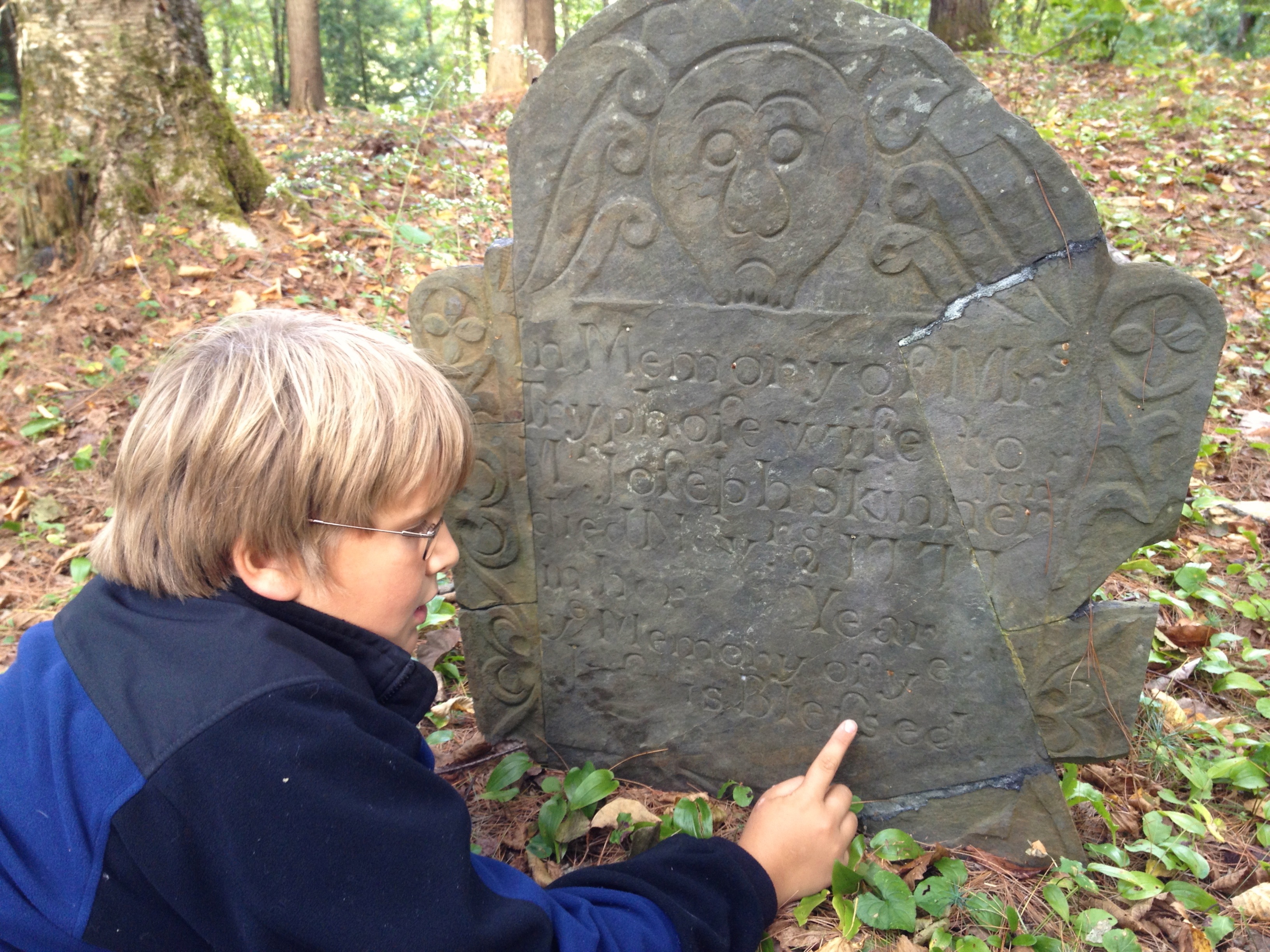
On Saturday we took a gentle hike close to home – indeed, we finished the hike at home. The Upper Valley Land Trust has conserved large sections of Lyme Hill [map], which is the long ridgeline behind our house and overlooking the river. We parked at their new lot on Route 10, the other side of the hill, and followed the nice new trail system [map] to the 1050′ “summit” of Lyme Hill. The kids were grumpy (“why do we have to go hiking!?”) but on the downhill side the moods cleared and we had a great time visiting Gilbert Cemetery, at the base of the trail where it meets River Road. This cemetery is the final resting place of the first settlers in Lyme, and we found gravestones from 1777 to 1784. I posted a few more photos in the gallery.
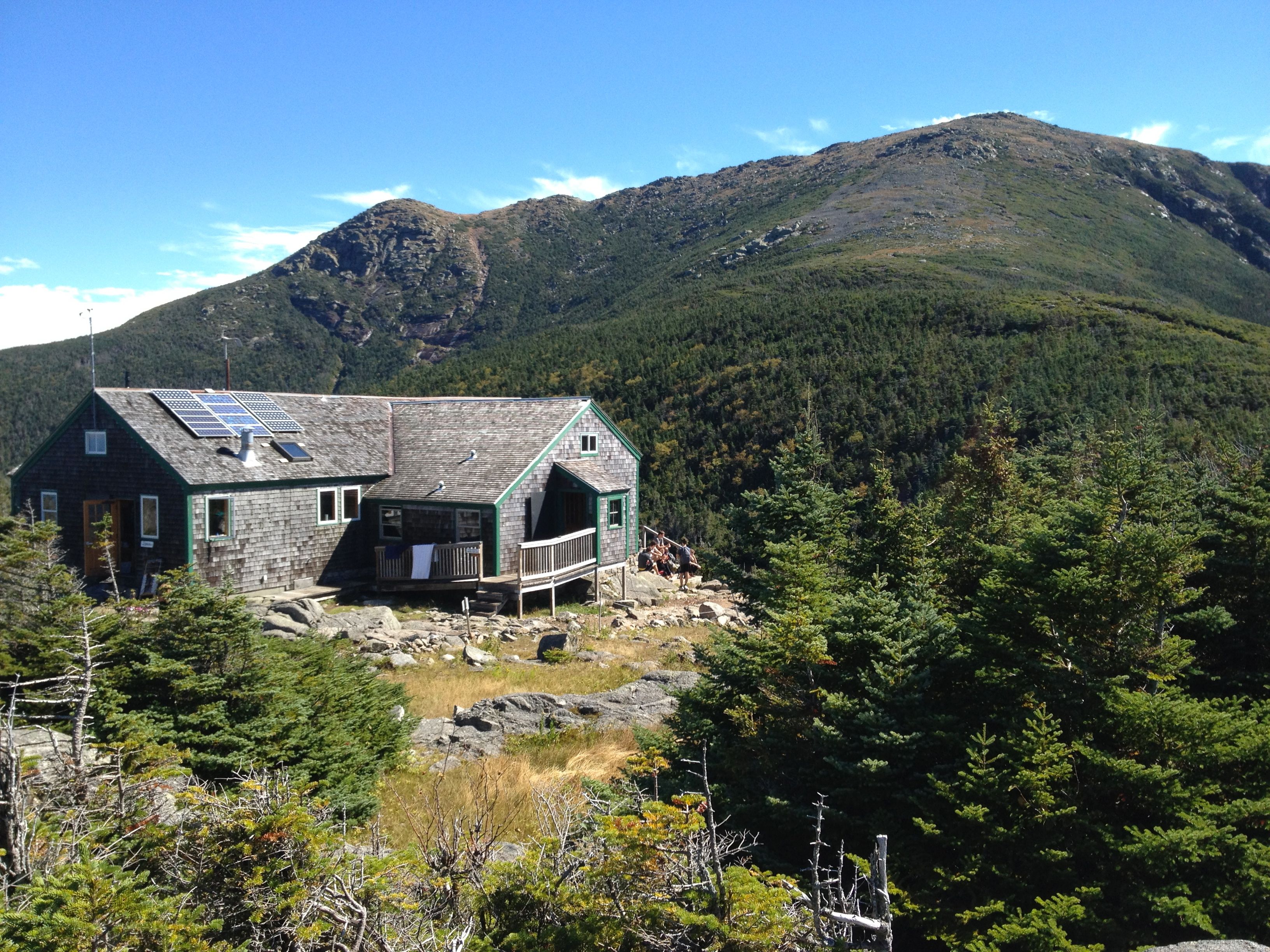
John and I took advantage of beautiful September weather to hike a classic loop in the Franconia Range of the White Mountains (NH). This 8.8-mile loop climbs from Franconia Notch up the Old Bridle Path to Greenleaf Hut, run by the AMC, then to Mount Lafayette. The day was warm and the breeze friendly, with just a few puffy clouds brushing the summits as they passed through New Hampshire. Check the photo gallery.
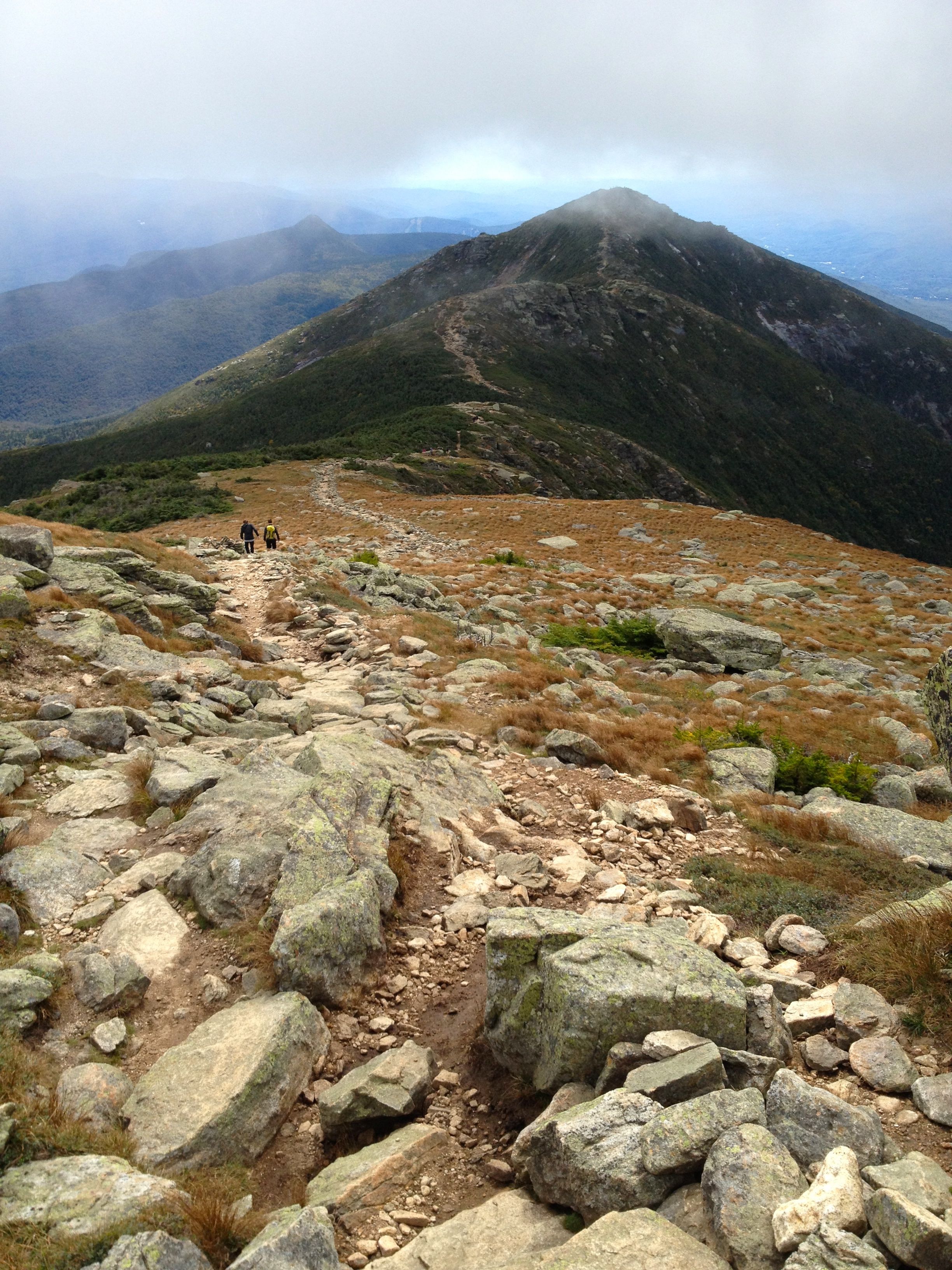
Although our original goal was simply to summit Lafayette and return, we reached the summit by 12:30 and the southbound ridgeline beckoned to us.
Southbound along Franconia Ridge
We popped south along the ridge, over an unnamed bump and then Mount Lincoln, reaching Little Haystack mountain by about 1:45pm. We then fell down the Falling Waters trail to our starting point at Lafayette Place. I’ve always wanted to hike the Falling Waters trail; aptly named, it passes five or ten gorgeous waterfalls in its lower reaches. However, I learned one painful lesson: one should always hike this steep trail uphill, never downhill! [My knees were screaming this lesson to me all the way down, and throughout the next day.]
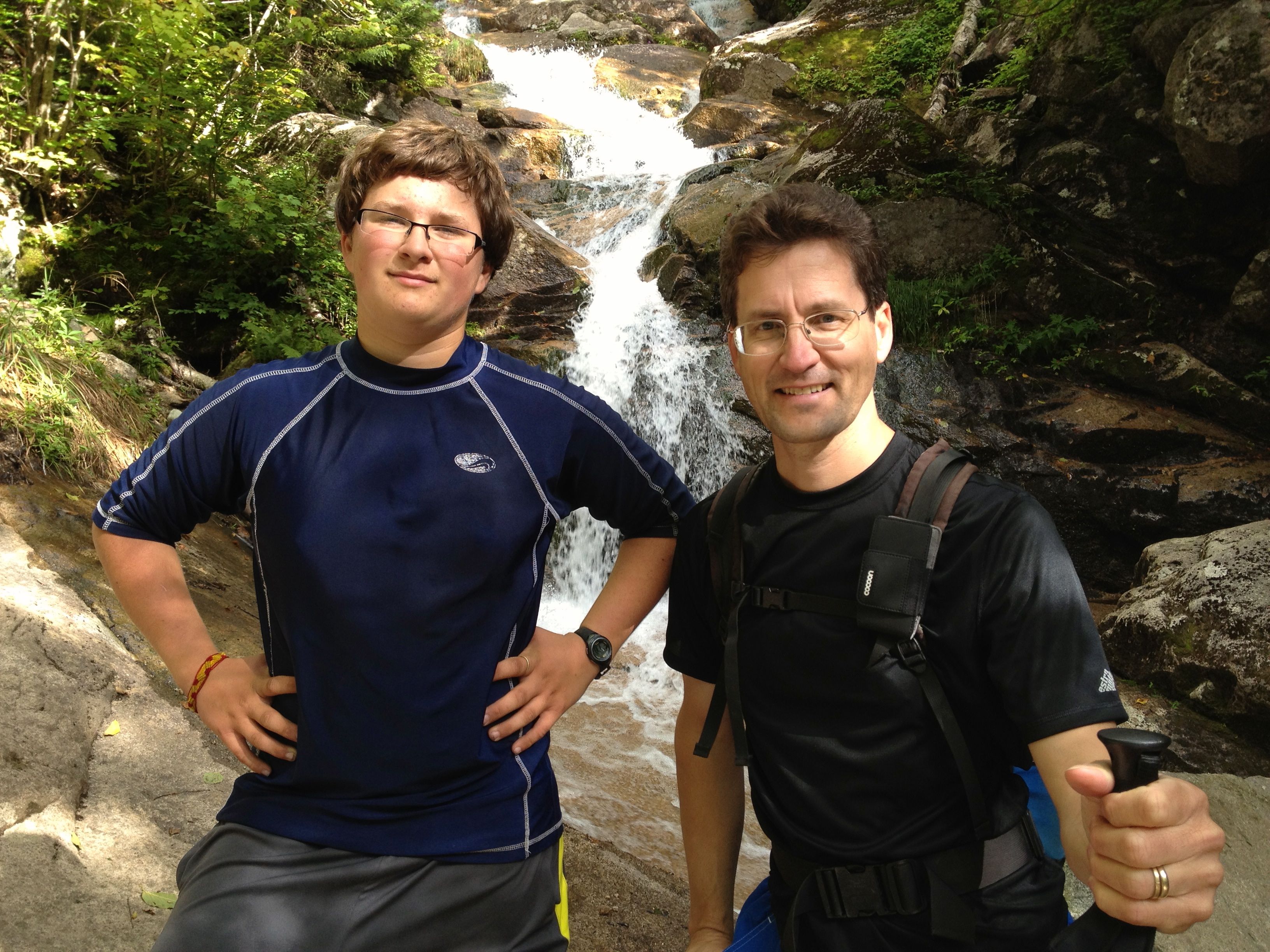
John and David pause at a waterfall
As it was a gorgeous day on a Sunday in early September, there were many other people out on the trail. I estimate that we passed about 60 other people, most doing the same loop in one direction or another. On the summit of Lafayette we watched one youthful group repeatedly pose for a group photo, pants dropped and butts bared, the photographer using a self-timer so he could join the picture. Ah, I remember those days 😉
The kids and I spent Labor Day weekend on the upper Connecticut River, visiting its source on the Canadian border, stepping into each of the five Connecticut Lakes, and then paddling one of the first navigable sections from North Stratford NH to Maidstone VT. The weather was gorgeous, indeed, absolutely perfect. Check out the photo gallery!
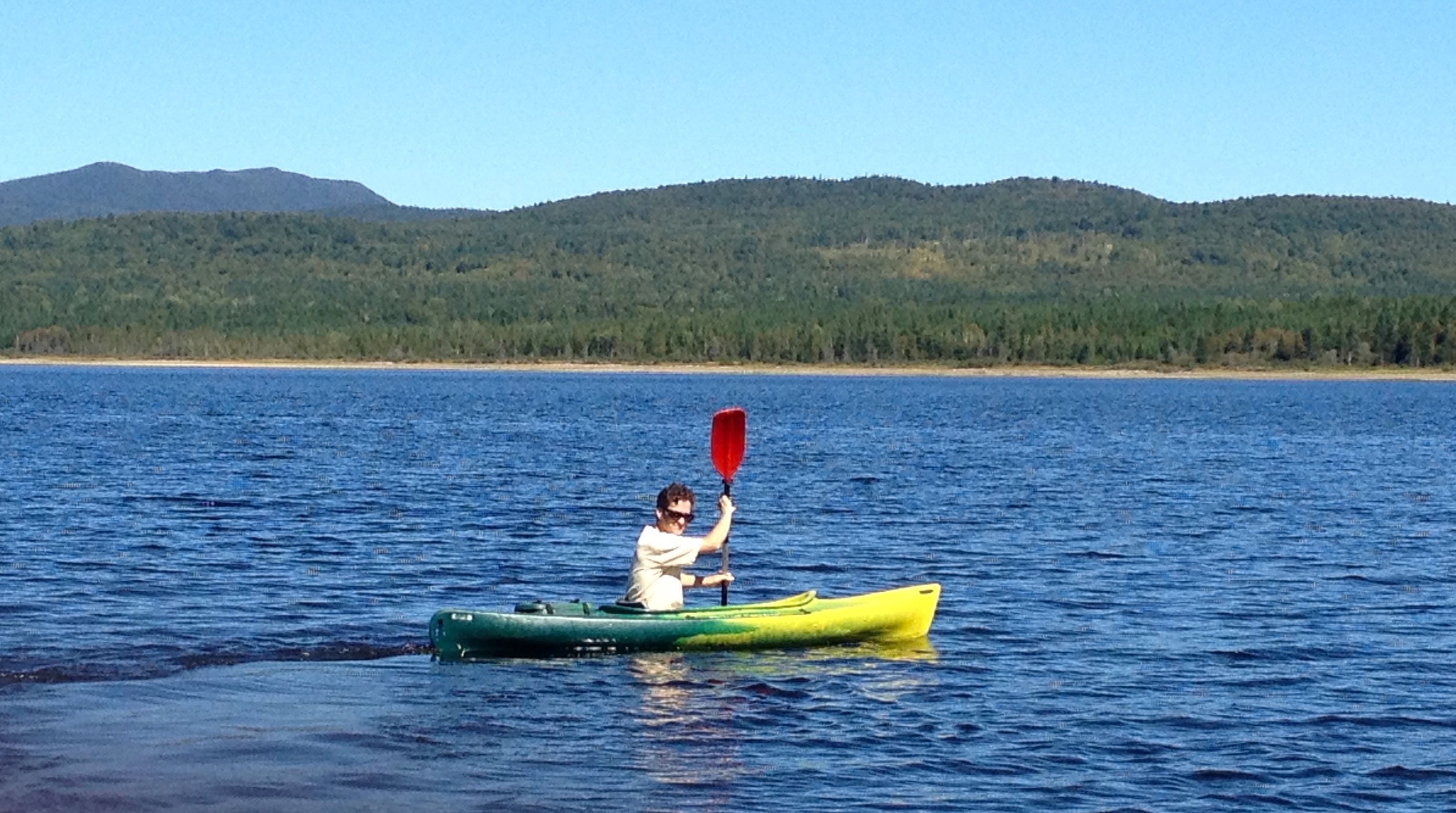
Kayaking in Second Connecticut Lake
I brought along a kayak and managed to take a brief paddle in three of the four Connecticut Lakes that lay at the headwaters of the river. My paddles were so brief as to be symbolic, and the “river” is not really navigable between these lakes anyway. The gallery shows photos from all five Connecticut Lakes: Lake Francis, and First through Fourth Connecticut Lake.
Source of the Connecticut River
The “Fourth Connecticut Lake”, which is the source of the river, lays a few hundred meters from the Canadian border, and has no road access. We drove to the border station, a recently upgraded monstrosity that before 9/11 was no doubt a sleepy unmanned stop sign in the woods. Confused about where to park, we crossed into Canada and asked at the Canadian entrance where to park. He sent us back to the United States. We never legally entered Canada, but had legally exited the U.S.. “Didn’t I just see you going north?” said the US-CBP guard. He checked our passports and told us where to park – next to the huge sign for the Fourth Connecticut Lake; we never needed to cross the border. We hiked to the lake – it’s quite uphill, not feasible to visit by boat, and managed to walk all the way around this pond, er, lake, and to stand in a tiny inlet stream, the source of the Connecticut River. Very cool! for those of us who live along the river.
NFCT map of the region around our trip
After stopping to visit all five Connecticut Lakes [map] we drove back downstream, stopping briefly at the 45th parallel to marvel that we were halfway from the Equator to the North Pole. In North Stratford, NH we rented two canoes, with shuttle service, because I had only one car (anyway, my Prius can barely carry one canoe let alone two!). There are two great groups that are set up for CT river paddlers, the Connecticut River Paddlers Trail and the Northern Forest Canoe Trail. I found the latter to be far more organized and up to date than the former and we stayed in two campsites managed by the NFCT. That said, the NFCT only covers a small section of the river, but if you check out their home page it is quite an impressive trail!
Dragging the canoe up the Nulhegan River to the Debanville Campsite
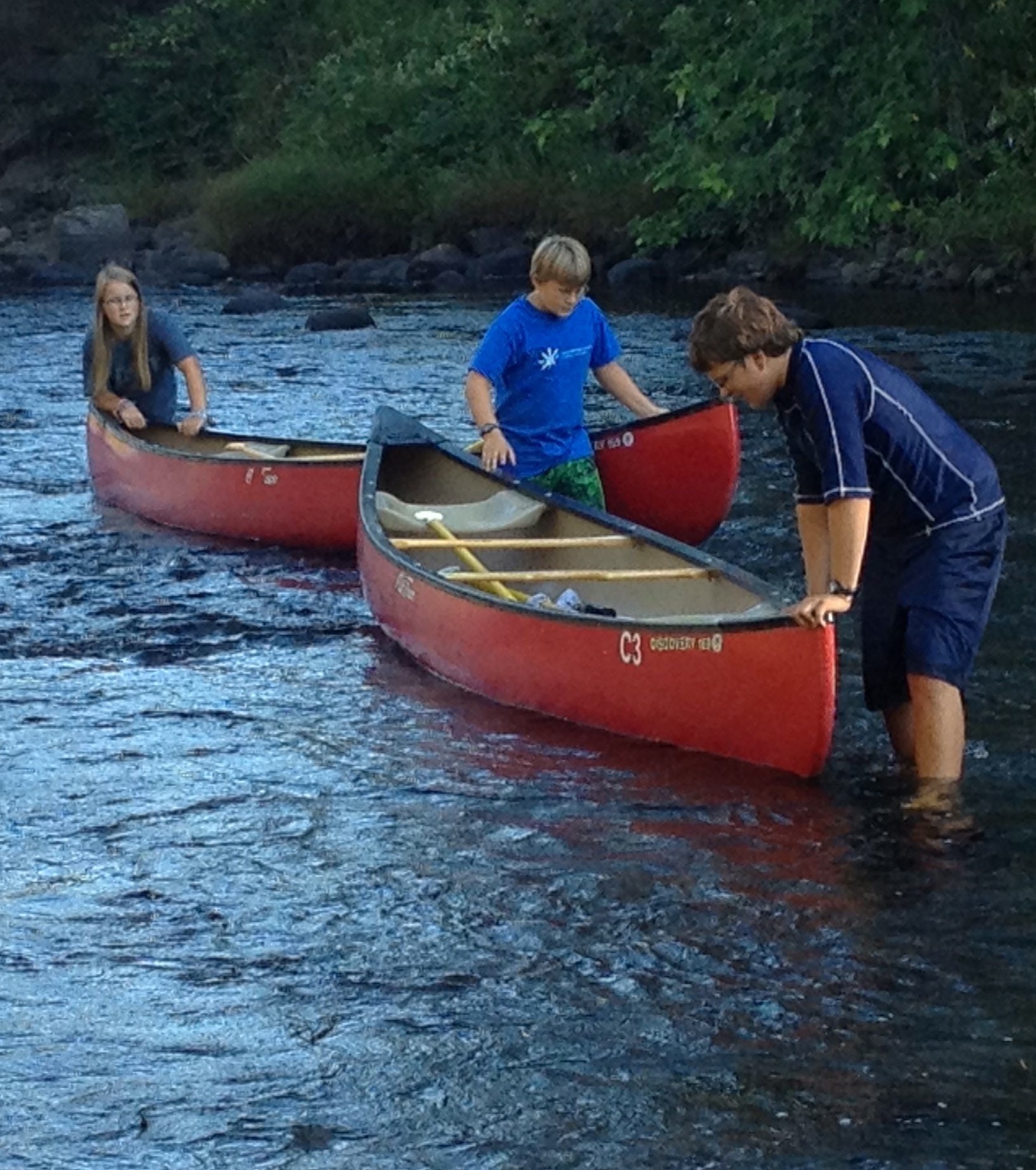
I spent a lot of time, in advance, studying websites and guidebooks, and calling the two canoe-rental places. North Woods Rafting strongly recommended that I avoid the Canaan–to–North-Stratford section that I had planned, because late-summer low-water conditions would be unsuitable. So we did a really short segment, from North Stratford NH to Maidstone VT, because I wasn’t sure what to expect or how far the kids could go, and to add another segment would have doubled the distance. So, we had a laid-back experience rather than pushing for extra mileage. (All the best, I think!) Sure enough, at our starting point the river was so shallow we had to drag our canoes, and we met people who had dragged their canoes for miles through the upper section. We had just enough “quick water” to be exciting for the kids, and to make our paddle pretty easy.
Ready to launch our canoes! Nulhegan river in the background.
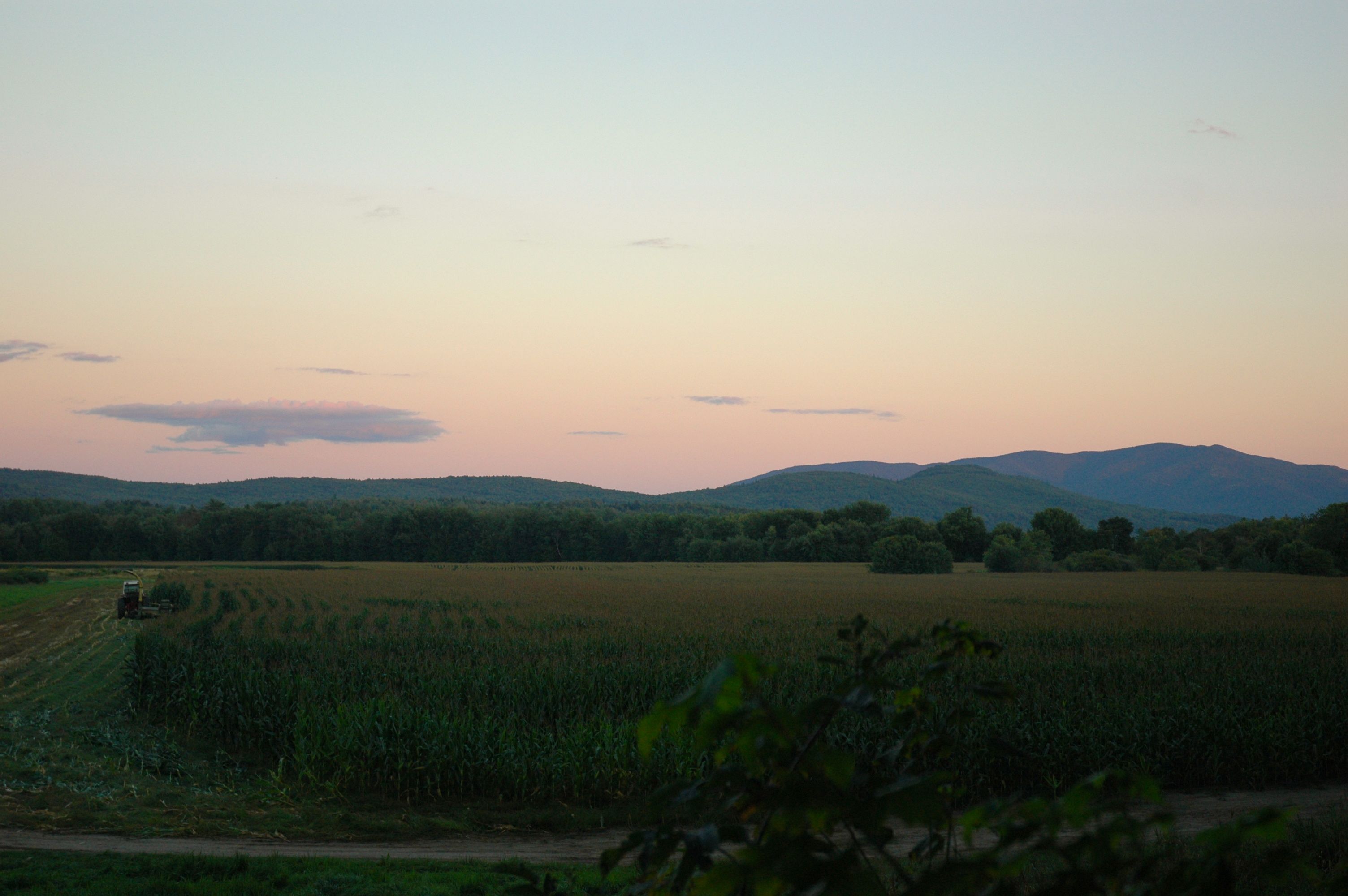
We had two gorgeous days of paddling, through a largely wild section of river. We zipped through a couple of mild “rapids”. We watched a bald eagle circle right over our heads. We stopped for lunch and a swim. We stayed the night at two wonderful campsites, the second at the site of an old railroad trestle and next to a Vermont corn field. The weather was sunny and warm, and we encountered few other people.
I highly recommend the upper Connecticut River. It’s beautiful countryside, largely farmland and small towns, covered bridges and pristine lakes. We only paddled 11 miles of river, in a day and a half, but could easily have done twice that distance in two days. I hope to go back and pick up where we left off, or (in higher water) try the section to the north. I also hope to go back in the winter – I hear the Connecticut Lakes are great for skiing! Meanwhile, the photos will remind me of warm summer days.
Sunset over Vermont cornfield, from the Railroad Trestle campsite.



 David Kotz