It’s raining today, aka miserable winter weather for a guy who loves snow and snow sports. What little snow we had left is melting quickly. As a fun side effect of the past week’s moderate temperatures (highs just above freezing, lows just below freezing), however, the snow on our garage roof is curling. What the heck? read on.
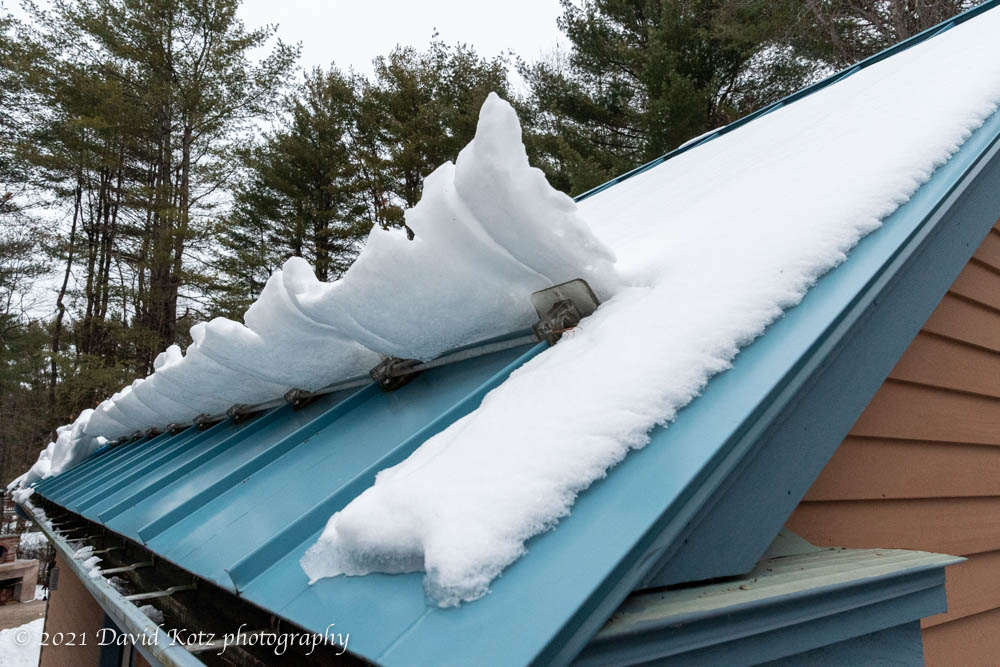
The roof held 2-3″ of snow from a snowfall two weeks ago; when the weather warmed above freezing, it started to slide down the roof, but a row of plastic bars hold it in place (see why, below). This past week, the snow was just slick enough to slide over the bars, but just dense enough to hold together, forming what looks like a ski jump. When the temperature dropped below freezing, overnight, the curls freeze in place. This slow process persisted for a week.
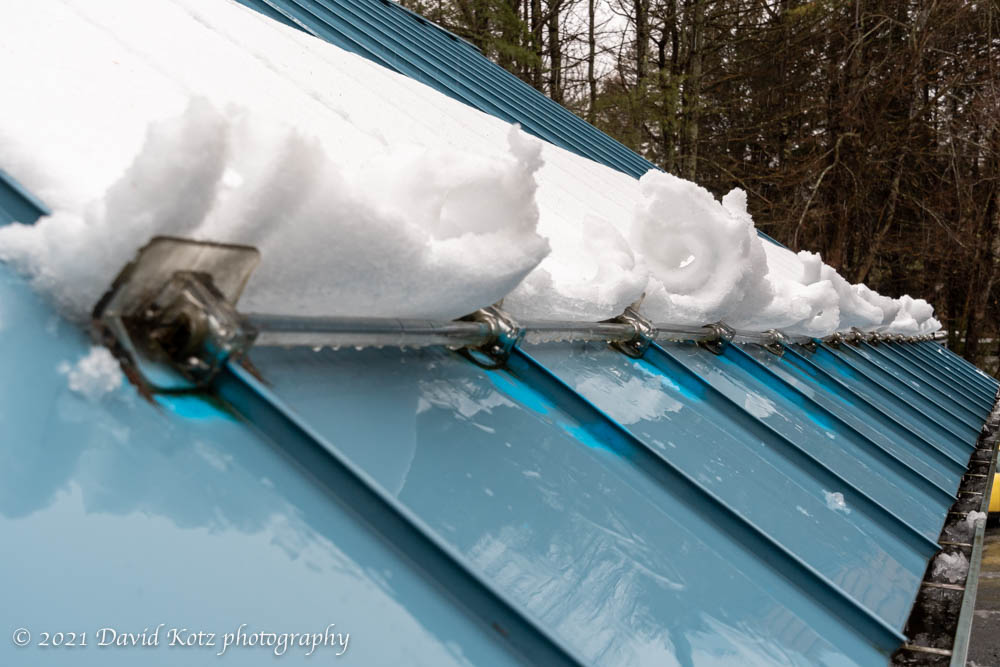
With today’s rain and warmer temperature, the process is accelerating, leading one curl to roll up triple! Here, seen today from the opposite end of the roof:
I know some of my readers are not from snowy climates, so let me explain. On traditional roofs (asphalt shingles), it’s important for snow not to accumulate, then melt and re-freeze. The snow will not slide off rough asphalt shingles; indeed, it can bond to the shingle as a thick layer of ice. These “ice dams” can cause future rainwater (or meltwater) to back-up and seep into the roof and inside the home. I used to spend a lot of time raking the snow off the edges of the roof, to prevent this expensive damage. So, about ten years ago we replaced our roof with a standing-seam metal roof, and I no longer need to rake the roof. The snow now slides off! 🙂
On the other hand, the snow slides off in massive avalanches. 😦
The snow can still accumulate in cold conditions, perhaps several feet thick; when the weather warms a little, a melt layer forms between the snow and the roof and, all of a sudden, an entire roof-full of snow can slide off and create an avalanche below. (Our cat loves to watch for these, from the safety of a windowsill.) On one side of the house, Pam re-designed the decking to fold up in winter, allowing the avalanches to fall right through and onto the ground below.
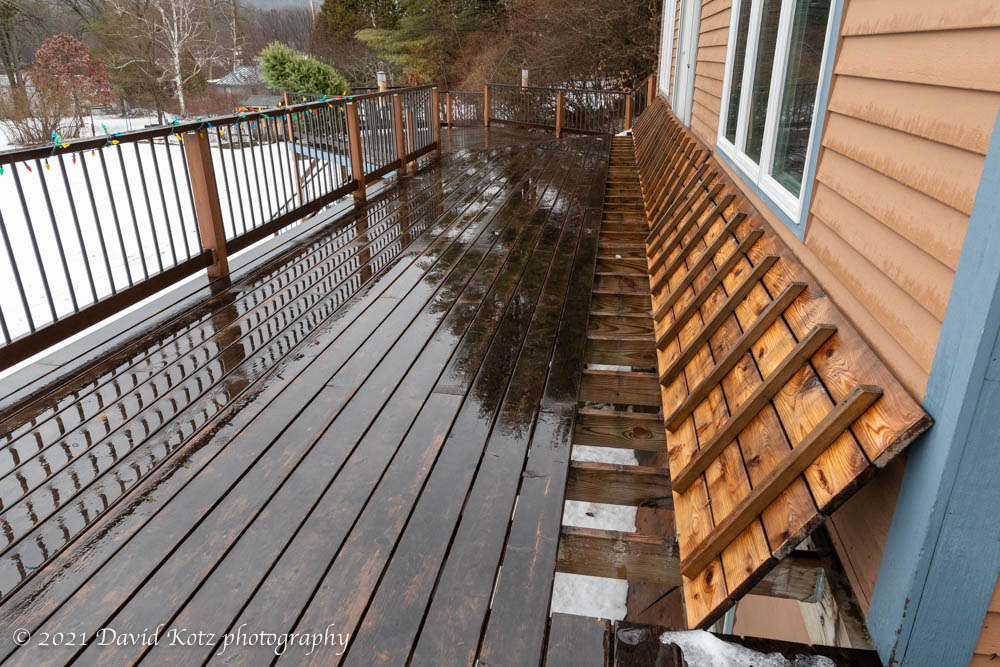
Great solution! On the other hand, it passes the buck to the floor below, so we set up plywood ‘deflector shields’ to angle the snow away from the siding and foundation.

On the other side of the house, however, we have a walkway between the house and the garage; when those roofs let go of their snow, we end up with a densely-packed mass of snow on this walk and our entryway. Today it’s a minor irritation, because there is little snow left to fall off the roof.

Next time we get a good dump of snow, I’ll show you what that looks like, and invite you to come shovel it out with me ;-).


I still my the Pennsylvania snowfalls of my youth. Midwest snow just piddles around❄️
I was googling around to try to understand a similar phenomena and came across your post! I was seeking to understand how when snow slides off a metal roof, it curves towards the ground. I saw this a lot at Dartmouth on the copper roofs. I haven’t found a satisfying explanation. A lot of articles say it’s because of gravity but I don’t buy it. I remember a physics professor telling me it was similar physics to how bimetallic strips work (governed by differential rates of thermal expansion), but I can’t quite square it.
Let’s think: if the physics are the same as a bimetallic strip, you would think of a sheet of snow as two layers: one, close to the roof and the other in contact with the air. If the snow sheet contracts towards the ground, the roof layer shrinks while the air layer expands. Could that be the case as the sun warms the upper layer but fails to warm the lower layer? Or would the heat from the roof make the lower layer heat up, while the upper layer remains the same?
Wondering if you have any thoughts as someone who has thought about snow a bit it seems 🙂
Jake, thanks for your comment! It is a fascinating phenomenon. I’m not sure of the reason but here is my theory. Slow sticks to the cold roof. When the bottom layer becomes wet – either from heat leaking from the house, or from warm outdoor air causing some snowmelt, or from rain falling on the snow – the friction is reduced and gravity causes the sheet of snow to slide down the roof. In the example pictured in this post, the sliding snow hit some horizontal crossbars meant to prevent the snow from falling off the roof. The snow sheet must have been heavy, and friction low, because the sheet attempted to slide up and over the bars. But the outdoor air was cold enough that the sheet froze as it rose away from the roof and the water drained out of it. As long as it stays cold, the snow sheet stops sliding and the curls stay frozen in place! (Note this case was on our unheated garage, so the only snow-melting heat came from the environment.)
For another example, on our home roof, the snow slides directly downward but remains attached … again, because it freezes after both sides are exposed to cold air. See https://davidkotz.org/2022/01/15/roof-snow-sliders/