Friends school

Interior of the new Kinder building.

As I mentioned in an earlier post, our friend Kathy is teaching at the Monteverde Friends School. Her husband David has designed and is building a new timber-frame meeting house (check out the project’s Facebook page). The school was founded by the Quaker community and the current meeting house, which serves the whole community, has been outgrown. It is a complex project, because the new meeting house will sit on the footprint of the kindergarten building; and the new Kinder building is still under construction. Indeed, the goal is to have the old Kinder demolished (by hand!) and the new Kinder open for business, by next Tuesday!

David helps to disassemble the bodega.

When we arrived at the job site the new Kinder was abuzz with activity; a mixture of the contractors’ staff and volunteers were painting the interior and completing a retaining wall next to the structure. Our family and Jim’s family spent much of the day helping with today’s big task: disassembling the bodega (a storage shed for construction materials) so it can be moved to a new site, away from the new Kinder and closer to the new meeting house. Further, to clean up the construction debris from the area around the Kinder; imagine the challenge of removing every dropped nail and scrap of wood from the area where kindergartners will soon play. Our kids did a wonderful job, working hard to pick up debris and sort it into piles suitable for recycling, and were soon recruited for ferrying loads of soil to backfill the new retaining wall.

There was a mid-morning break for Meeting, in which all of the K-12 schoolchildren, plus teachers and staff, elders of the Quaker community, and guests, sat quietly for an hour.  After about 20 minutes of silent contemplation – quite impressive for the young schoolchildren – one of the teachers spoke (first in Spanish, then in English) about an inspirational quote from Chief Seattle. We sat for another period of silent contemplation.  I thought perhaps another person would be moved to speak, but eventually the head of school stood to invite the guests to introduce ourselves, then shared some school announcements before dismissing the Meeting.

The kids clean around the bodega while Jim removes the roof.

We returned to the hard work – the bodega was built with heavy tropical timbers – yet the work was made pleasant by good weather and good friends. One of the other volunteers in the bodega crew was David, who I learned is the son of Ricardo (our guide from the cloud forest). David had been a student at the school until recently and was home from university for a break. Nice fellow!

Our team was tuckered out, and headed home mid-afternoon for a good rest.  John was excited to babysit for the other five kids, who recruited them all to prepare a dinner of fried rice, so we adults walked down the road to Café Caburé for a fine meal of food inspired by both Argentinian and Costa Rican traditions. Concluded, of course, by fabulous chocolate desserts!

For more photos from the Friends School, view this gallery (start on page 3).

Cloud Forest

In Monteverde, the Main Event is always a visit to the Monteverde Cloud Forest Reserve. This astonishing place is home to a high-altitude tropical rainforest, well, actually, cloud forest.  The forest along the high ridge that forms the continental divide in Costa Rica is almost perpetually bathed in cloud, and all that moisture supports a verdant ecosystem of plants and insects and animals.  (The very name monte verde means green mountain in Spanish, well-noted by our friends from Vermont, which of course derives from the French vert mont.) At this time of year, the stiff trade winds blow off the Caribbean sea and over the tropical lowlands of eastern Costa Rica; when they rise to this ridge at 1500m they cool and clouds form. Almost immediately they evaporate within a kilometer of the ridge, so the village of Santa Elena (where all the people live) is nearly always sunny. We were chilly and damp in the cloud forest, then later warm and sunburned down at the house.

Richard Guindon, at right, was our guide for the day.

We caught the morning bus as it passed by the Cheese Factory near the Hooke residence. This being a school day, the bus was packed with children riding up the mountain from town to the Monteverde Friends School (more on that in the next blog post). We walked through the forest for about two hours, stopping frequently while our guide, Ricardo Guindon, told us about the plants, insects, animals, and forest ecosystem, as well as the history of the reserve. This area was largely unsettled before 1950, when a group of Quakers left the U.S. to found a new community in peace-loving Costa Rica. They built dairy farms throughout the town that is now Santa Elena.  They recognized the importance of the cloud forest as a source of water, and conserved many pristine areas in the watershed. George Powell, a biologist, recognized the biodiversity value of this region and, working with a local man Wilford Guindon, formed a non-profit and began to acquire land that forms this reserve.  Our guide Ricardo is Wilford’s son, and told many stories about his childhood play in the forest, and driving cattle along the trails to the pasture on the eastern slopes. After childhood, he has been leading forest tours for nearly 20 years and is encyclopedic in his knowledge of the place.

Andy and Mara face into the trade winds.

It was chilly and misty, with clouds condensing on the canopy overhead; thus we walked through a steady dripping drizzle all morning. We reached the far side of the reserve, at La Ventana (the window), a platform on a narrow section of the ridge – the continental divide! – that on a clear day allows you to see the Caribbean Sea to the east and the Pacific Ocean to the west.  This being the cloud forest, of course, it is almost never clear. The kids found the stiff breeze of the trade winds to be exhilarating.

Family photo at La Ventana, along the continental divide.
A spider monkey in the canopy.

On the way back out we were excited to see Spider Monkeys browsing fruits high in the canopy, and a toucanette bird close enough to see really well. Curiously, the spider monkeys have evolved to lose their thumbs, but have prehensile tails that make them very agile in the treetops.

The sun broke through, as the warming day started to evaporate the clouds closer to the ridgeline.

A violet sabrewing hummingbird.

We enjoyed lunch at a picnic table next to a hummingbird feeder, with its gloriously colorful visitors. I took many dozen photos and got just a few keepers. The violet sabrewing was our favorite.

Waterfall in the cloud forest.

After lunch most of us walked back into the forest to visit this stunning two-level waterfall. Along the way we spotted a hummingbird in its nest alongside the trail, and at the same spot, we watched a pair of spotted woodcreepers building a nest right above the trail.

For the photos, see the Monteverde nature gallery, starting on page 2.

Andy helps Chocolate Bob to grind the roasted cocoa beans.

Late afternoon we went to the Chocolate Tour at Café Caburé, close to the Hooke residence. “Chocolate Bob” is a Massachussetts native and former biologist, who lives here with his Argentinian wife. She runs the restaurant (café) and makes wonderful chocolate desserts.  He took up chocolate making, and gave us a fascinating tour of how it works. Starting with the cocoa beans, which he buys after they are fermented at the farm, he demonstrated all the steps in producing chocolate. The kids got to help and we all had opportunities to taste it at various stages. Wonderful!

For the photos, see the Monteverde other gallery, starting on page 3.

Day and night hikes

photo of Rainbow seen from the Hooke's yard
Rainbow seen from the Hooke’s yard

We awoke Monday to a sunny day and a bright colorful rainbow, after a heavy rain overnight. Rain is unusual – this is the dry season – but very welcome because there was little rain during the wet season.  Our main goal for the morning was a tour of a coffee plantation, which Kathy won as part of a fundraising auction at the Friends school.  Kathy and Benjamin had the day off school, so she joined us and the DiCarlo family for the tour.

Guillermo explains how they compost coffee husks.

Guillermo, one of several brothers who returned to Monteverde to take over the family farm after pursuing education and other careers, walked us through the plantation and explained its many sustainable organic practices. We learned a bit about how coffee is grown, and a lot about sustainable farming. The family grows its own vegetables and bananas, and keeps chickens, quail, pigs, and goats for eggs, meat, and milk. The coffee husks are composted (by earthworms) to fertilize the fields, and the animal manure is pumped into a biodigester that extracts the methane gas and pumps it to the kitchen for cooking. The kids had a wonderful time exploring the fields, petting the animals, and climbing in a beautiful tree. The tour ended with a lunch prepared by the staff, from their own produce (Mara skipped the main dish when it became understood that it included one of the chickens we had met earlier :-).

After shopping in town for groceries and souvenirs, we headed back to the casita for a little rest and a quick dinner before sunset. It turns out that the Hookes live right next door to Bajo del Tigre, a beautiful section of the Children’s Eternal Rain Forest. Many creatures are active only at night, so night hikes are a popular attraction in Monteverde. As the sun set, we obtained a guide and prepared to follow the trails into the darkness. He gave us stern warnings not to wander off the trail, or to touch the vegetation, and always to allow him to go first, lest you meet one of the local snakes.

photo of tarantula spider at night
Tarantula emerging from nest

Kids love hiking in the dark, of course. The guide had good eyes, and found two sleeping birds – a toucanette and a motmot. Each bright green bird was clinging to a low branch, almost within reach, gripping the branch tightly as it swayed in the persistent Monteverde wind. Astonishingly, the birds were asleep! and did not even notice us.  The highlight of the tour, however, was certainly the tarantula shown above. The guide knew of a tarantula nest – a small crevice at the base of a tree – and gently coaxed the tarantula out for us to see. Wow.

For more photos, visit the Monteverde nature and other galleries.

Costa Rica

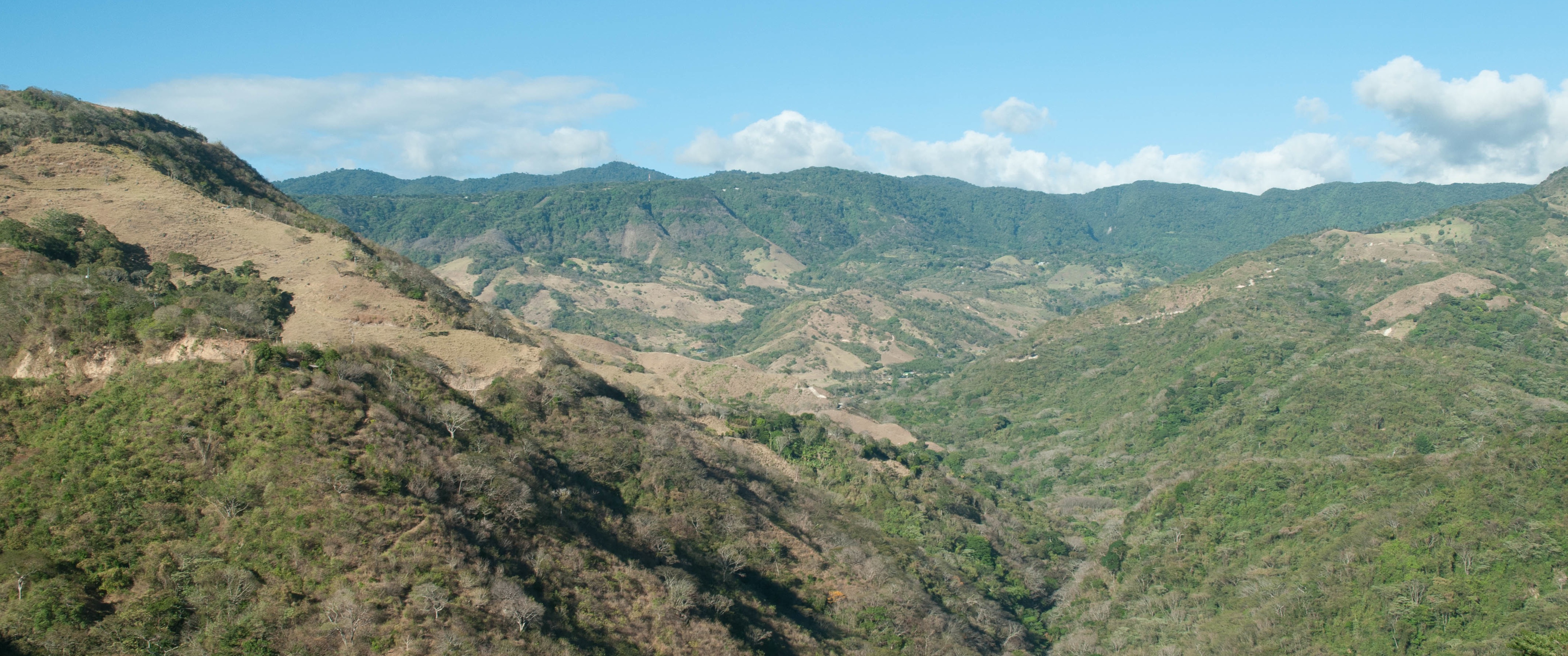
As the van bounced along the dirt road leading up into the central mountains of Costa Rica, leaving a dusty cloud behind to settle on every roadside home, we started to get spectacular views across the brown hills of the dry season.  We were headed toward the high hills of Monteverde, along the continental divide far above the tropical lowlands and the bustling city of San Jose. Our dear friends Kathy and David are living there for the year; Kathy is on sabbatical and is teaching at the Monteverde Friends School, where their son is in second grade. David, who runs a timber-framing business at their home in Vermont, was roped into building a new Meeting House for the school and its Quaker community.  We were thrilled to have a chance to visit this beautiful country during the kids’ school break, and grateful to Kathy and David for allowing us to share their hillside home for a week.

Monteverde and continental divide

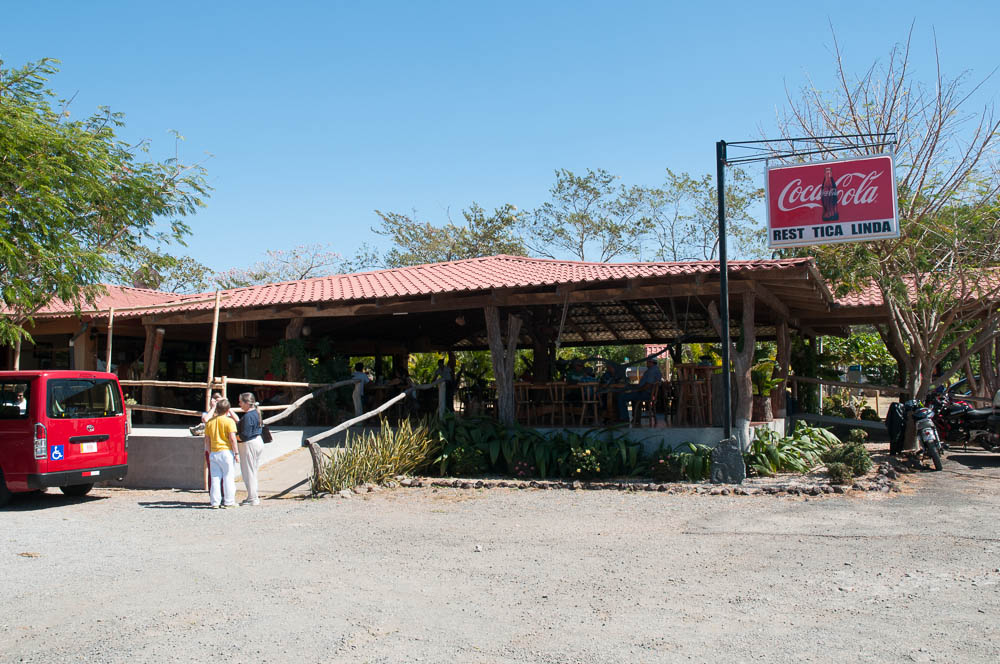
We were met at the airport by Sergio and Jose, in their comfortable van. Sergio, very friendly and gregarious, chatted on and off about the various sights along the way. From San Jose we drove the PanAmerican Highway – which runs the full length of central and south America, I think – and briefly along the Pacific coast. As we climbed into the high country, we pulled over to examine (and taste!) fresh cashew fruits growing on a cashew tree. Tico Linda restaurantWe stopped half-way at a wonderful open-air roadside cafe, for a filling and traditional meal of rice and seafood.  It was hard to believe, sitting in the breezy warm air of Costa Rica, that we had braced ourselves against the gusts of winter in Newark the night before. (We drove to Newark on Saturday, staying overnight near the airport, to catch an early-morning flight that had us arrive in San Jose before noon. As a bonus we had a wonderful dosa meal on ‘India alley’ in Jersey City, with recent alum Bhavna.)


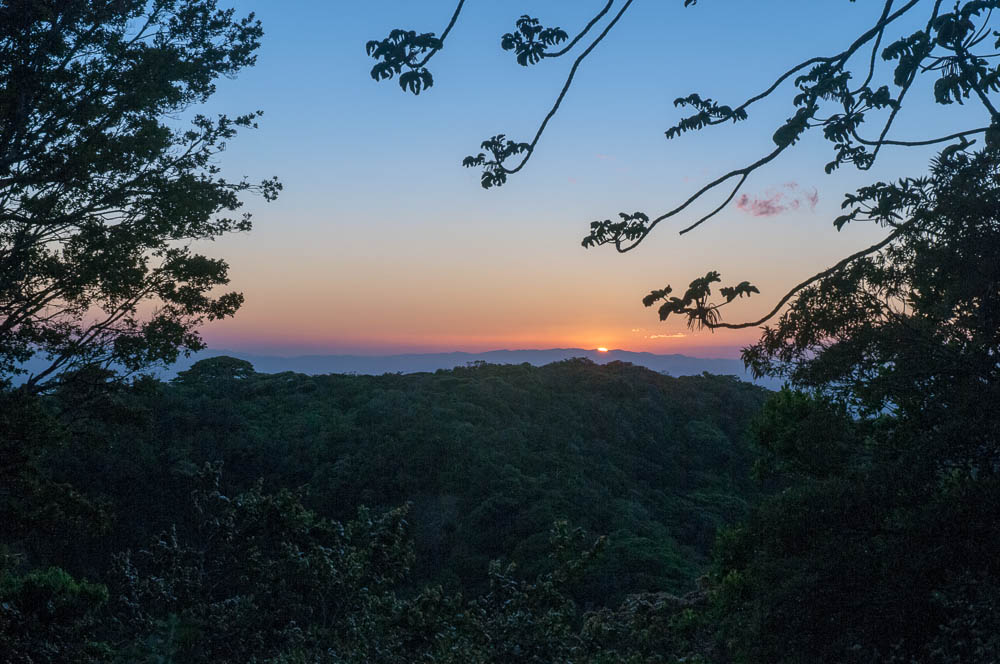
We arrived in late afternoon at Kathy and David’s rented home, where we were also greeted by another Dartmouth family (Jim and Laurie and their two daughters), who are also passing through during their sabbatical year.  They all share the main ‘casa’; we are snuggled into the detached cottage (‘casita’). Both have a beautiful sunset view (below). A huge feast of casado (rice & beans) with sausage and vegies, with seating for 12, rounded out a long but enjoyable day. A full week of exploring yet to come!

Sunset from Casita

Photos from India

family photo
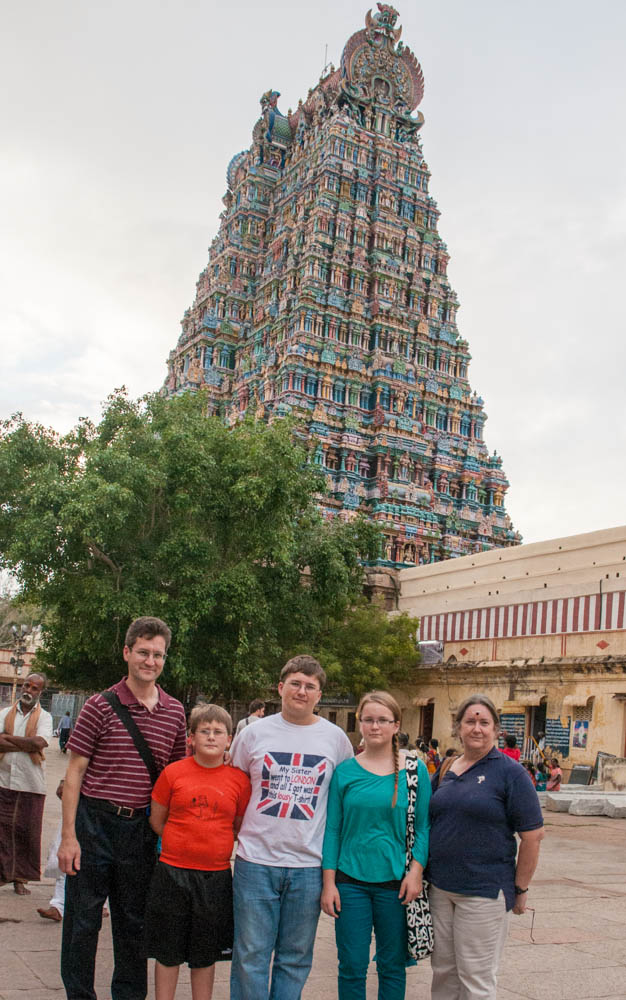
Family portrait with one of the gopurams.

Here’s a quick link to all of the photos from our trip to India (mid-December 2012 through mid-January 2013). There are galleries for Mumbai, Madurai (and Aravind Eye Hospital), and Bangalore.

At right is a photo of us visiting the main temple in Madurai, showing only one of the many gopurams (towers) at this huge temple.

A Bangalore birthday

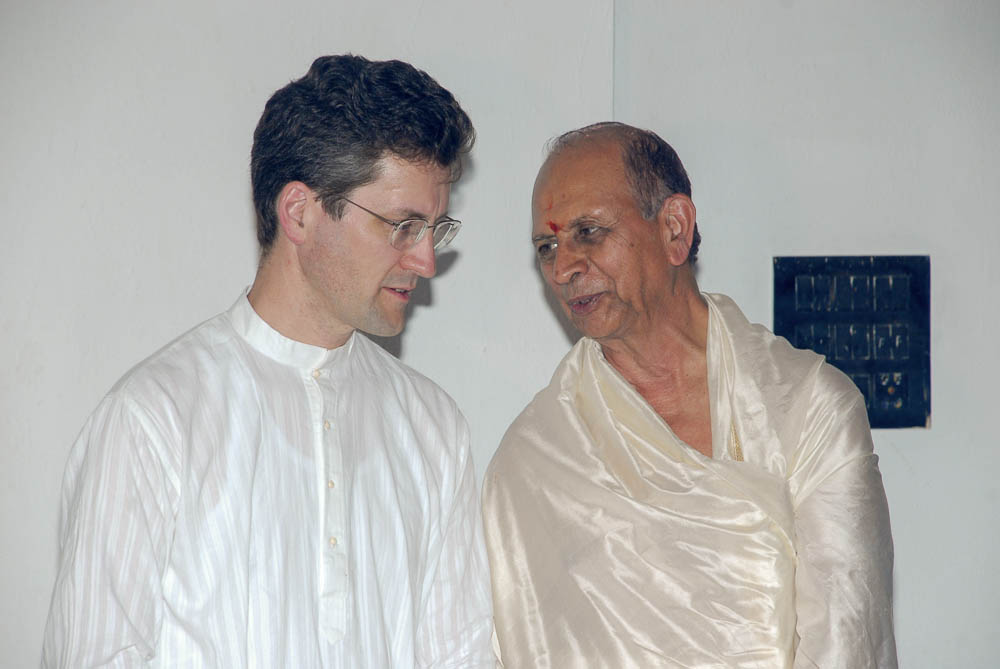
When Rima invited me to attend her father’s 75th birthday celebration, at a temple in southern Bangalore, I was more than happy to accept.  A 75th birthday is a special event for anyone, anywhere, and I was honored to be asked to share such an event. Even more honored to be invited to a family event, in a culture where family is so important — and families are so welcoming.

Image

So I put on my finest kurta and pyjamas, and set out to find an auto driver who could understand where I wanted to go.  (I’ve written about autos, and auto drivers, before – and this day was pretty typical. They quote overly high prices, I get out of the auto and walk a few blocks ’til I find another auto; this is the routine.) Finally I found a willing driver, but we had to duck into a nearby shop so the shopkeeper could read the address and help the driver figure out where it was. After a bit more price negotiation, we headed south.

Eventually, I found the temple. I spotted an entrance with a huge collection of shoes and sandals outside, and rightly guessed that was the way to go. I was unprepared for the size of the gathering! There were easily a hundred people seated behind Rima and her father and her mother.  I arrived just as the puja was finished – apparently this part lasts three hours – and we all moved to a larger hall for the final blessings and a meal.  A fascinating ceremony, and fun to photograph. (I felt awkward using my camera, but Rima assured me it was fine, and anyway there was a professional photographer and videographer using their bright lights so I was more like a fly on the wall.) 

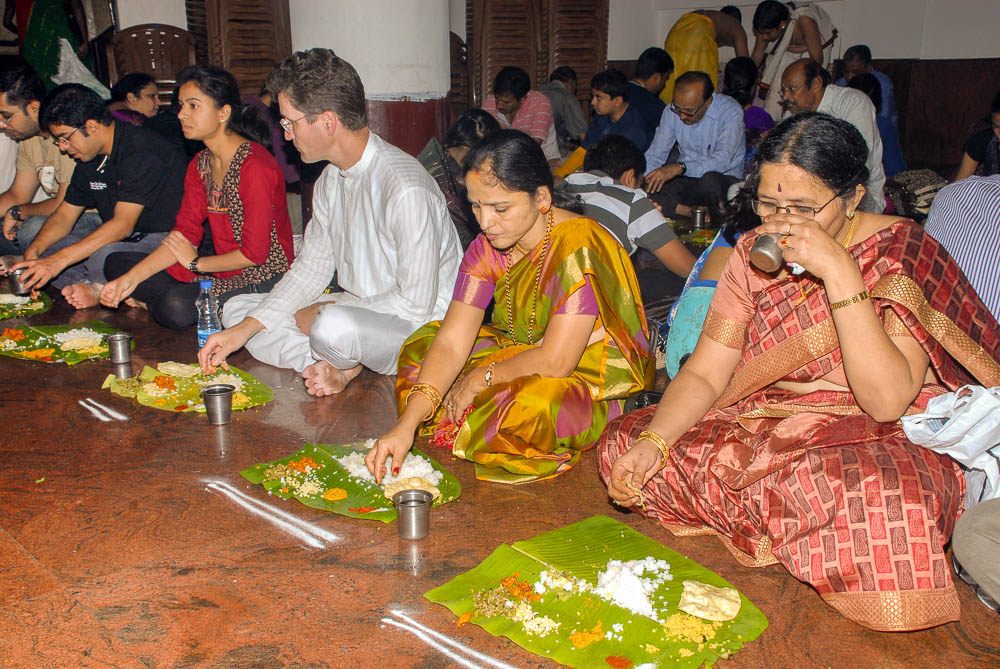
Ceremonies were finished, the floor was swept clean, and lunch prepared.  The staff laid out about a hundred banana leaves, in rows, on the marble floor. Each guest chose a place to sit. Next to each leaf was placed a metal cup with water.  Then the staff came along with buckets of food, rapidly scooping out chutneys, curries, dals, rice, curd, sweets, and more, using their hand (or sometimes a spoon).  Sitting on a marble floor eating food served by hand from a bucket onto a leaf — this is not everyone’s idea of fine dining — but the food was wonderful and plentiful and the mood festive. I marveled at how quickly the food was served to so many – really, it took them about 3 seconds per person as they came by with each dish. I ate so much it was hard to stand up!  As we all prepared to leave, a group of cleaning women came along stacking the leaves and their leftovers; it occurred to me that, other than the reusable metal cups, everything left was compostable.

Image

[Why are so many of my blog entries about food?  Why do I have a Smugmug tag specifically for photos of food? Can you tell I love Indian food?]

I really enjoyed my time at the celebration. Many of Rima’s cousins introduced themselves and were very kind in welcoming me to the event.  Thank you all for inviting me, for allowing me to join your family for the day. And thanks for the two photos of me, above.

I posted a dozen more photos. My very best wishes to Rima’s father on his 75th birthday!

Bangalore traffic

Crossing the street in Madurai.
Crossing the street in Madurai, in light traffic.

Having spent time in Mumbai and Madurai on this trip, I can again state that Bangalore has the worst traffic.  Still, it somehow seems better than last year, at least in the places I’ve been.

Bangalore is building a new metro rail system, and the first segment opened this year. I saw the trains gliding above M.G. Road last week. This line only serves a particular area, however, so it will take time before the metro system has a broad impact. People tell me that the Delhi metro has made a big difference since it was fully open a few years ago.

New flyovers are there, as well as subways. A “flyover” is a bridge or elevated roadway; a “subway” is a tunnel. They are both used to ease congestion at an intersection by avoiding the need for stoplights or avoiding cross-traffic.

[I just caught myself writing like an Indian would speak.  We might say “There are new flyovers”; they would say “Flyovers are there.”]

As a pedestrian, I’ve seen some new “skywalks”, that is, pedestrian bridges over particularly busy streets or intersections. Still, in most places, to cross the street is means weaving through moving traffic and hope that the traffic goes around you instead of over you.  But the biggest novelty is the advent of pedestrian crossing signs — those green and red lights that tell you when it’s time to walk. They seem to work whenever there is a traffic cop present – all the traffic stops and the pedestrians can safely cross. But at other times, I’ve noticed that the traffic ignores the walk sign and just proceeds into the intersection!

After three weeks walking the sidewalks of India I notice myself becoming more aggressive. I push my way through crowds, I bat away the touts who want to sell me trinkets, I step out into traffic as if I own the street. That’s just the way it’s done. Maybe it’s a city thing. Maybe it’s an India thing. But if I defer to either courtesy or safety, I’d never get across the street.

Perspective of a Bangalore auto-driver

“So is the US a country or a continent?” the auto-driver asked me as we puttered up Residency Road on our way to IISc.

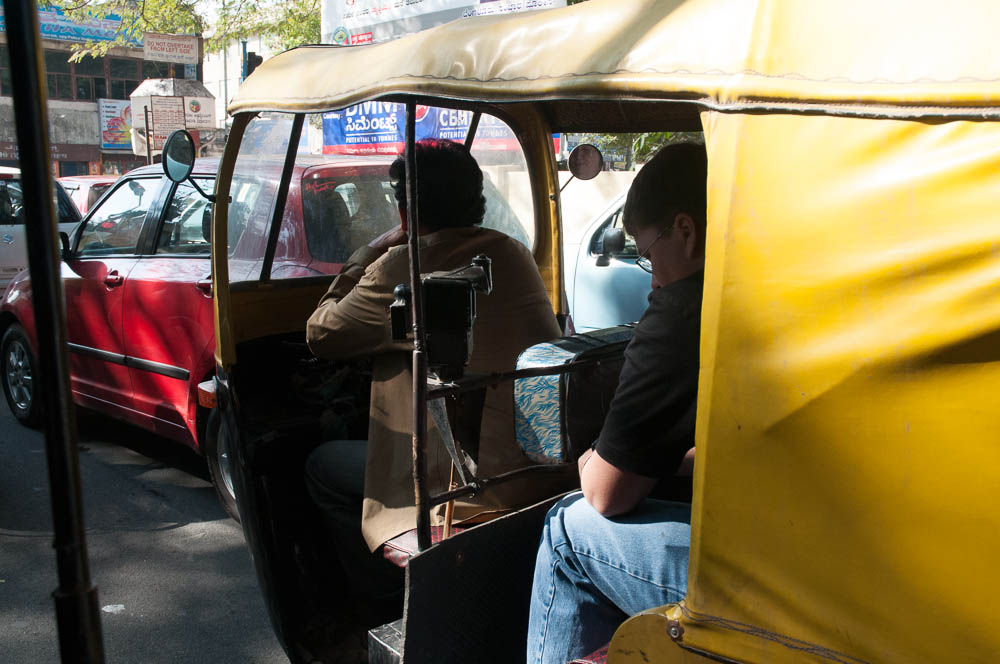
John sits in traffic, in autorickshaw. Can you see Pam in the mirror?

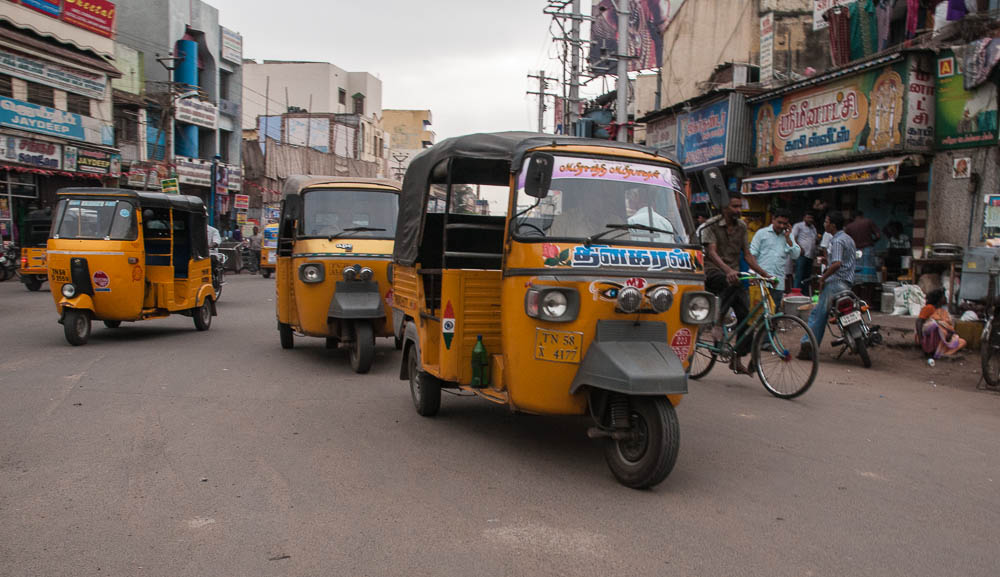
Normally, I don’t have much of a conversation with the driver of an autorickshaw, the ubiquitous three-wheeled taxis that ply the streets of Bangalore and most other Indian cities.  The conversation usually is limited to my attempt to describe where I want to go and their attempt to convince me that their meter is broken and that I should therefore pay triple the appropriate price for the trip :-).  One of the things I like about autos, however, is that their open-air construction and the frequent lengthy stalls in traffic encourage chatter between the auto driver and nearby auto drivers.  It’s not uncommon to have one auto driver ask another for directions, or for motorcycle riders to chat with an auto driver, all while stopped for a light.

On this sunny Saturday morning, this particular fellow was very conversational and his English was good; certainly far better than my Kannada. His geography was a little challenged.  “US is a country,” I said. “North America is a continent, with three countries – US, Canada, Mexico.”  This was good enough until he stopped to jam us  into the crowd at the next traffic light.  “Is Washington a city or a country?”  he asked. “Is Obama the president of the US or of the continent?”  “So, Washington is the capital of the US?”  So far, I know the answers.  Then, it gets more complicated: “why is the US dollar the most popular currency?”  I should have taken global economics.  “why is English the most popular language?”

We talked on like this.  He noted that the US had just had elections; Obama had won again? yes, I confirmed.  “Indian democracy is not good,” he said, “ninety percent of politicians are corrupt.” I decided not to pursue the topic of politics too far, so I switched to a safer topic.  I noted that there are many new autos on the road, all green on the bottom instead of black, and labeled “LPG”. He confirmed that all new autos must be LPG, which is cleaner than the stinky diesel units of the past. He lamented that the newer machines were much harder (and more expensive) to service, however.

Nice fellow. I asked him where he was from – was he from Bangalore itself?   “Ninety percent of auto drivers are from Bangalore,” he told me.  Interesting; the city has many migrants from all over the country so I assumed otherwise.  I wished him well and we went our separate ways.

A new year in Bangalore

Every time I arrive in Bangalore it feels like coming home.  Even the kids – who were last here three and a half years ago – said it feels “welcoming” and “comfortable” here, particularly at IISc where we lived. We arrived on December 29; Pam and the kids get four days here before making the long trip home.  I’ve posted some photos.

So far we’ve spent time with friends and families of friends. On Sunday we had a wonderful lunch at MTR with Bhavna’s parents, on Monday we had breakfast with Rima and her parents, and afternoon tea with neighbors at IISc. Today (New Year’s Day) we’re resting and plan a bit of shopping.

MTR waiter brings salad

Lunch at MTR is always an incredible experience. I first ate there in April 2009 and have returned several times. That location, the original, is an old building and you practically walk through the kitchen to get to your table – a bustling kitchen with vats of bubbling curry and sambar. On Sunday we visited a newer MTR location on the top floor of a new hotel building in Jayanagar. We had to wait 45 minutes for a table, because so many families were out for a Sunday meal. The anticipation only makes it tastier! They filled a roomful of tables all at about the same time; this is how they are so efficient. Everyone sits at the same time. Then they lay out the plates. Then a flurry of waiters come around, each carrying a bucket of something — chutney, curry, salad, etc – stopping at each table to slop some onto each plate. If you want more of anything, you just wave down the waiter when he comes around with more. I made the same mistake I’ve made before, that is, to ask for more dosa only to realize that there are several more courses to come. Mara and I counted 20 separate foods they delivered. We were so full, but the food is so wonderfully tasty.

Our first visit to IISc was a real treat for the kids. We went to their favorite candy shop, and we walked through our old neighborhood and along the same route to the school bus stop. This brings back so many memories! one would say “remember when we saw…” or “remember the time when we did…” and they would all laugh about it. We tried to visit our apartment but it is occupied by new residents who did not seem to understand why we were visiting. We did have a nice tea with our downstairs neighbor, talking politics and listening to her visiting daughter tell about her experience living in NYC through Hurricane Sandy.

Brigade Road on New Year’s Eve

We spent New Years Eve at one of our favorite restaurants (The Tandoor) on M.G. Road, and walked back via Brigade Road, which was festooned with colorful lights for the holidays. Hundreds of people were gathering in this popular street, and 16,000 police were patrolling the area [The Hindu]. Back at our hotel, a dance party had thumping loud music until after midnight, and the kids stayed up late watching movies.

Do check out the photos.  Now we’re off to do some more exploring. More later!

Madurai

Before we leave Madurai, I wanted to share a few photos from the streets and villages around the city. It’s an ancient city, perhaps 2,500 years old, and has been the site of a major Hindu temple for (quite literally) millennia. In many ways, though, it feels like a village trying to be a city. The streets are filled with trash, the traffic is chaotic, and livestock wander the streets and empty lots.  Tourists are coming in greater numbers, though the infrastructure is not yet fully developed to support them. A brand-new airport now welcomes international flights, but there appear to be only a small number of tourist-quality hotels and restaurants.  Still, the people are friendly and the Aravind medical facilities world-class, so there is huge potential here.

A woman shares a laugh with banana vendors.