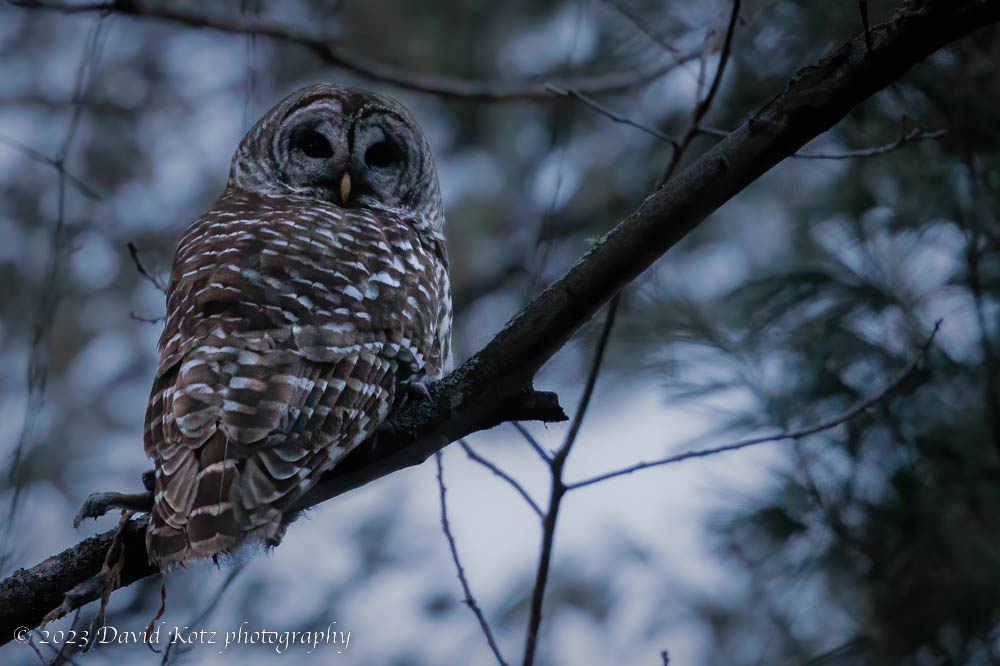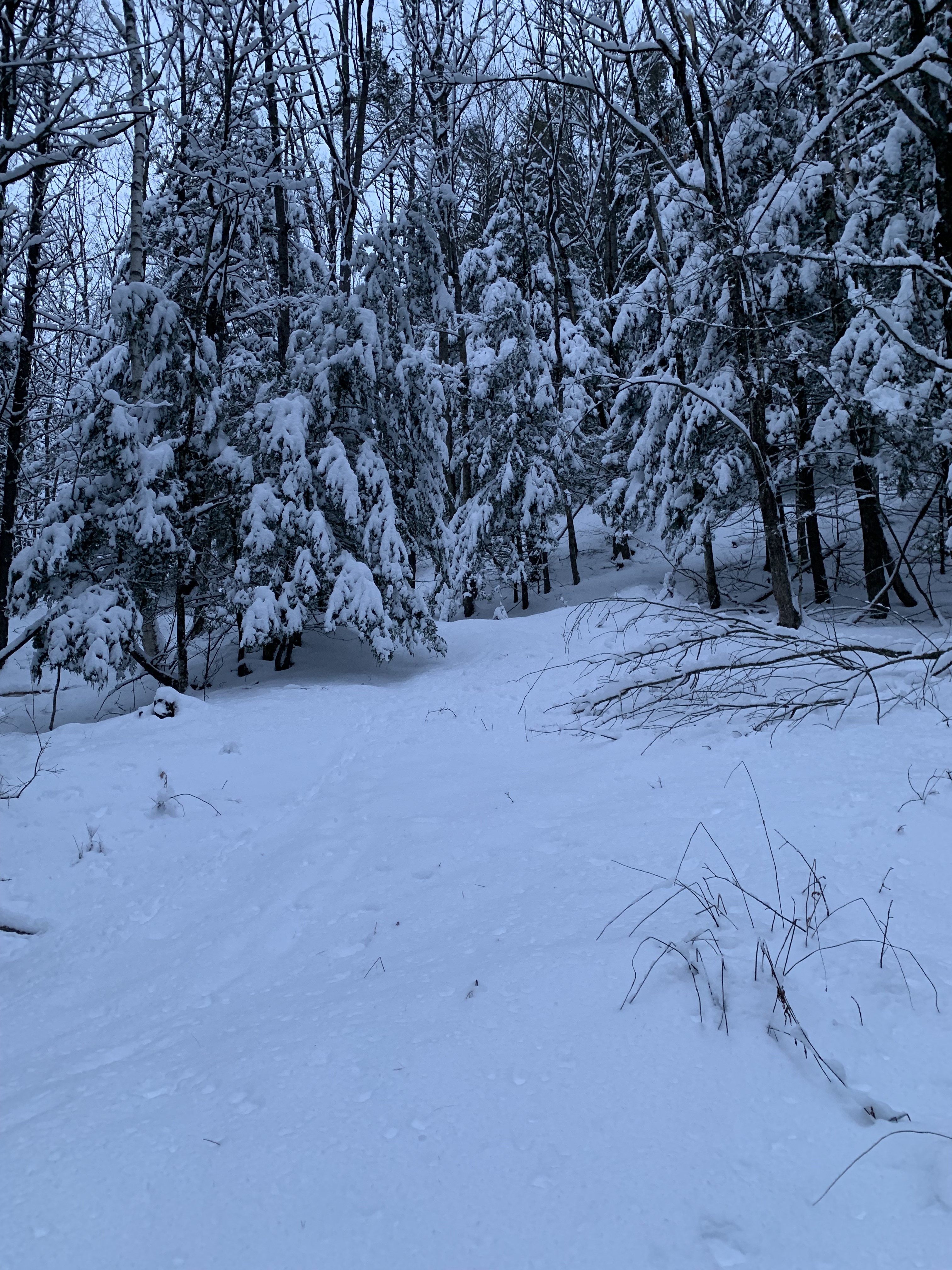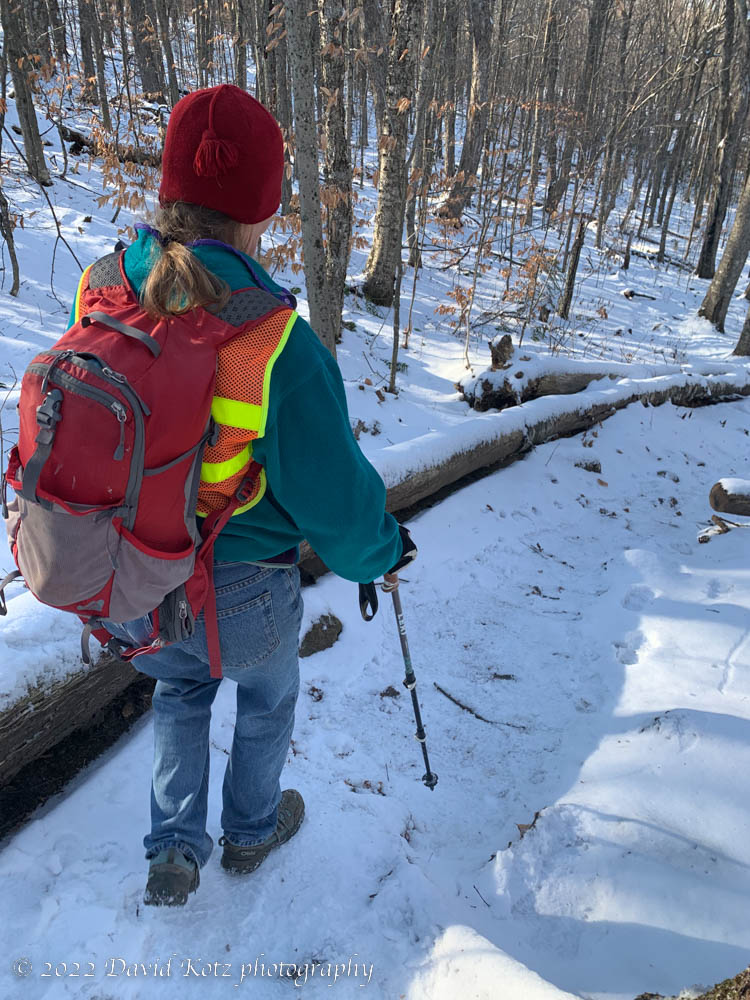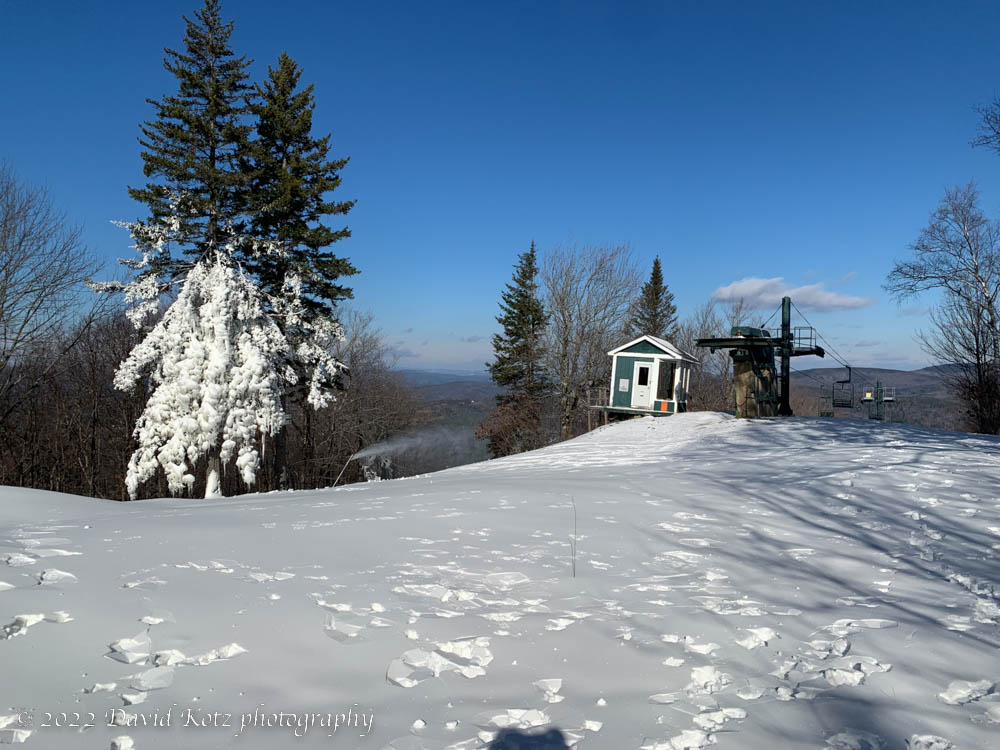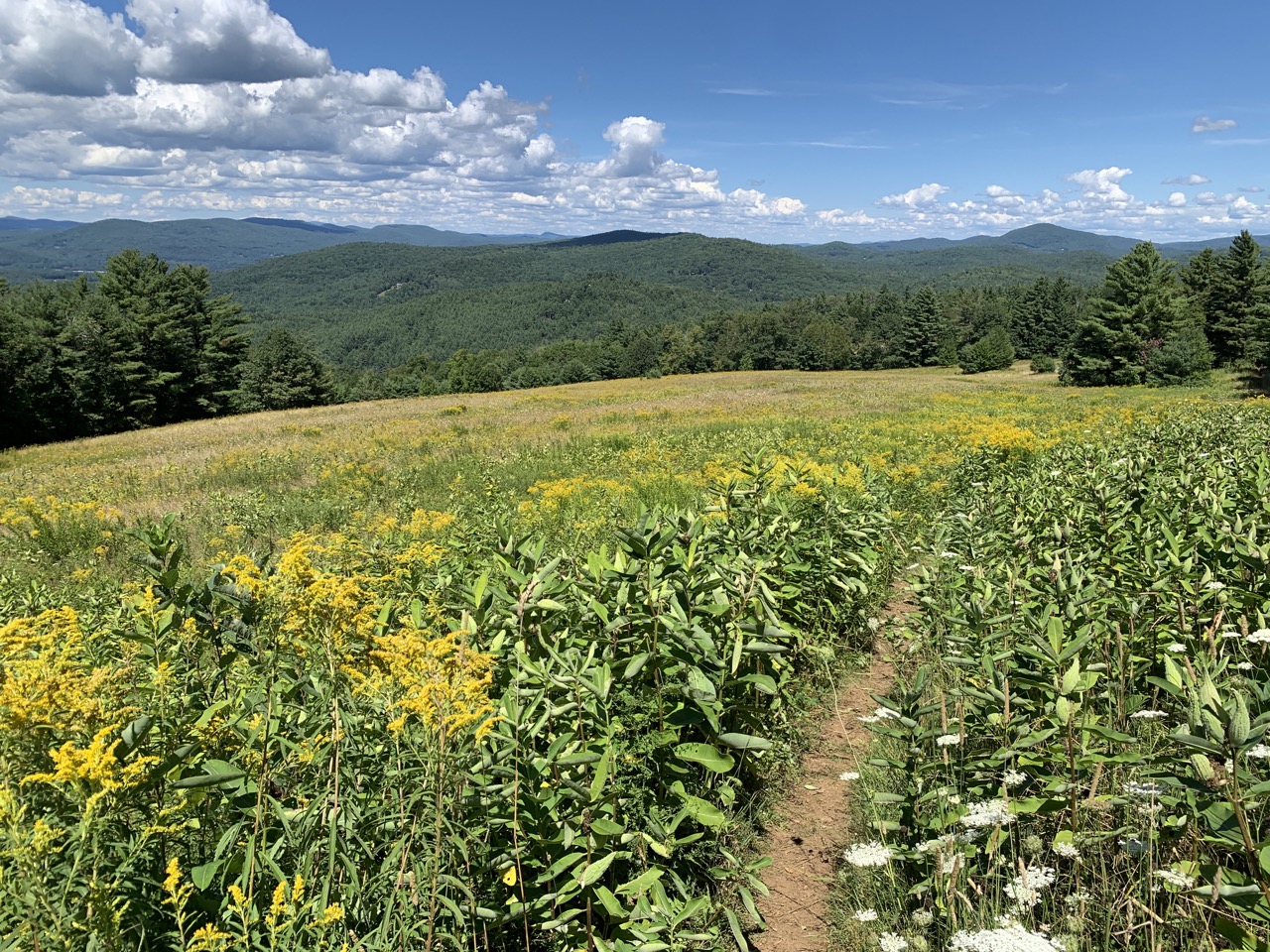
August is a time of quiet in the meadows and forests of New Hampshire, as the plants and animals enjoy the long days of late summer after the busy days of spring and early summer. This afternoon I strolled down from the summit of Lyme Pinnacle, through a mature meadow filled with goldenrod and Queen Anne’s Lace, with the crickets chirping and a light breeze blowing puffy clouds in from Vermont. Very peaceful.
Canon R5, 800mm + 1.4xTC, f/16, 1/200; ISO 12,800. Cropped about half.
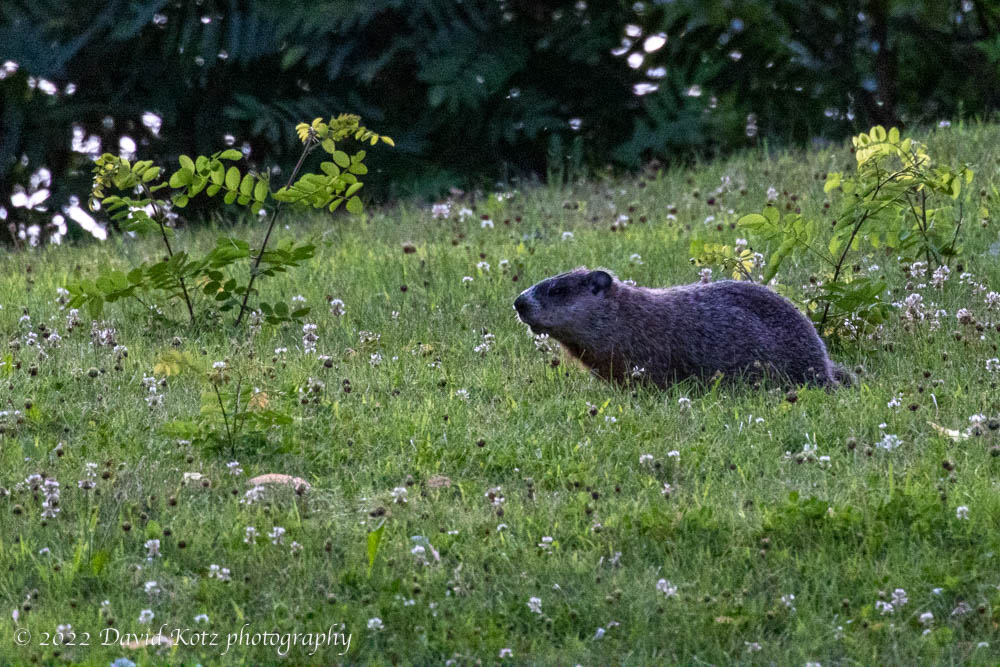
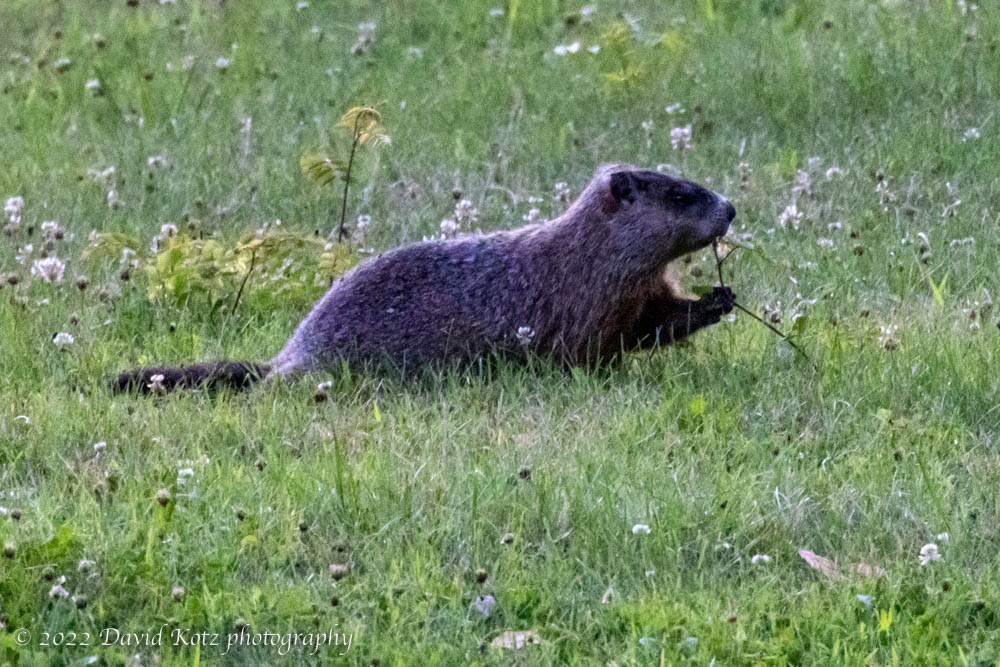
After sunset, and as the summer evening fades into twilight, our friendly neighborhood groundhog comes out to browse. (I think he lives under our storage shed.) He’s quite shy, so I snapped a few photos from the deck – using my new 800mm lens plus a 1.4x teleconverter (effective 1120mm). The combination is fixed at f/16 and, combined with the deepening twilight, the photos are a bit noisy. Still, he’s a cute fellow!
Canon R5, 800mm + 1.4xTC, f/16, 1/200; ISO 12,800. Cropped about half.
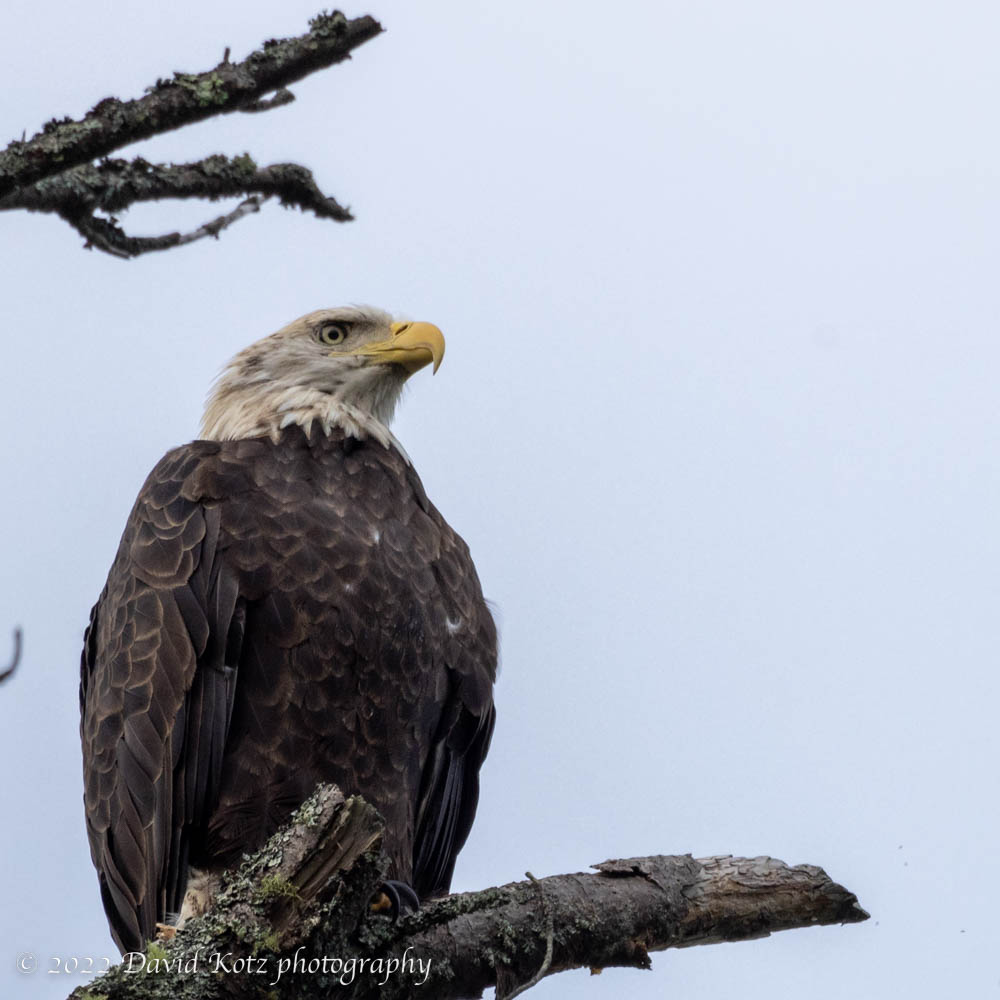
As I was rowing on the river this morning, I scanned the tall riverside trees to see whether I might see anything interesting, as is my habit. Unlike other days, today I spotted the telltale white head of a bald eagle, high in the branches of a distant dead snag. I turned around, headed home, grabbed my camera, and drove up the road to that location. This was a great opportunity to test my new 800mm lens!
Canon R5 with 800mm f/11 at 1/400, ISO 500, cropped
It appears to be a somewhat immature bald eagle – not fully developed with the all-white head of an adult. It stuck around as long as I would, and beyond. I hope to see it again sometime soon.
Today is the summer solstice (in the northern hemisphere). More precisely, the solstice occurred at 5:15am here in the Eastern timezone. The summer solstice is the moment at which the sun has ‘traveled’ to its northernmost latitude, in its annual cycle of apparent movement to the north in summer and to the south in winter. (It’s a great day for those of us with solar panels, because it means we’re getting hours of sunlight!) Read on.
Every year, since the children were small, we walk up River Road in early May, scanning the roadside brush for trash and debris as part of New Hampshire’s “Green-up day.” It’s a perfect time to do this – after the snow melts and before the undergrowth reappears. (Most importantly, before the poison ivy emerges.) Our kids were always eager participants, scampering down the roadside banks to fetch a soda can or a beer bottle, a cigarette pack or a shopping bag. It was a great lesson in the importance of community service, and the callous disregard of those who feel it is somehow appropriate to toss their fast-food bag and beer bottles into the roadside brush, perhaps imagining the river would wash it away. Today I ended up filling two large trash bags, of the special blue variety designated for this day; read on.
Early spring (late winter?) storms sometimes give one the opportunity to see the dramatic difference elevation makes. It rained yesterday afternoon, hard at times, for many hours. When I hiked up to the top of the Lyme Pinnacle this afternoon – it’s really just a grand hill, not really fair to call it a small mountain – I enjoyed the broad views into Vermont on the west and the hills of Lyme to the east. Most prominent, today, was the vast bulk of Smarts Mountain, with its level summit ridge and its fire tower rising above the trees – all coated in a fresh dusting of snow.
My weekend wanderings through the woods near home allowed me more glimpses of the white-tailed deer living therein – emphasis on the white tail, because I only tend to spot them after they’ve chosen to bound away from me, white tail flashing and leaping through the trees until they fade into the distant brownness of the tree bark and leaf litter. Yesterday I saw them three times, though never with enough time to capture with a camera. Saturday I also saw a big ol’ turkey waddling off into the bushes.
Several of my favorite paths pass by vernal pools – intermittent shallow pools formed by spring rains and snowmelt, on deep-frozen ground not yet ready to absorb the moisture. Not much spring life there yet, but I’ll check again next week. (Last year these pools became active in May.)
So, photographically, all I have to share this week is another “new” thing along my path. It was very windy last week and this hemlock snapped off at the base. When a tree like this falls in the woods; do you think the deer hear it? 😉
Yesterday afternoon I took another walk up the hill behind our home, to revisit the curious spot where a deer had met its end (discovered last week). As I climbed the hill, a family of wild turkeys slowly tried to sneak away – not easy now the snow has melted and the crisp, dry leaves of fall cover the forest floor. I noted they were heading uphill away from me, but toward the summit that I would soon reach by a looping path. As I neared the crest, two deer bounded away, flashing their white tails. One paused and turned, curious about me. I was able to approach much closer, allowing me time to capture photographs and video.
A stroll along River Road, just upstream, brought me an opportunity to see some of the local regulars as well as some unusual migrants – all at the mouth of Grant Brook. Although the winter’s ice has just begun to recede, the critters moved in quickly. We saw some green-headed Mallard ducks, but also a pair of Mallards with vibrant blue heads:
Unusual blue-headed (Mallard?) ducks at the mouth of Grant Brook, Lyme NH
Meanwhile, a beaver zipped by, then dove.
A beaver swims at the mouth of Grant Brook, Lyme NH
I never quite know where I’ll go or what I’ll find.
Last weekend’s hike to Holts Ledge emphasized the end of winter/snow hiking, despite the spectacular powder snow I encountered on Kinsman Ridge two weeks ago. That change, coupled with area roads swallowed under a mud season of “biblical proportions”, led me to stay close to home for my hiking this weekend: literally out my back door. It’s a common mud-season opportunity for me, while the trails remain muddy in the mountains and the river is still shedding its winter ice. Today’s outing led to two interesting finds! Read on.