Well, that about wraps it up folks. I’ve just finished blogging about our February-March trip to South Georgia Island and the Falkland Islands. (It’s now mid-June, and I’ve been backdating the posts to keep them in chronological sequence with the trip.) If you’ve landed on this post and want to read the whole story in order, start here.
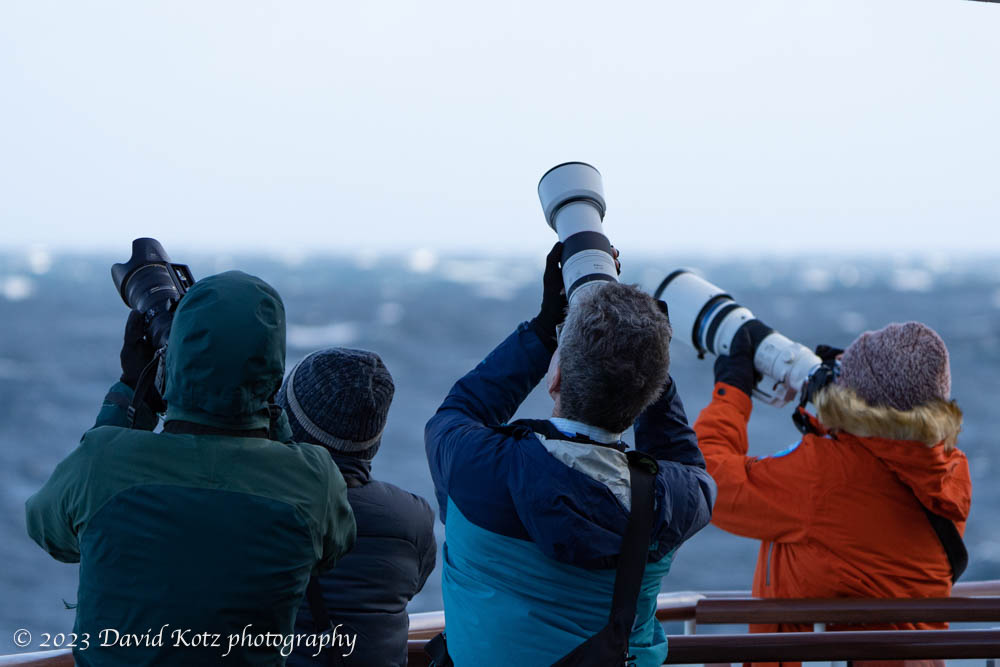
Jack and David (at center) trying to photograph seabirds.
During the trip I snapped over 10,000 photos and videos. I kept about 2,900, and posted about 400 in the galleries associated with this blog. Four percent – not bad. But I have one final gallery for you: my 40 favorite photographs. Enjoy!
[backdated to fit into the sequence of posts about our trip to the Falklands and South Georgia in March 2023.]
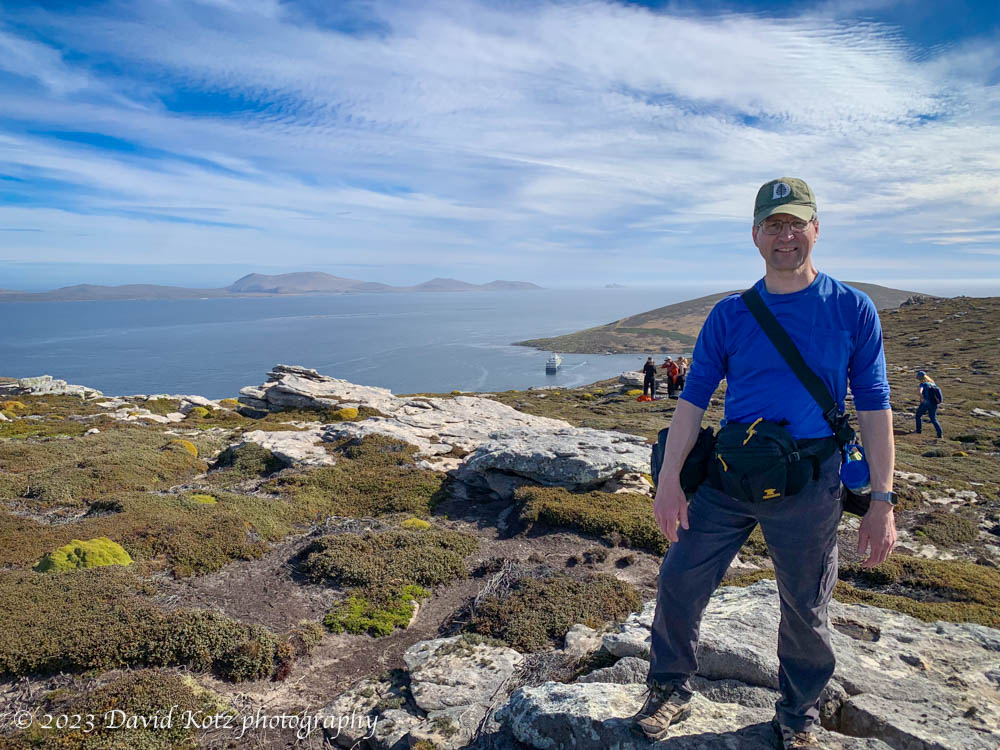
Our last stop in the Falkland Islands was on Carcass Island. As Wikipedia notes, its “grim-sounding name comes from the ship HMS Carcass, which surveyed the island in 1766.” Despite the grim name, we visited on a beautiful day and had a lovely hike up the steep and grassy slopes, past a small Gentoo settlement and through sheep pasture, to a rocky summit with broad views of the bay and surrounding islands.
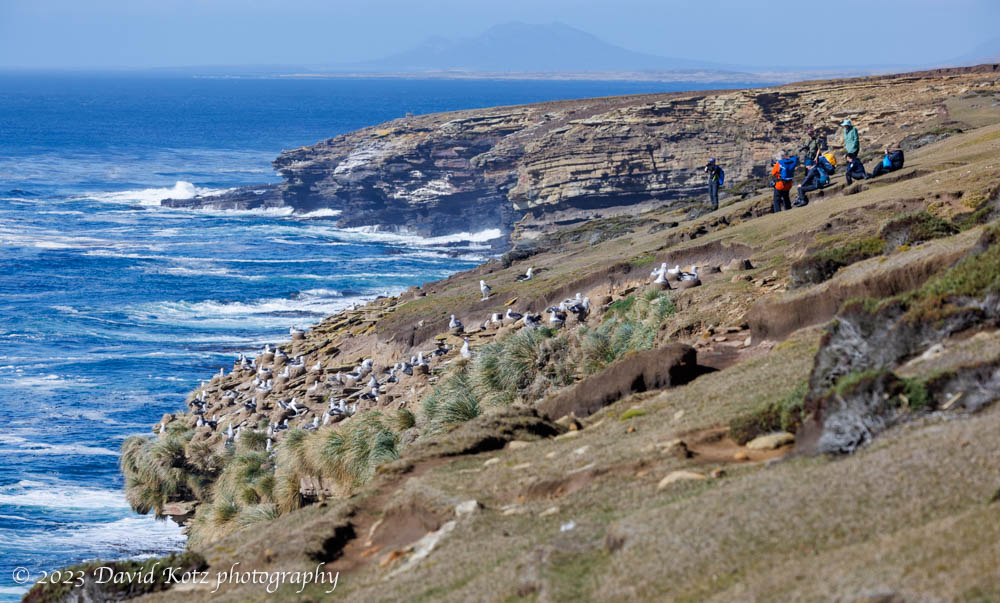
The world’s largest breeding colony of black-browed albatross.
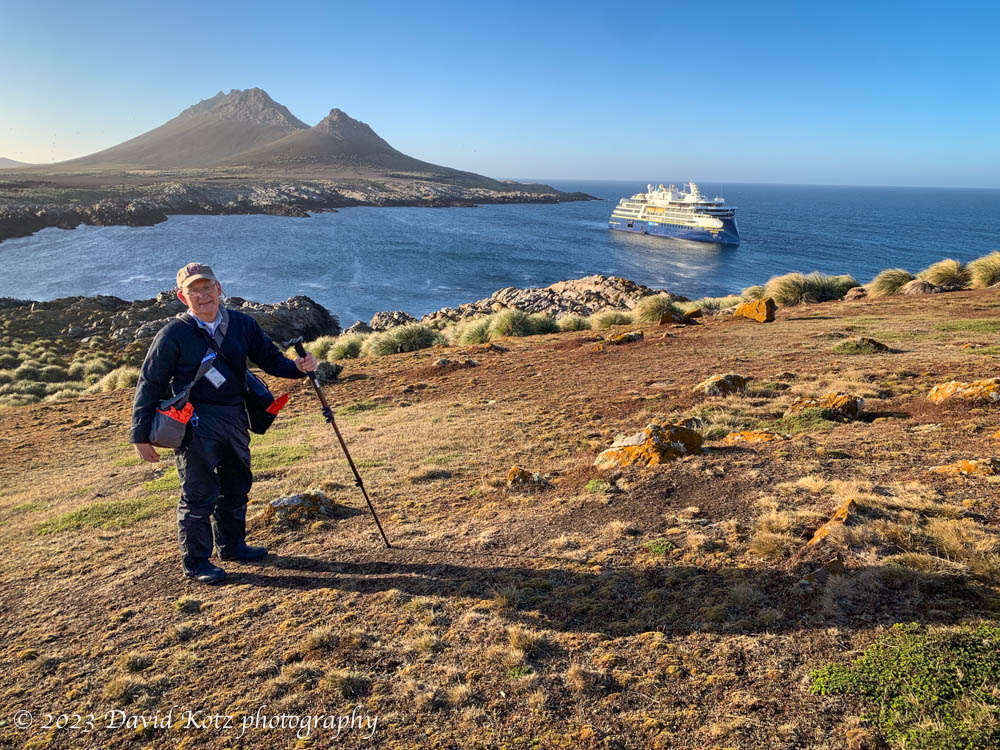
The sun was still low as we pulled into a beautiful harbor between the two halves of Steeple Jason Island and shuttled ashore in Zodiacs. As we climbed into the grassland above the beach, passing a small colony of Gentoo penguins, we followed our long shadows around to the western shore of the island – home of the world’s largest breeding colony of black-browed albatross. (Indeed, over 70% of the world’s population breeds in the Falkland Islands!)
Jack hiking on Steeple Jason Island – Falkland Islands.
It was a spectacular experience – spending the morning with tens of thousands of albatross chicks, with adults occasionally swooping in from their days-long fishing expeditions to find and feed their youngsters… all while Caracara birds kept a watchful eye out for any opportunity to make a meal out of an unwary or unprotected chick. Read on! and check out the gallery of photos and videos.
We arrived back in the Falkland Islands after two full days at sea; this time, we aimed to visit some of the smaller islands on the western side. (We had intended to make these visits on our outbound trip, but an incoming storm convinced the captain to head early to South Georgia and pick up the Falklands on the way back; good call!)
Albatross chicks at an Albatross rookery – Saunders Island, Falkland Islands.
We spent today on Saunders Island, site of the original 1765 settlement, a garrison established by the British Navy. We spent the morning visiting an active sheep farm, and the afternoon visiting a cliffside rookery for albatross and rockhopper penguins. Read on! and check out the gallery of photos and videos.
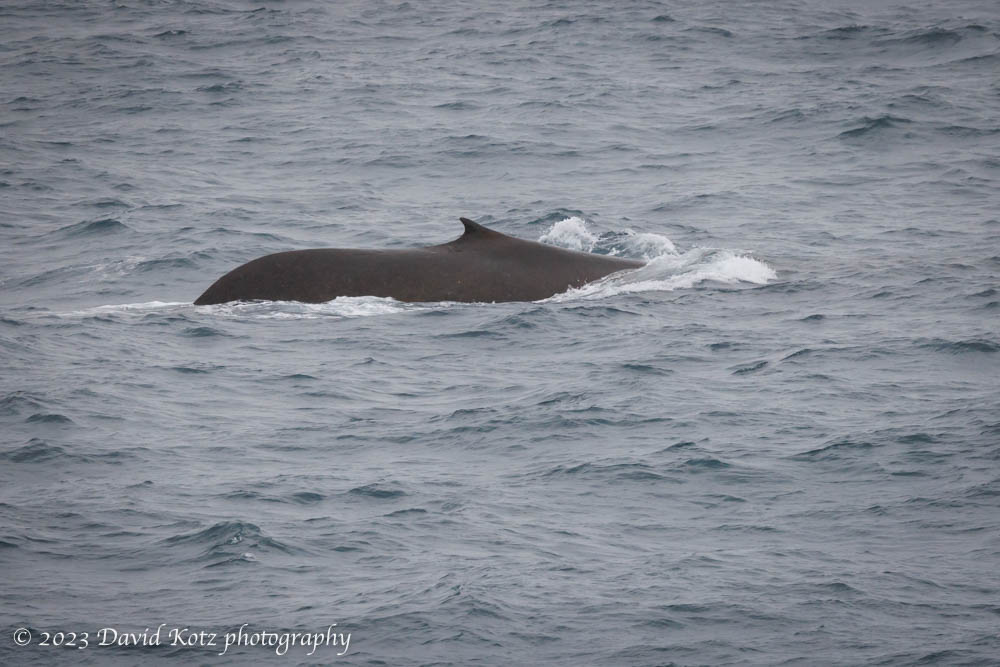
Incredible encounters with whales, off the shores of South Georgia.
As we departed South Georgia on 9 March for the long journey (two and a half days at sea) back to the Falkland Islands, we settled in for a post-lunch lecture on whales by one of the naturalists in the expedition crew. Not long after he had begun to describe the various types of whales, and the history of whaling and whale conservation, a guest near the windows shouted “whale ho!” The lecture was quickly paused and soon we were all out on deck to view and photograph the largest mammals on earth: Blue Whales. And this was just the start! Read on and check out the gallery of photos and videos.
On the sunny afternoon of 8 March, we stopped in St. Andrews Bay for a visit to shore. I joined a group that hiked quickly up across the vast glacial plain formed by the retreat of the Heaney Glacier… and then up onto the glacier itself. Led by Eric, a member of the expedition team who is a glaciologist, we had an opportunity to learn about the dynamics of retreating glaciers.
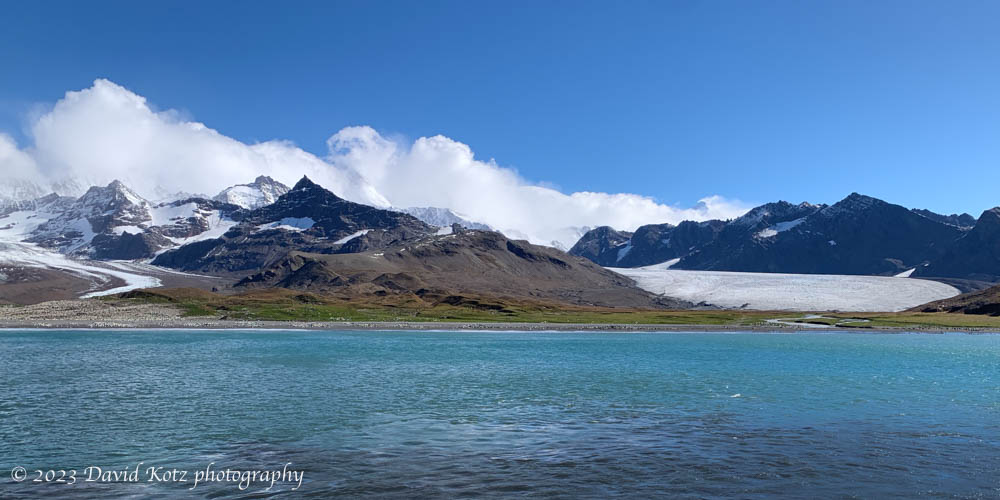
Arriving at St. Andrews Bay, South Georgia. Heaney Glacier on right, Buxton Glacier on left.
On the way back we walked to an overlook where we had a sweeping view from the bay to the Buxton Glacier and across a massive colony of King Penguins – scientists estimate 130,000 pairs, which translates to nearly 400,000 penguins. In the photo above the shore at left is speckled white: those are penguins!
Read on and be sure to check out the gallery of photos and videos.
Shipwrecks, fur seals, and panoramic views – all on a hike above Ocean Harbour.
As the sun rose on 8 March, it painted the grassy slopes of South Georgia Island a deep golden color, and dropped a hint of a rainbow into the offshore mist. As I snapped a photo of this splendid sight, I knew we were in for an incredible day. Our first stop: Ocean Harbour, which had once been home to a sealing and whaling operation. In the bay is the derelict wreck of the three-masted ship Bayard, once a cargo ship that sailed the world from India to Fiji and from South Africa to South Georgia, but now home to hundreds of nesting shag; and an old hut, now home to visiting researchers.
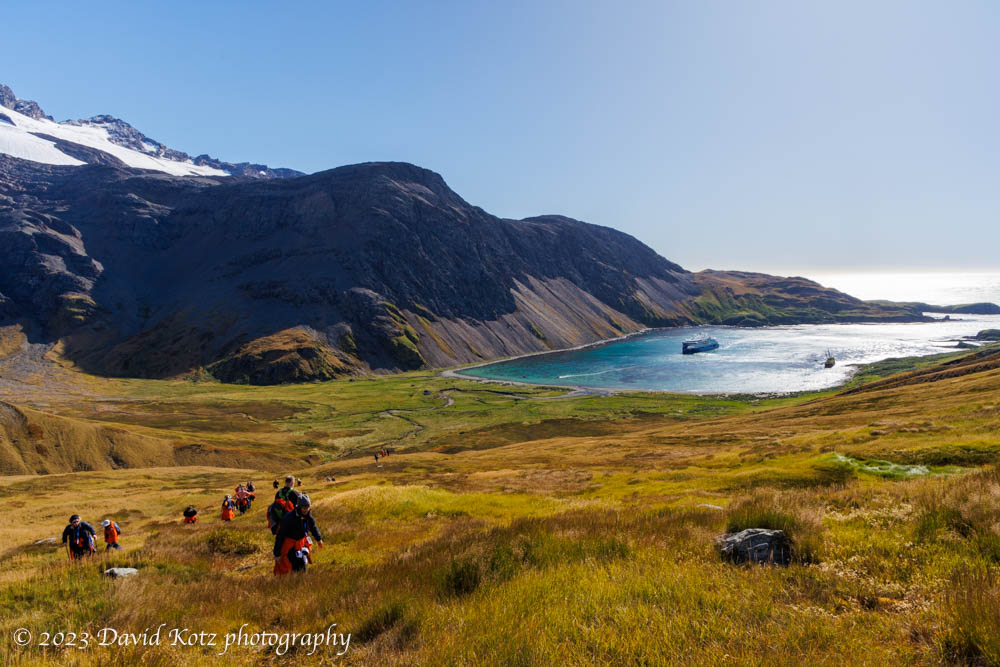
View of Ocean Harbor, with the “Endurance” and the wreck of the “Bayard” – South Georgia.
We set out to hike up into the hills surrounding the bay. Read on and be sure to check out the photo gallery.
A hike from Maiviken to Grytviken, and a toast to Shackleton!
Before breakfast on the misty morning of 7 March, I was among a hardy group that was shuttled via Zodiac to the shore in Maiviken, a small bay in the center of South Georgia’s eastern coastline. We sloshed our way up through the soggy hillside to the rocky height of land on the Thatcher peninsula, and down into the storied whaling village of Grytviken. This tiny settlement encapsulates, in a few small acres, every important aspect of South Georgia human history – sealers, whalers, explorers, soldiers, governors, researchers, and even tourists. Read on and check out the gallery!
A sunrise visit shows why Gold Harbour got its name.
It was 4:30am on 6 March as a hardy group of guests quietly stopped by the top-deck café, looking for coffee, tea, and pastries. The Endurance was resting calmly in the middle of Gold Harbour, so named by the early sealers because the morning’s first rays of sun tend to paint the surrounding cliffs with a golden glow. The weather was calm but a bit misty; nonetheless we soon climbed down to the bottom deck to don our waterproofs and were launching the Zodiacs by 5:30 as the horizon behind us hinted at the coming day. Each Zodiac had a lighted pillar to aid the ship in tracking us in the morning gloom; the penguins on shore seemed nonplussed by this early wake-up call.
Landing in Gold Harbour, South Georgia.
The mist later rose, leading to a spectacular morning on the beaches of Gold Harbour; after a return to the ship for a hearty breakfast, we made a second trip on which I joined a group for a hike up to the headlands – and sweeping views of the harbour, its glaciers, and tens of thousands of penguins.
King penguins – Gold Harbour, South Georgia.
Read on, and be sure to check out the two galleries of photos and videos: sunrise and hike.
After a delightful morning visiting the penguins and seals on the beaches of Right Whale Bay, we re-boarded the National Geographic Endurance and enjoyed a hearty lunch while it sailed further down the coast to the Bay of Isles. As we approached shore, hundreds of King Penguins leapt in the choppy waters in front of the ship, curious about this odd, huge creature that had joined them in the bay. This brief video gives you a sense of their frolic and a panoramic view of this broad alluvial plain fed by two glaciers – it’s the best way to see the whole scene!
David with King Penguins – Salisbury Plain, South Georgia.
We quickly cleaned and donned our waterproof boots and pants and hopped into the Zodiacs for a trip to shore… this time to visit the vast glacial plains known as Salisbury Plain. Read on, and check out the gallery of photos and videos!



 David Kotz