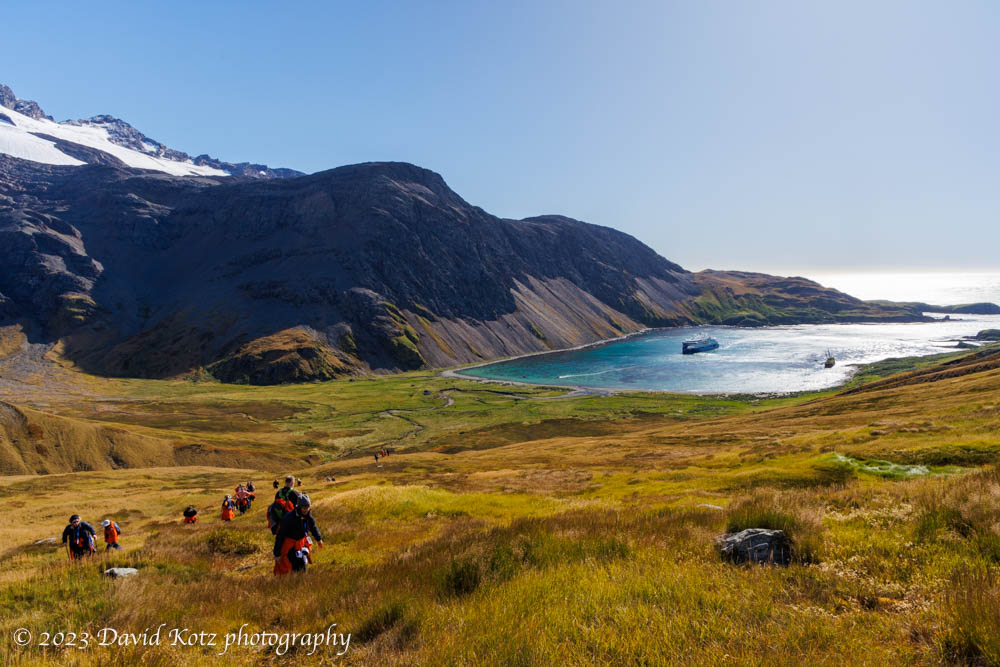
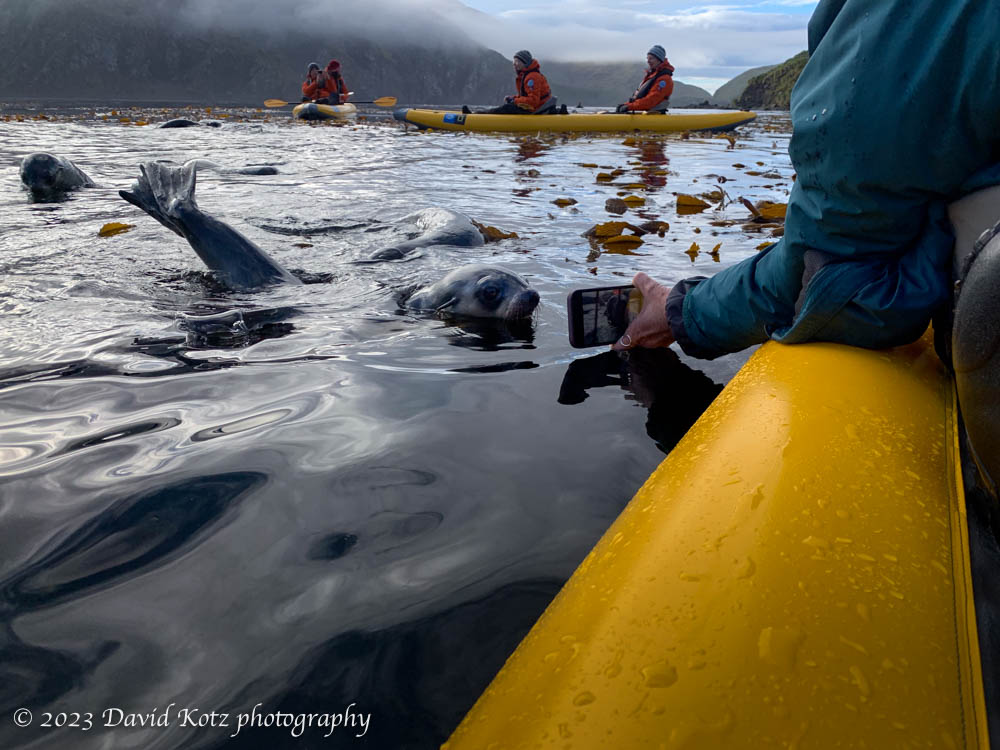
As the afternoon waned on 6 March, we sailed deep into a deep fjord at the southern tip of South Georgia, its walls lined with glacier after glacier. As the glaciers have receded – all too fast, in recent years – the fjord has gotten longer, and it took an hour for us to motor slowly “upstream” to the head of the fjord, where the Risting Glacier was actively calving into the tidal bay.
Glacier near the head of Drygalski Fjord, South Georgia.
Visit the gallery for more photos and a video panorama. You’ll note one tiny iceberg, recently broken off the glacier, just large enough to allow a fur seal a spot to rest while it fished for its dinner in the frigid waters of the fjord.
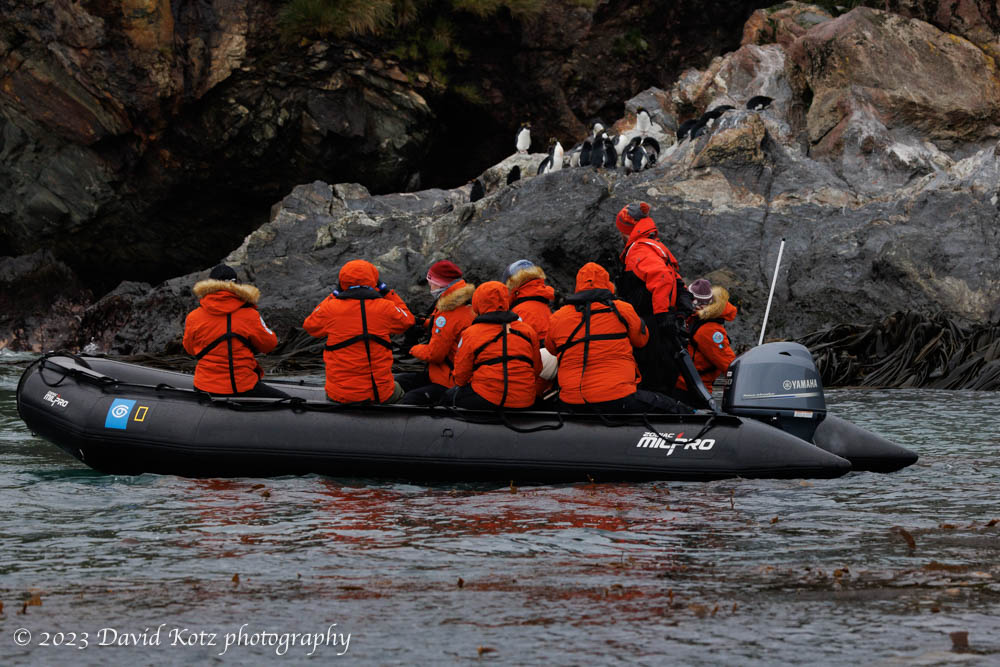
A Zodiac tour gives our first glimpse of Macaroni Penguins.
After a delightful morning in Gold Harbour, on the afternoon of 6 March we stopped briefly in a tiny bay on the southeastern point of South Georgia Island – Cooper Bay. We were not able (not allowed?) to land here, so they took us out in groups to tour the bay by Zodiac. On the beach we saw a small, mixed colony of penguins – Chinstrap, King, and Gentoo – and nearby a steep, rocky hillside frequented by Macaroni Penguins.
Macaroni penguins – Cooper Bay, South Georgia.
Visit the gallery for more photos. The weather was windy and the water was choppy, and it was difficult to photograph wildlife from a bouncing boat!
A sunrise visit shows why Gold Harbour got its name.
It was 4:30am on 6 March as a hardy group of guests quietly stopped by the top-deck café, looking for coffee, tea, and pastries. The Endurance was resting calmly in the middle of Gold Harbour, so named by the early sealers because the morning’s first rays of sun tend to paint the surrounding cliffs with a golden glow. The weather was calm but a bit misty; nonetheless we soon climbed down to the bottom deck to don our waterproofs and were launching the Zodiacs by 5:30 as the horizon behind us hinted at the coming day. Each Zodiac had a lighted pillar to aid the ship in tracking us in the morning gloom; the penguins on shore seemed nonplussed by this early wake-up call.
Landing in Gold Harbour, South Georgia.
The mist later rose, leading to a spectacular morning on the beaches of Gold Harbour; after a return to the ship for a hearty breakfast, we made a second trip on which I joined a group for a hike up to the headlands – and sweeping views of the harbour, its glaciers, and tens of thousands of penguins.
King penguins – Gold Harbour, South Georgia.
Read on, and be sure to check out the two galleries of photos and videos: sunrise and hike.
After a delightful morning visiting the penguins and seals on the beaches of Right Whale Bay, we re-boarded the National Geographic Endurance and enjoyed a hearty lunch while it sailed further down the coast to the Bay of Isles. As we approached shore, hundreds of King Penguins leapt in the choppy waters in front of the ship, curious about this odd, huge creature that had joined them in the bay. This brief video gives you a sense of their frolic and a panoramic view of this broad alluvial plain fed by two glaciers – it’s the best way to see the whole scene!
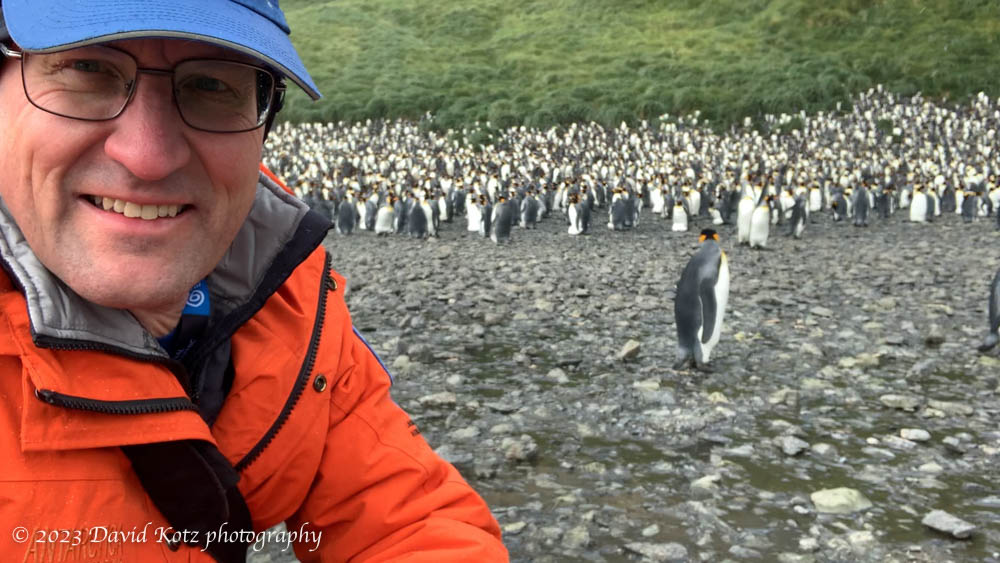
David with King Penguins – Salisbury Plain, South Georgia.
We quickly cleaned and donned our waterproof boots and pants and hopped into the Zodiacs for a trip to shore… this time to visit the vast glacial plains known as Salisbury Plain. Read on, and check out the gallery of photos and videos!
Our first opportunity to land on South Georgia was in Right Whale Bay, on the morning of 5 March. The stony beach was home to several thousand King Penguins and hundreds of fur seals. We were able to wander among the seals, across the grass, and around the edges of the penguin colony, slopping through the mud, penguin guano, and wet rocks. The weather threw us a bit of everything – drizzle, flurries, sleet, sunshine, and a stiff wind bursting downslope from the glaciers above. We were dressed warmly and the excitement of meeting penguins face to face – quite literally – made for an exciting morning. Read on and don’t miss the gallery of photos and videos!
An overview of our five-day visit to South Georgia Island.
Finally, on the 5th of March after two days at sea en route from the Falkland Islands, we approached the shores of South Georgia island just as the sun rose over its shoulder. Watch this brief video panorama as the ship approaches Right Whale Bay on the northern shore at the west end of the island.
Sunrise and first glimpse of South Georgia.
Where is South Georgia Island – and what makes it such a special place? Read on for an overview of our action-packed five-day visit to this incredible corner of Planet Earth.
I enjoyed photography in 2022 and decided to share my pick of favorites. It was not easy! 12 photos for 12 months – not one per month, but just the twelve that I felt were especially beautiful or interesting. See the full gallery – where I recommend clicking the “play” button to see them as a slideshow – and read on for some commentary about each one.
Several days without power, but with snowy beauty.
A large snowstorm passed through New Hampshire on Friday and Saturday. At our house, snow fell for about 26 hours. It was warm (33º), so the snow was wet and heavy, accumulating to a depth of 8″ … but I just know that higher elevations would have seen fluffier snow that got much deeper. Can’t wait for a chance to get out and hike some mountains!
Home, during a heavy, wet snowfall.
Snow on the solar tracker.
Unfortunately, the weight of all this snow caused many trees and branches to fall, blocking roads and knocking out power and Internet across the region. We are fortunate to have battery backup – which lasted for about 17 hours, fed in part by our solar tracker soaking up the post-storm sunshine. In turn, the batteries can be refilled by a propane generator. (The relationship between the two is complicated and buggy, but that’s another story.)
I took the opportunity to ramble around the backyard – local authorities asked everyone to stay off the roads unless necessary – and try to improve my ability to find interesting compositions and to expose properly for snow. Check out the gallery; at the end is a bonus: bald eagles spotted high in the trees during my afternoon walk, including a short video of two eagles taking off to fly across the river and greet a third bald eagle in the trees over there. (Apologies for the low-res iPhone photo and video… it’s all I had with me.)
I’ve been using a DLSR camera since 2008 and have been photographing in Raw since 2012, after I finally realized the benefits of camera-raw over jpeg. In 2012 I also started keeping my entire photo collection in Adobe Lightroom, allowing Lightroom to convert any Raw photos to DNG (‘digital negative’) files at the time of import. Why? Because I was convinced by books and bloggers that DNG is The Right Way to store images. Today, ten years later, I’ve changed my mind. In this post I explain why.
Photo galleries from our trip at the end of August.
Some of you will recall that in early September my father and I visited Katmai National Park on the southern coast of Alaska, as part of a Muench Photography Workshop focused on photographing the Coastal Brown Bears that feast on the annual salmon run along the southern coast. I wrote a summary of the trip – and posted a few teaser photos – shortly thereafter, but then became busy. Since then, I have struggled to find time to complete the work of selecting and editing a few photos out of the 8,000 shots I snapped during the trip. I finally finished. Read on!