
I’ve been enthralled by the story of explorer Ernest Shackleton and his ill-fated expedition to Antarctica ever since I read the incredible story in the book Endurance: Shackleton’s Incredible Voyage by Alfred Lansing. You can imagine, then, how exciting it was for me to be able to walk in his footsteps on the final leg of his incredible trek for survival in 1916. Read on!
This book chronicles the incredible story of Shackleton and his men in their Trans-Antarctic expedition of 1914-1917. Their ship, the Endurance, was beset by ice before they had a chance to reach land; frozen into the ice pack, they drifted for months and were forced to over-winter on the ice while their ship was slowly crushed. As the ice pack melted, they camped on ever-smaller ice floes until they were forced to put to sea in three wooden lifeboats. They eventually reached Elephant Island – a remote and desolate place with no hope of rescue. So Shackleton and five men set out in one boat, the James Caird, and sailed over 800 miles – across the roughest sea on the planet, through intense storms and with scant opportunities to fix their position – to South Georgia. (This journey is still considered one of the most incredible ocean-navigation feats of all time.) I had seen a replica of the Caird at Grytviken, just two days earlier. It’s difficult to imagine the hardship they endured!

The catch? they landed on the deserted western coast, but needed to get to one of the whaling stations on the east coast. Only then could they find people and resources who could rescue them – and the rest of the crew left waiting on Elephant Island. So, exhausted and starving, in tattered clothing, and with no knowledge of the interior (South Georgia had never been explored or mapped), Shackleton and two men (Frank Worsley and Thomas Crean) set out to cross the island on foot. They made the 26-mile trek to the whaling station in Stromness in 36 hours – a feat that rarely been repeated, even by professional, modern mountaineers, and never at such speed or in such desperate conditions.

By the middle of the night they had reached the eastern coast, but realized they were in the uninhabited Fortuna Bay – so they had yet to climb over a peninsula to reach Stromness. They struggled onward, once again climbing steep slopes. it was 20 May 1916, and winter was settling in fast.
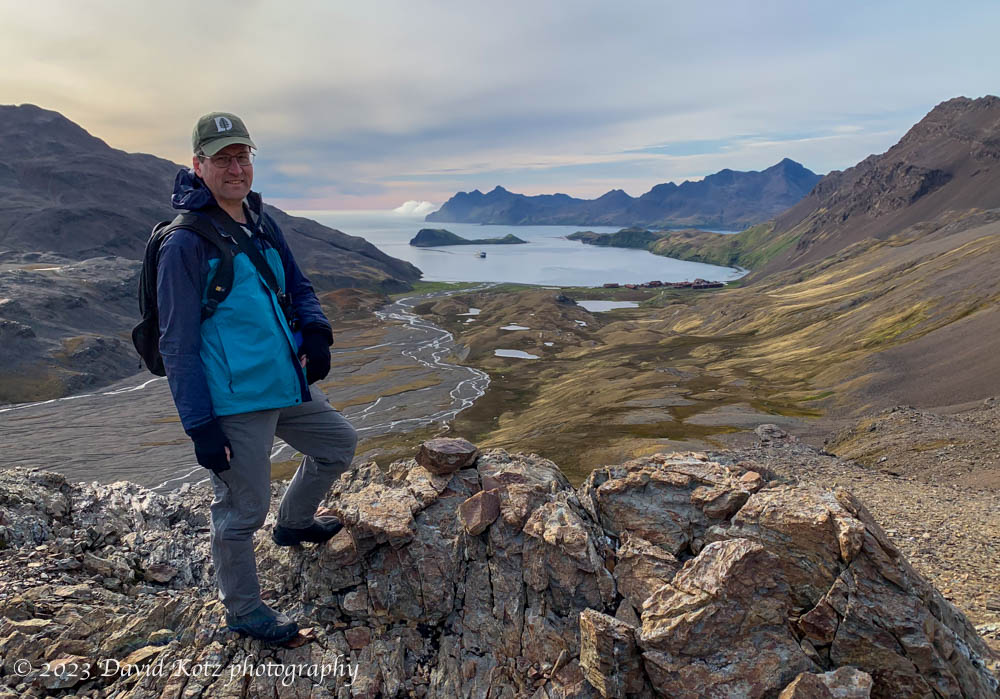
Here’s where we come in, nearly 107 years later. Early in the morning of 9 March 2023, we put ashore in Fortuna Bay – a spot now known as Worsley Beach – and trekked up the steep and boggy grass slope in the footsteps of Shackleton, Worsley, and Crean.

Soon we left the vegetation behind and were hiking on loose scree, although when Shackleton scrambled up this way, it was covered in winter snow.
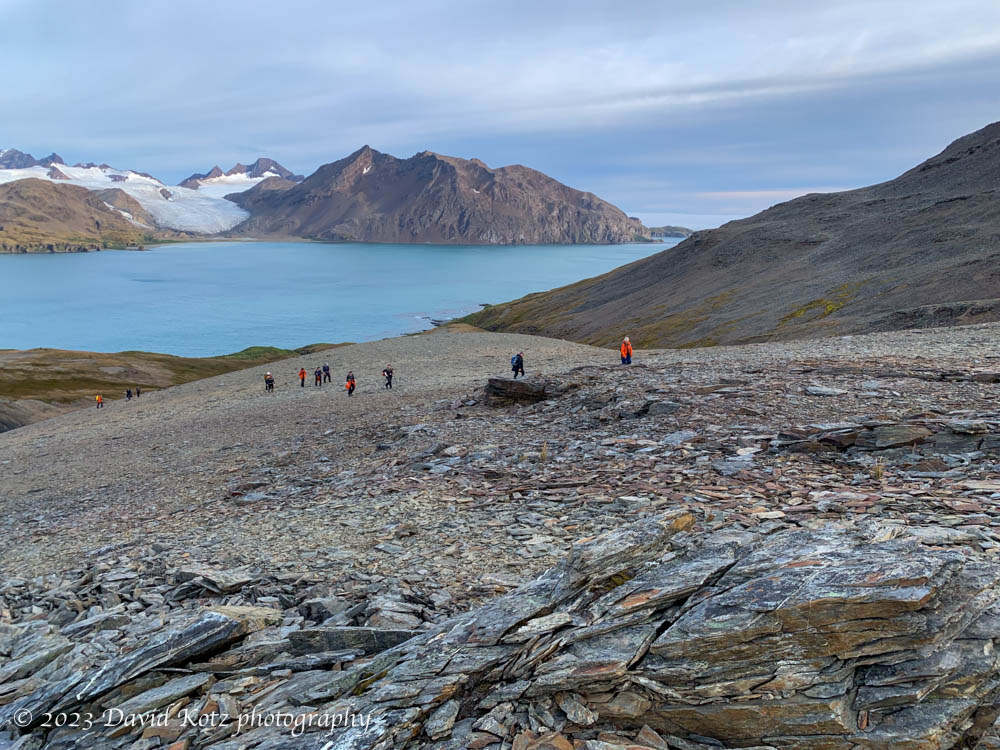
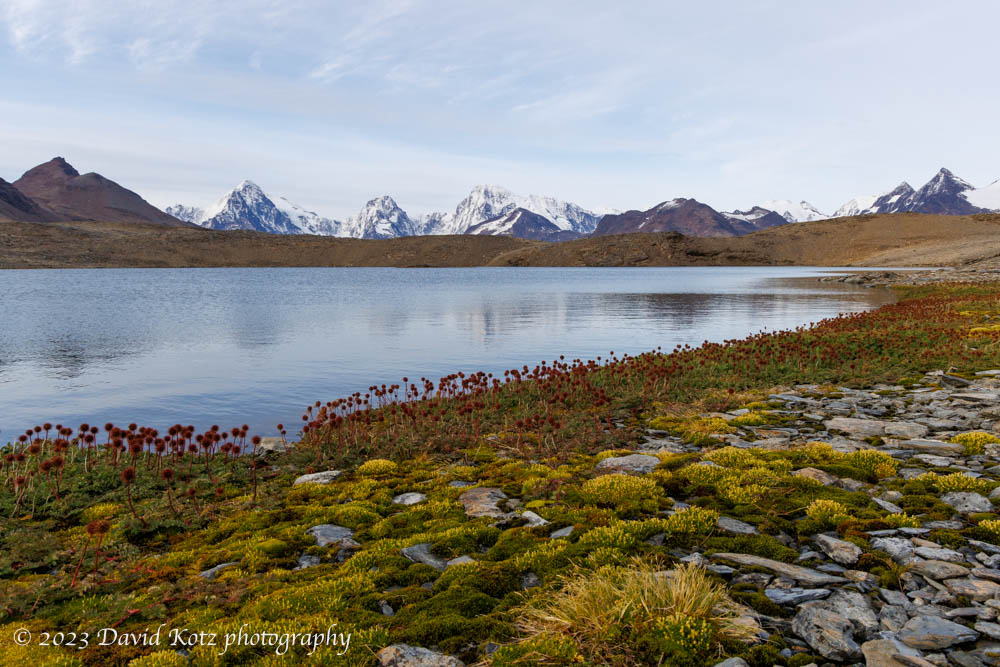
We reached the broad shoulder of this peninsula between Fortuna Bay and Stromness, where we carefully skirted a small lake now known as Crean Lake… after Thomas Crean, who in 1916 had dropped through the ice into waist-deep water; at the time they did not realize they were crossing a lake. Luckily, he ws pulled out and was able to keep moving. Today, the scenery here is beautiful!
Soon we had topped the ridge and dropped steeply down toward the flat glacial plain forming Stromness harbor. We paused to enjoy Shackleton Falls, which he had actually descended in order to avoid the steep, icy slopes surrounding it.

The final stretch was a boggy walk through flat terrain to the beach. More about Stromness in the next post; meanwhile, check out the gallery of photos and videos!


 David Kotz
One thought on “South Georgia – Shackleton”