
I’ve just completed an amazing ten-day visit to Svalbard, an Arctic archipelago far to the north of Norway. In a prior post from Longyearbyen (the only substantial town in Svalbard), I described the fascinating multi-national character of these islands located at 76-81ºN latitude, only 600 miles from the North Pole. I flew here for a week-long photography workshop with Muench Workshops, aboard the MS Virgo. In this post I’ll share an overview of the ship, our itinerary, and our activities. I’ve posted a photo gallery; the videos may give you a good sense of the incredible landscape, but I am saving the best shots for future posts focused on wildlife and landscape – I’m still sifting through over 12,000 raw images snapped over ten days!
Overview
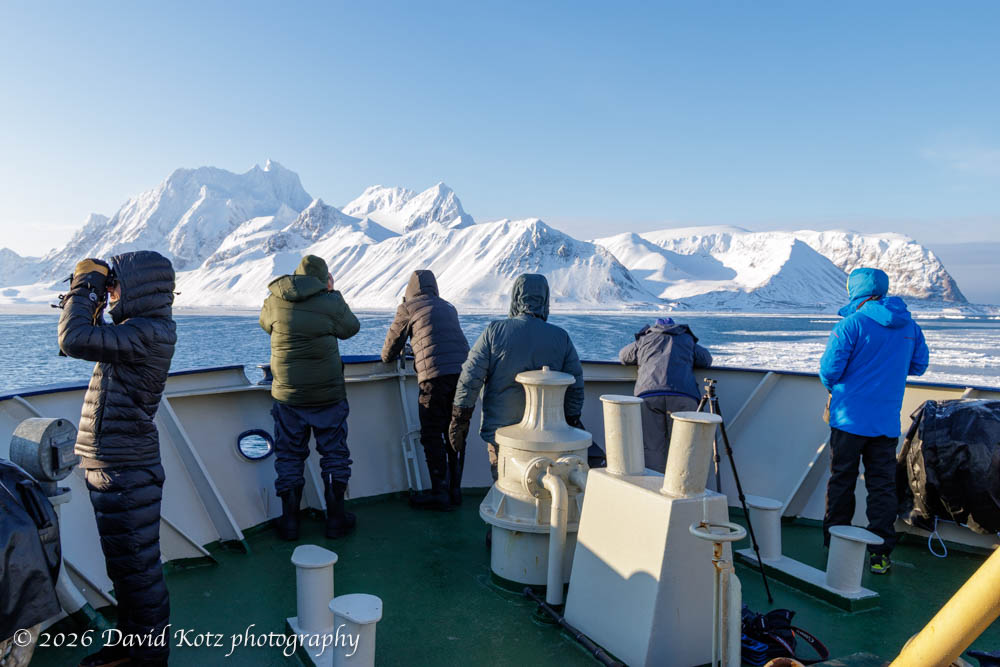
We were a group of eleven photographers, each here to enjoy the spectacular scenery, spot some of the unique wildlife, and learn to be a better photographer. We were led by two wonderful photographers, Talor Stone and Virgil Reglioni, who were kind and patient in helping us with everything from in-the-moment tips about composition or camera settings, to advice about post-processing. At slower times – like when cruising to a new location during the harsh midday sunlight – they offered mini-lectures and demonstrations about various techniques. Twice we shared our own images for an open critique session, which allowed all of us to learn from the photography of others and the expert wisdom of Talor and Virgil.
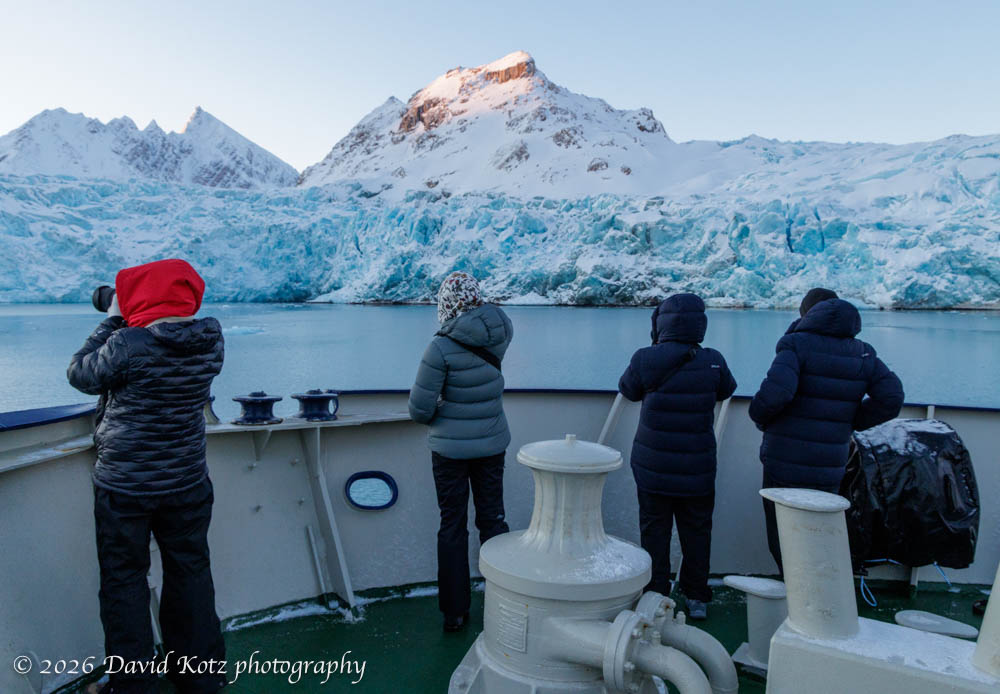
Smeerenburgfjorden, Svalbard.
We were also led by an experienced expedition team – Jonas Beyer and Anders Granström – who worked closely with the photo instructors and the ship’s crew to place the ship, and us, in the best possible location each day, given the ever-changing weather and ice conditions. They were skilled photographers themselves, and understood how to position the ship to offer the best angle for photographs. They were constantly scanning the ice and shoreline for wildlife, then adapting to whatever presented each day.
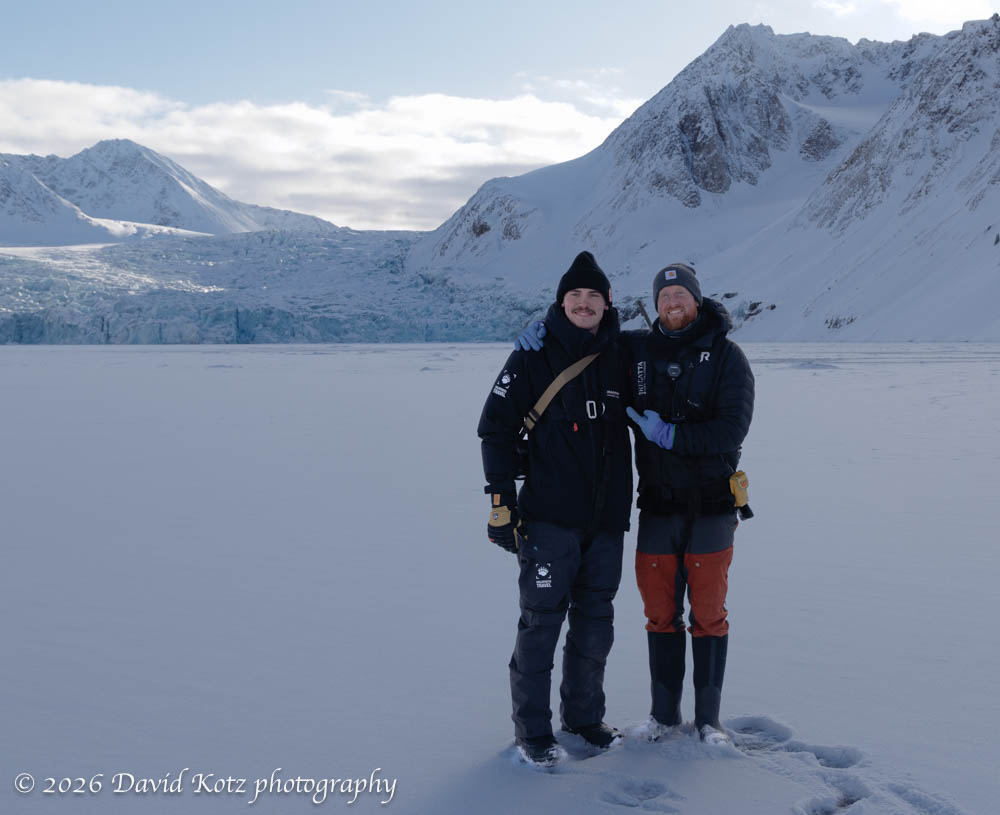
The ship’s crew – about a dozen – was led by a captain with decades of arctic experience. I was impressed by his ability to nudge the ship gently next to “fast ice” (ice attached to shore), to anchor the ship to the ice, and to respectfully approach wildlife like seals and walruses. And the chef created three hearty, tasty meals each day!
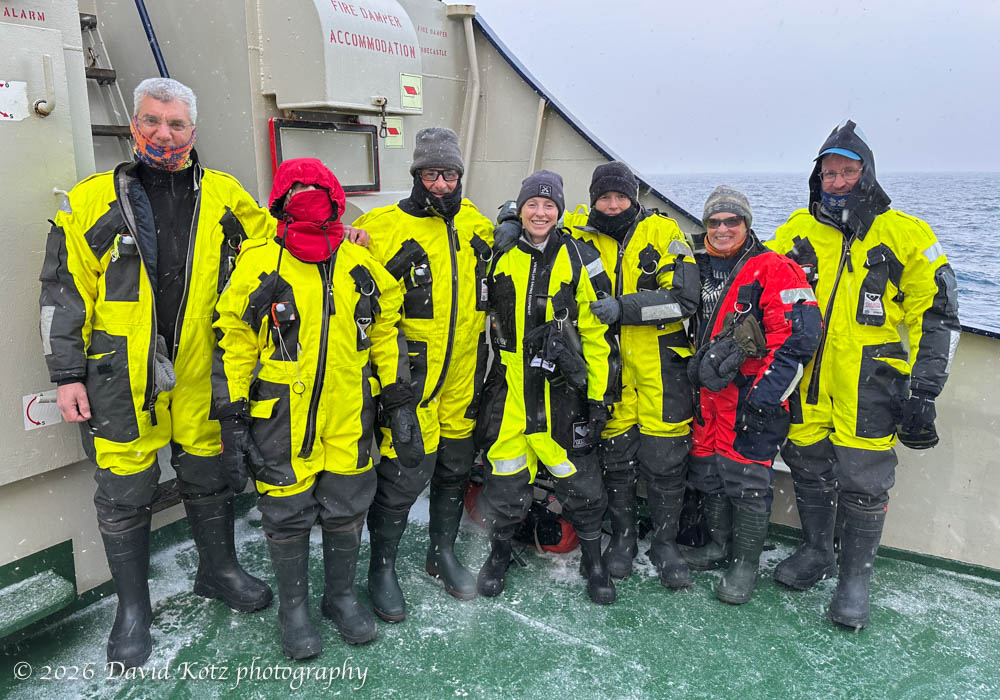
We got off the ship only twice – once, via Zodiac to visit the remote Moffen Island (about which I posted last weekend), to photography walrus during a snowstorm; then again a few days later, descending via ladder to walk on the ‘fast ice’ in Magdalene fjord under late-afternoon sunlight. The expedition team was always on the lookout for more opportunities, but only wanted to use the Zodiacs when there were specific goals (e.g., to watch wildlife on shore), because any Zodiac outing required substantial preparation, including donning special safety suits.
Wildlife
One of the major reasons people visit Svalbard, of course, is to see a polar bear in the wild. We were fortunate to see a polar bear on the first day (thanks to Anders!), albeit on the shore at a great distance across a vast area of fast ice. (Svalbard has strict rules for ships exploring its fjords and islands: one cannot break fast ice, because it is critical habitat for bear and seals and others; and one cannot approach polar bears closer than 500m.) When the polar bear lay down for a nap, we left to explore other shores and returned the next day. We anchored to the fast ice in hopes he might still be around. Indeed he was, and he walked out onto the ice where we could get a better view. (Photos to come!)
Over the course of the trip we encountered walrus many times. For our first sighting, a walrus startled me while I peered over the railing, emerging suddenly from deep below. She had a pup, and they bobbed and dodged around the boat, as curious about us as we were about them. We later saw walrus, or walrus pairs, napping on tiny ice floes. We were able to circle these with the ship, to photograph from many angles, while the walrus seemed to care less.
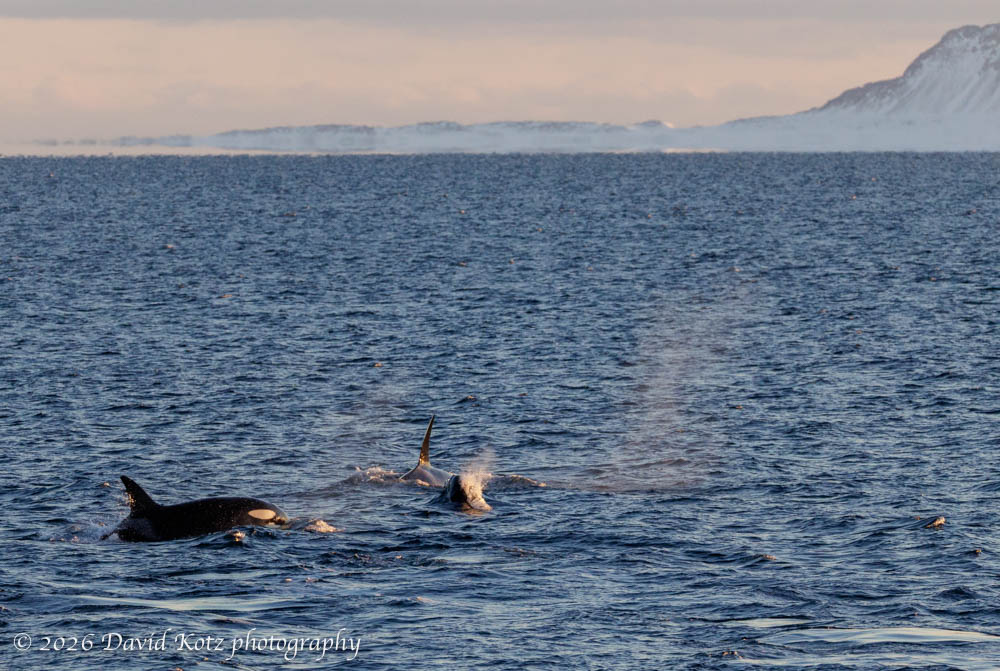
We didn’t see many birds – it is too early for most of the migratory birds to have returned – but we did see gulls, guillemots, fulmars and flocks of little auks. Several times, we spotted seals on the ice or in the water – harbor seals, ring seals, and bearded seals. Perhaps the most exciting sighting, though, was a pod of orcas (killer whales). The guides were flabbergasted: they’d heard rumors that the cousin of a friend of the sister of a colleague had maybe seen an orca in Svalbard once… and here we were watching half-dozen orcas dancing in the waves close to the ship, while our cameras (and drones) were filming the show.
On shore, in Longyearbyen, I had seen Svalbard reindeer and winter-white ptarmigan; at the end of the trip, we searched again for arctic fox and succeeded beyond our dreams. More to come… I’ll dedicate the next post to wildlife!
Weather
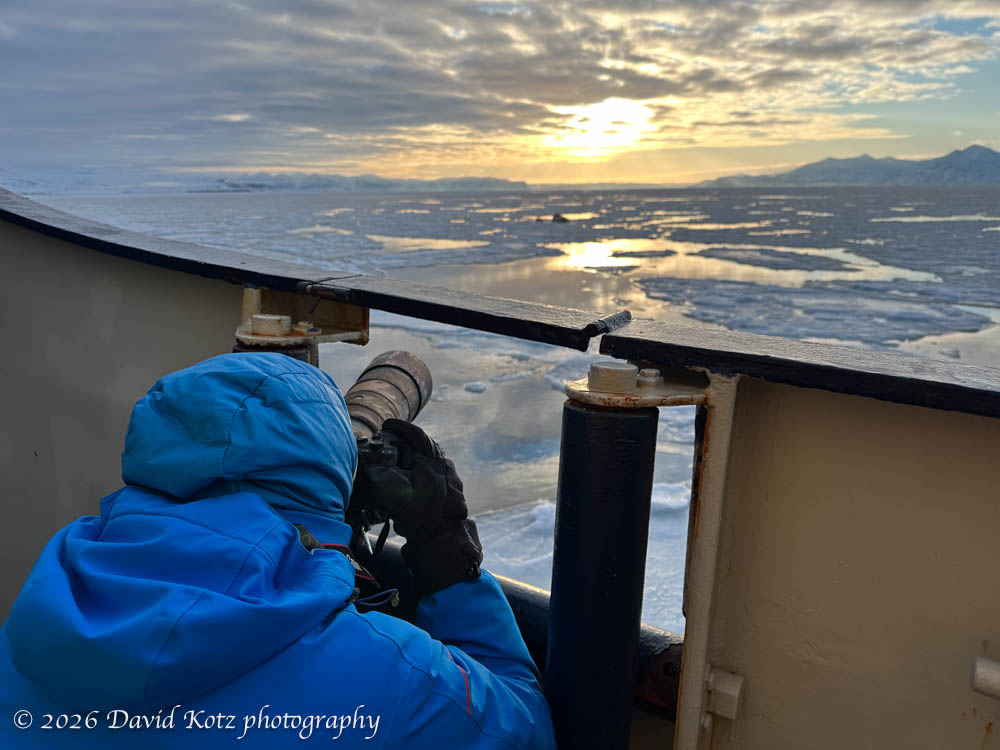
We had fantastic weather – often sunny, with the surrounding mountains only rarely obscured by clouds, with only brief snow flurries, and with moderate temperatures (I don’t think it ever fell below 0ºF… most mornings were in the single digits or even in the teens.) We were all well dressed for the cold. My challenge was fingers and toes; standing out on deck, in the wind, for an hour or more, wearing thin gloves and my finger on the shutter button waiting for a bear to move or for just the right light to hit a mountainside, led to many cold, cold fingers!
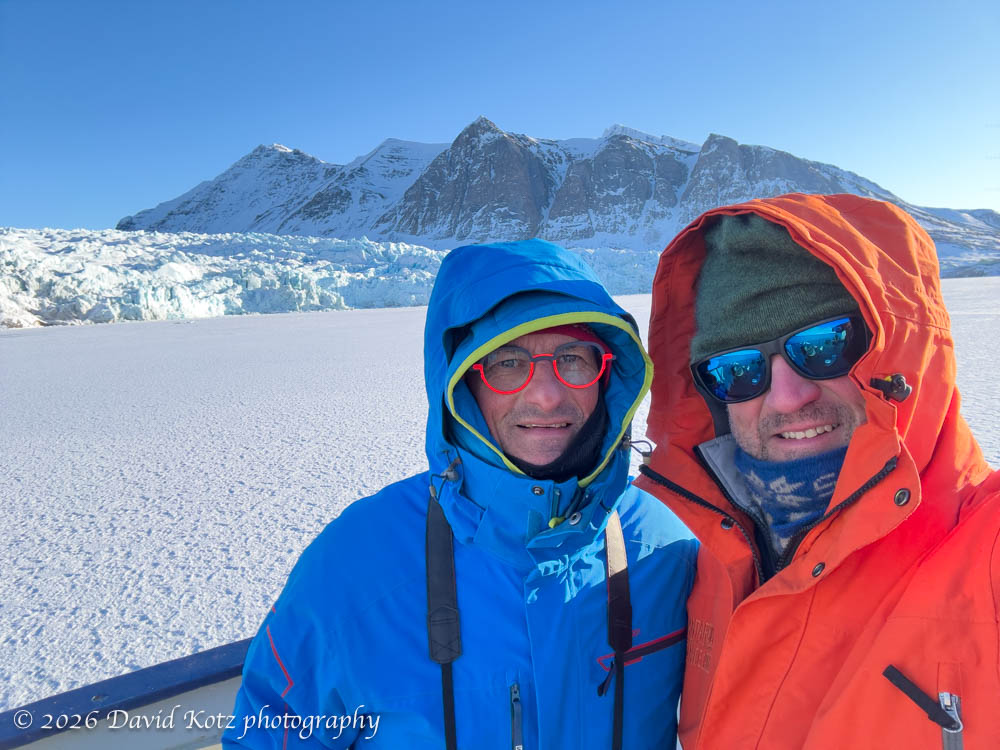
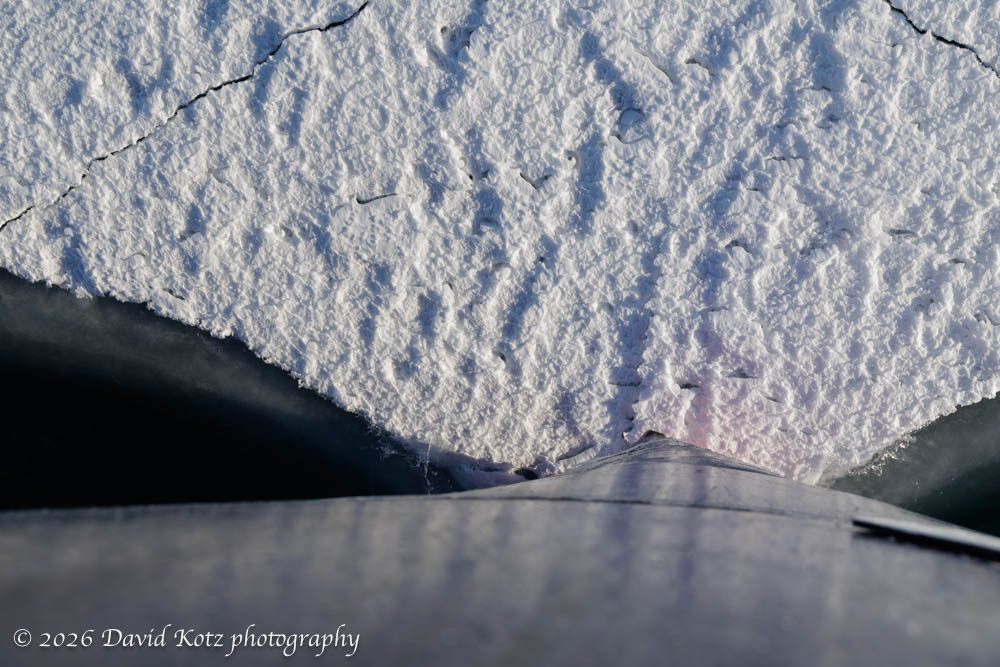
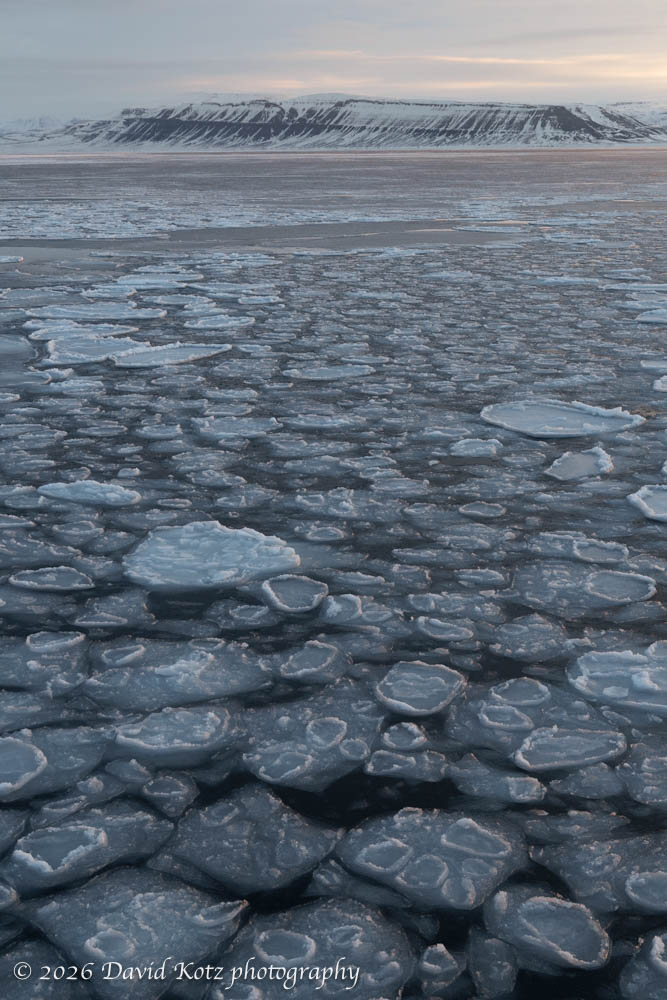
Indeed, some days were too sunny! Blue skies make boring skies, for photographers, and strong sunlight can make harsh shadows. Moody, cloudy skies are often better for photos, and partly cloudy conditions lead to pretty sunrise and sunset scenes. That said, the scenery was spectacular at every turn. I spent a lot of time on deck, just absorbing the surroundings. The ever-changing ice, like the ‘pancake ice’ below, lent drama to the landscape.
On the other hand, there was far less sea ice than there should be, this time of year, and even less than the guides expected. We needed to find “fast ice” – that is, broad areas of ice fastened to shore – if we had any real hope of finding polar bear. (Seals are their primary prey, so they need to be out on the ice where they can find seals. Due to climate change, some Svalbard bears are apparently learning to hunt reindeer.) Fast ice usually forms in sheltered fjords during the winter, including those we visited… but this year most of it had already broken up and gone (at least on the west coast).
Itinerary
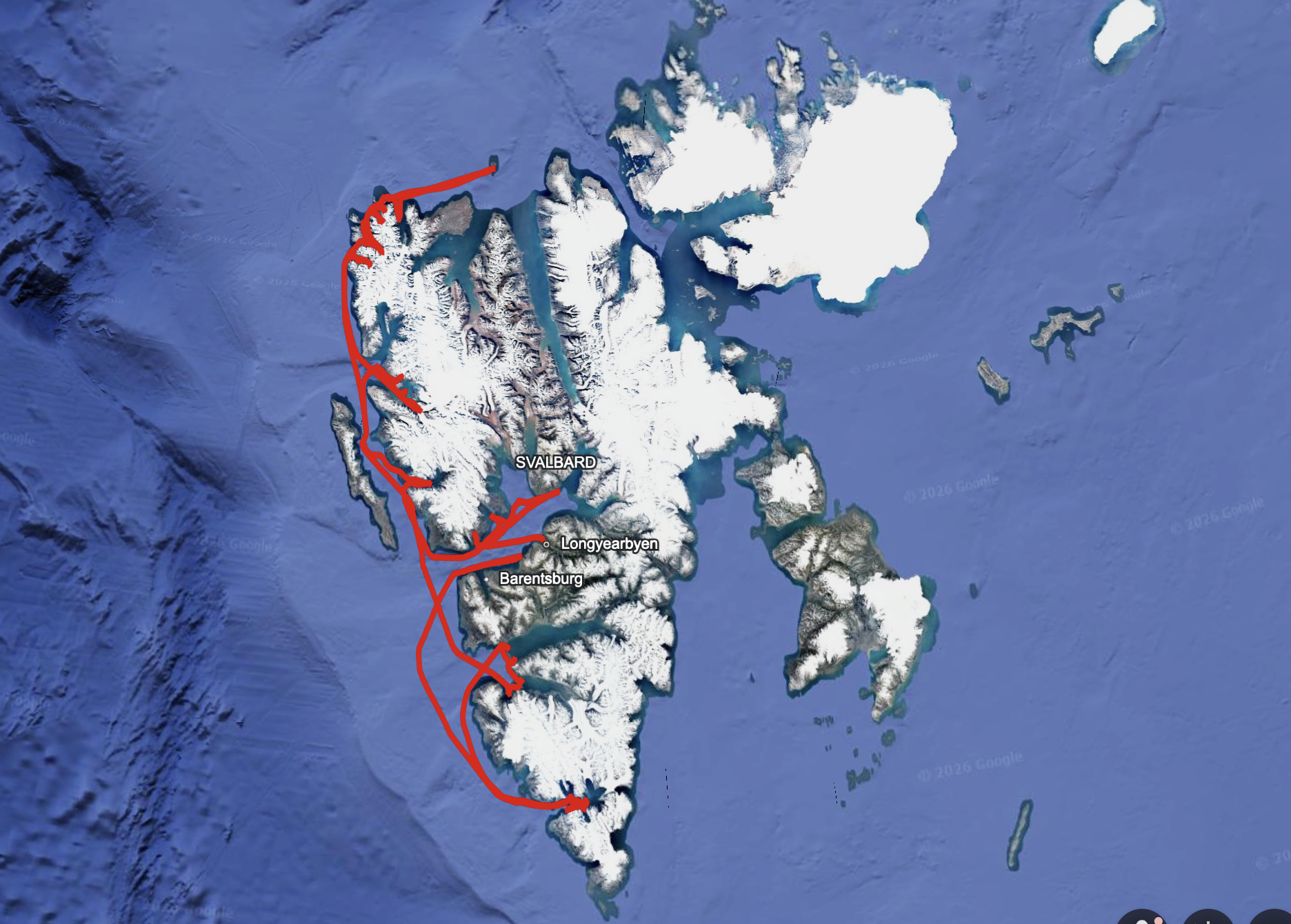
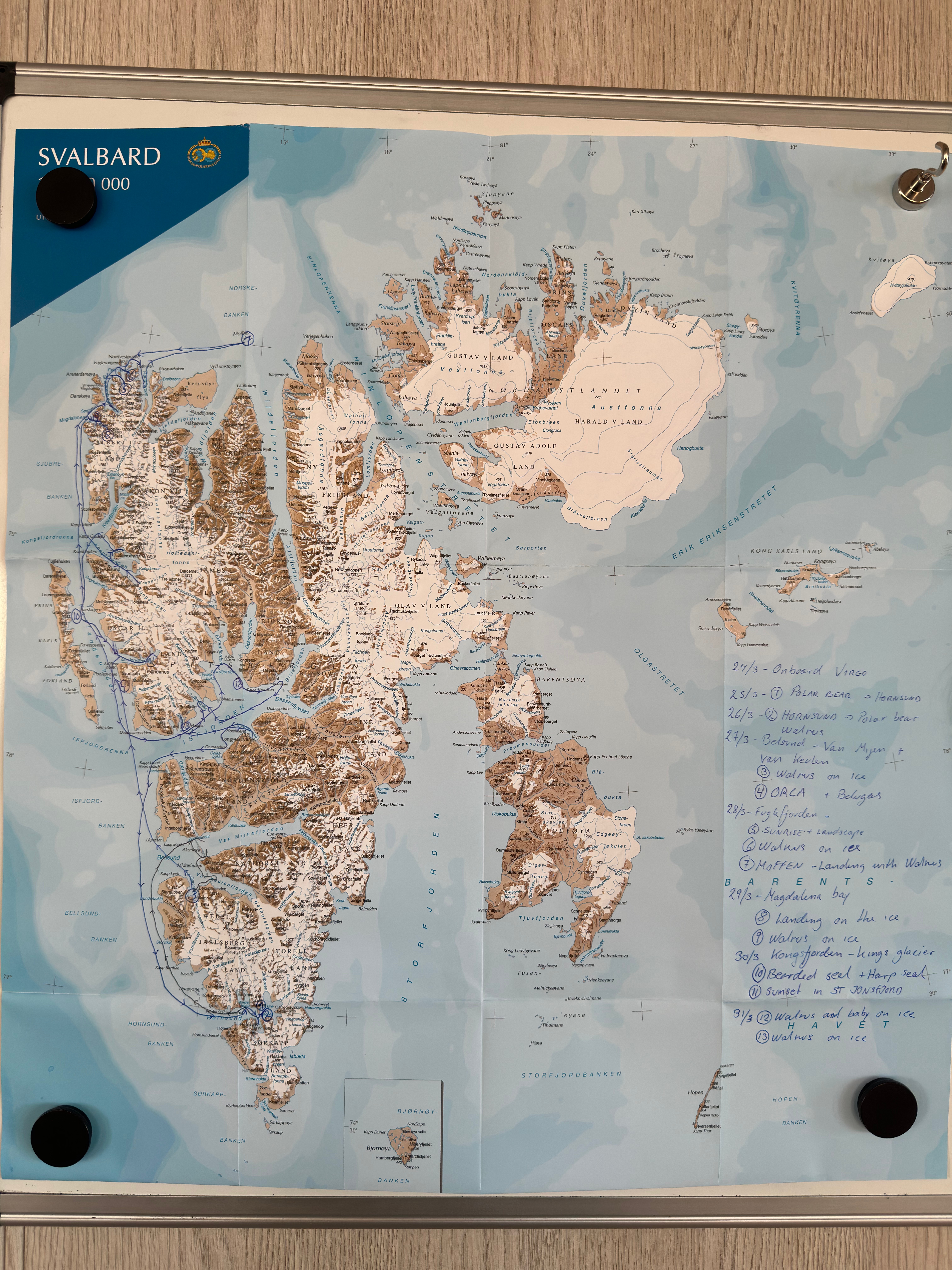
Our route and itinerary evolved day to day, as the leadership team monitored the weather and identified the best locations for wildlife, for photography, and for smooth overnight sailing. The eastern half of the archipelago is off-limits until summer, and the southeastern portion is apparently still locked in the winter icepack, so we sailed up and down the west coast, in and out of fjords.
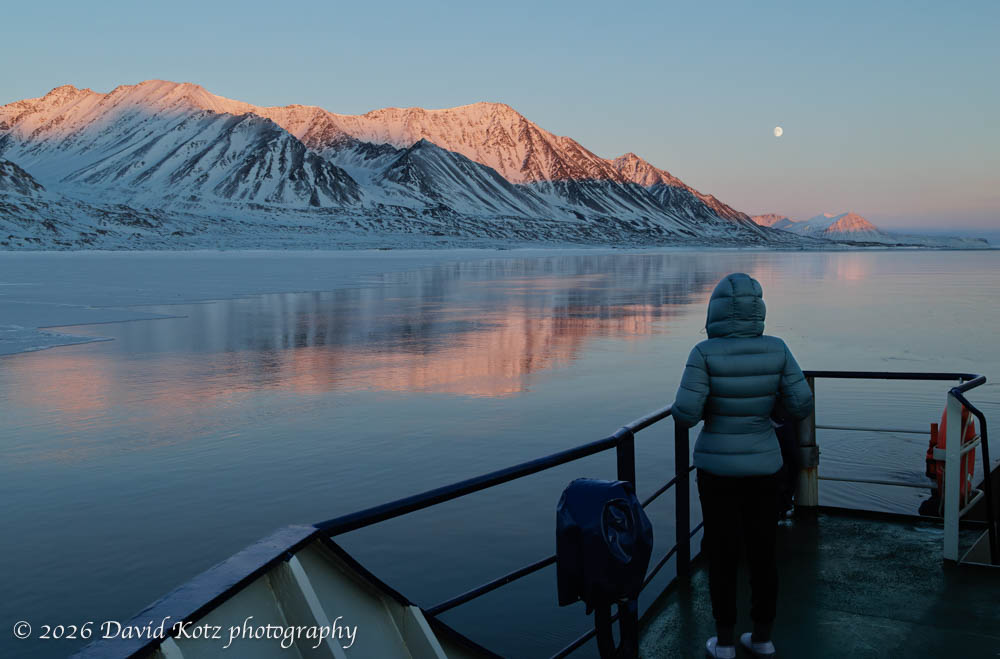
We gained at least 15 minutes of sunlight every day, as the sun raced from equinox (just three days before) toward the days of ‘midnight sun’ just three weeks hence. Because of the low-angle sunlight, and its shallow slope at sunset and sunrise, the “golden hour” light lasted three or four hours every morning, and three or four hours every evening – heaven for photographers!
- Tuesday 24 March -Longyearbyen
embark the MS Virgo (4pm) and transit southward.- sunrise 0520
- sunset 1851
- Wednesday 25 March – Hornsund fjord [track]
enter the fjord at sunrise, in fantastic light!- sunrise 0517
- sunset 1853
- Thursday 26 March – Hornsund fjord [track]
polar bear on ice; walrus mom + pup near the ship; great sunset light!- sunrise 0509
- sunset 1900
- -13ºC at sunrise
- Friday 27 March – Bellsund and transit north [track (with overnight gaps)]
walrus on ice; orcas!- Sunrise 0503
- Sunset 1915
- -14ºC at sunrise
- Saturday 28 March – Fair Haven to Moffen and back [track]
Morning snow flurries; Moffen island zodiac and walrus [post].- Sunrise 0450
- Sunset 1949
- -8.3ºC at sunrise
- Sunday 29 March – Smeerenburgfjorden, Magdalenefjorden [track]
arctic fox (far away); huge glacier; amazing light; walking on ice!- (switch to Daylight Savings Time)
- Sunrise 0545 (DST)
- Sunset 2100 (DST)
- -8.1ºC at sunrise
- Monday 30 March – Kongsfjord [track (with overnight gaps)]
photographing birds in flight; bearded sealsm ring seals; epic sunset!- Sunrise 0538 (DST)
- Sunset 2056 (DST)
- -13.3ºC at sunrise
- Tuesday 31 March – Nordfjorden and Isfjorden [track]
fulmars in flight; seals on ice; walrus on ice;- Sunrise 0525 (DST)
- Sunset 2053 (DST)
- -9.3ºC at sunrise
- Wednesday 01 April – disembark in Longyearbyen [track (belated start)]
photo workshop; amazing encounter with arctic fox!- Sunrise 0515 (DST)
- Sunset 2054 (DST)
- -6.3°C at sunrise
- Thursday 02 April –
fly home
All times GMT+1 (before DST) or GMT+2 (after DST transition).
All temperatures noted on the bridge, around sunrise ±1 hour.

 David Kotz