
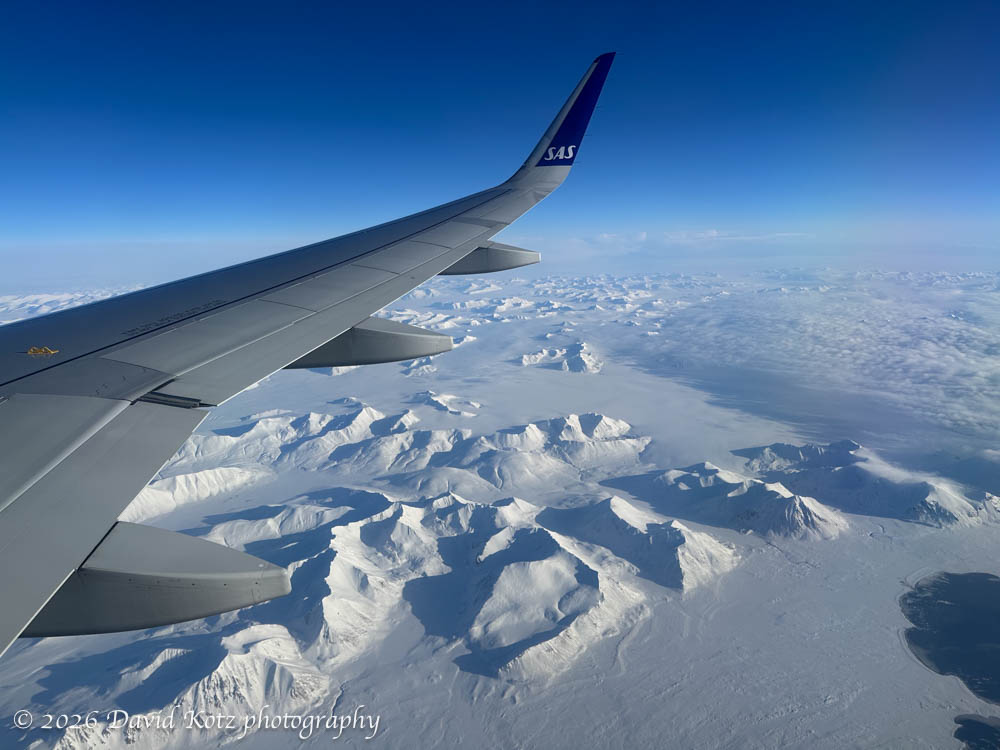
I’ve just concluded a 48-hour visit to Longyearbyen, the largest settlement in Svalbard, an archipelago far, far above the Arctic Circle. (Just to give you a sense how far north, the flight from Oslo (Norway) lasted over two hours.) The weather was fantastic and the flight delighted us with spectacular views of the snowy mountains and fjords as we descended along the west coast before landing just outside Longyearbyen.
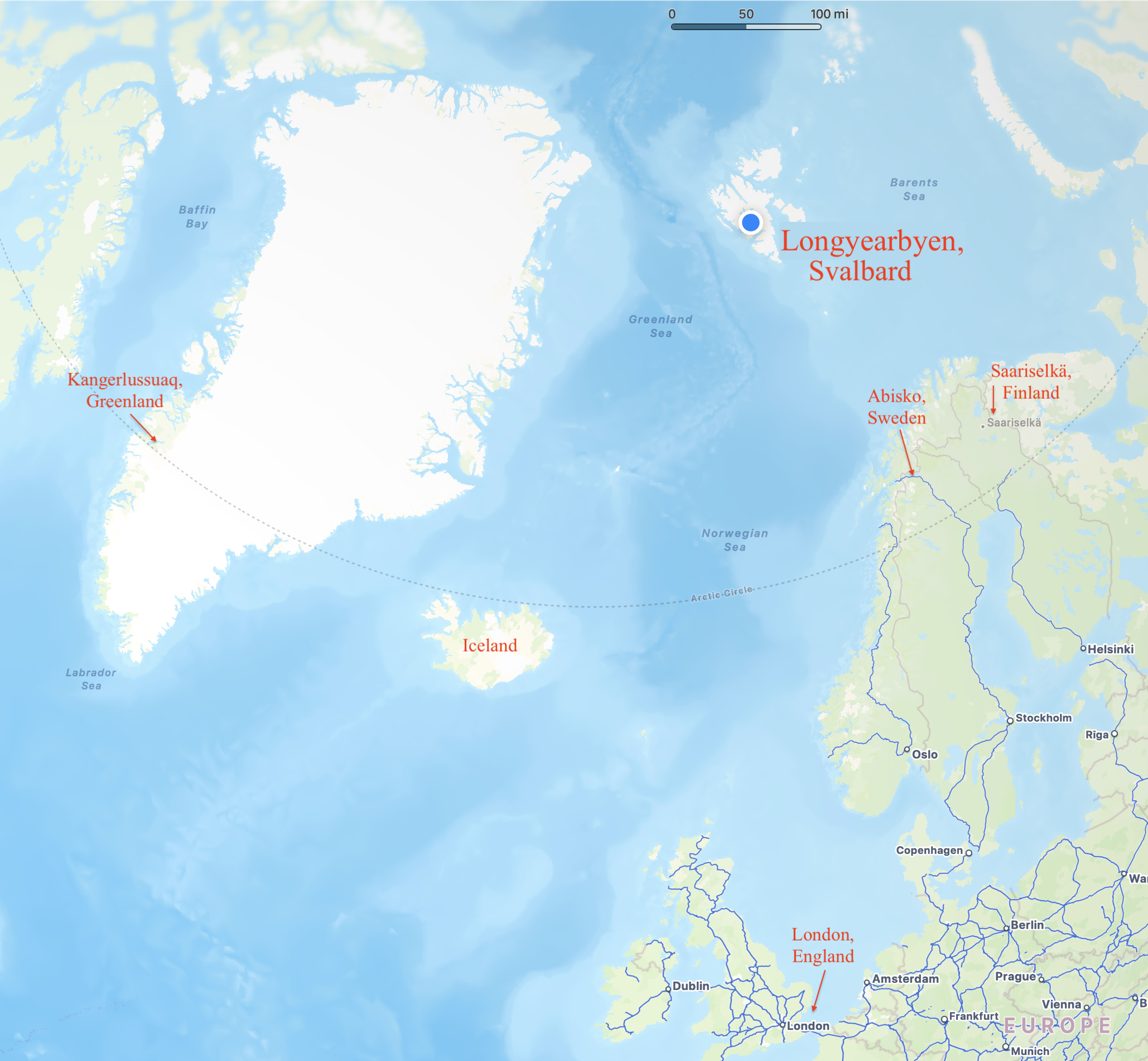
Although I’ve been north of the Arctic Circle before – in Abisko, Sweden in February 2020; in Saariselkä, Finland in March 2024; and in Kangerlussuaq, Greenland last August – Longyearbyen is by far my northernmost lifetime location, here at 78º13′ north. (For reference, our NH home is 43º47’N and our London home is 51º29’N.)
Svalbard is an interesting place! Let me share a few tidbits. Formerly known as Spitsbergen (a name meaning ‘pointy mountains’ given by Dutch explorers), Svalbard is now the name of the archipelago and Spitsbergen is the name of its largest island. Although Norway has had sovereignty since the Svalbard Treaty in 1925, the archipelago is outside of the Schengen Area, the Nordic Passport Union, and the European Economic Area… indeed, it is unique in being a visa-free territory: no visa is required to visit, reside, or work here. All goods are sold tax-free. It is the world’s northernmost permanent settlement of more than 1,000 people; it is also home to the northernmost K-12 school and the northernmost university. Sixty percent of the land is covered by glaciers and two-thirds of the land is preserved as national parks. It is critical habitat for polar bears, seals, and walrus, and breeding ground for migrating seabirds.
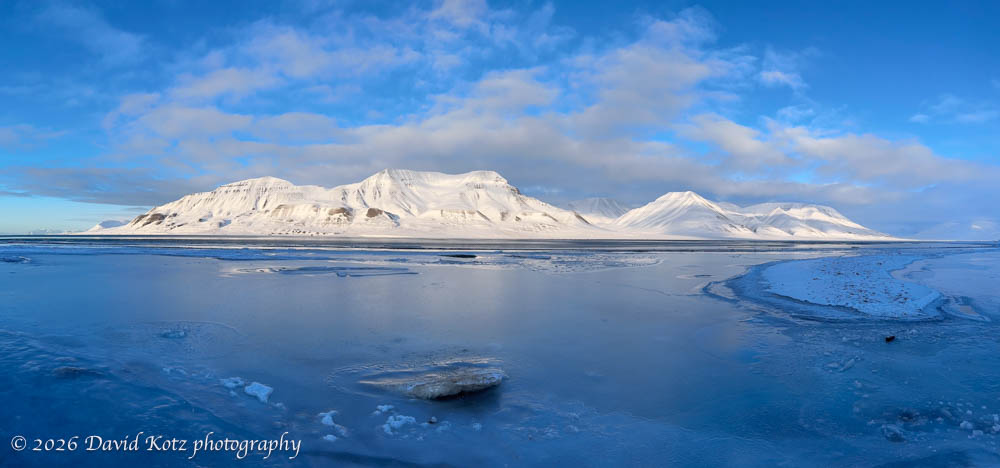
On my first afternoon, I wandered a few blocks down to the shoreline, and along the shore where the harbor ice meets the rocky beach. The mountains on the opposite side of the fjord (above) were brilliant white in the afternoon sun. Take a look around in this 300º panoramic video from the shoreline, beginning with a view across the fjord and behind to the town of Longyearbyen.
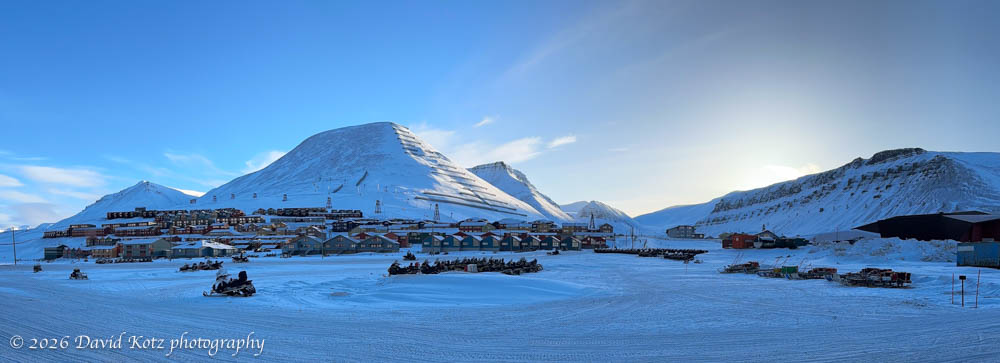
Longyearbyen is the largest settlement on the archipelago; the current population includes over 1,600 people from 50 countries. Although founded as a mining town by an American businessman (John Longyear) in 1906, coal mining ended here last year. Indeed, some former coal mines have been repurposed as safe storage for seeds and for data. These mines, deep under permafrost in a remote island archipelago that is geologically stable and officially a demilitarized region open to all nations, were deemed perfect for archiving the world’s genetic and information heritage. The Svalbard Global Seed Vault is perhaps most famous, but today I learned about the Arctic World Archive that archives digital content in physical form on film designed to last 1,000 years. Indeed, the GitHub Archive stashes a copy of all public repositories here.
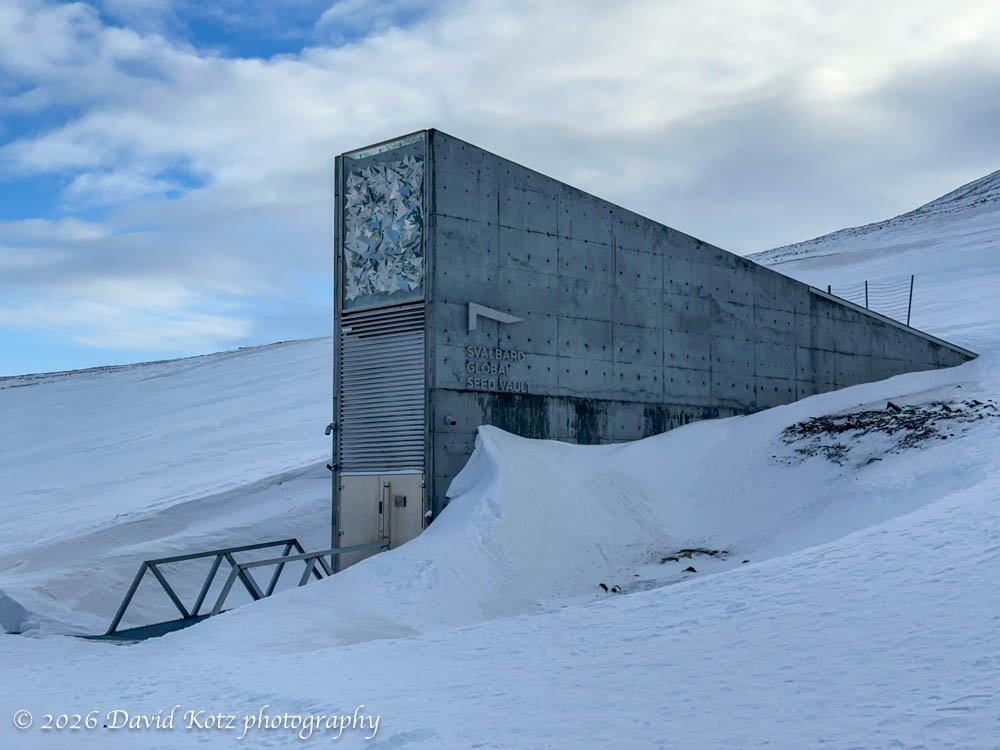
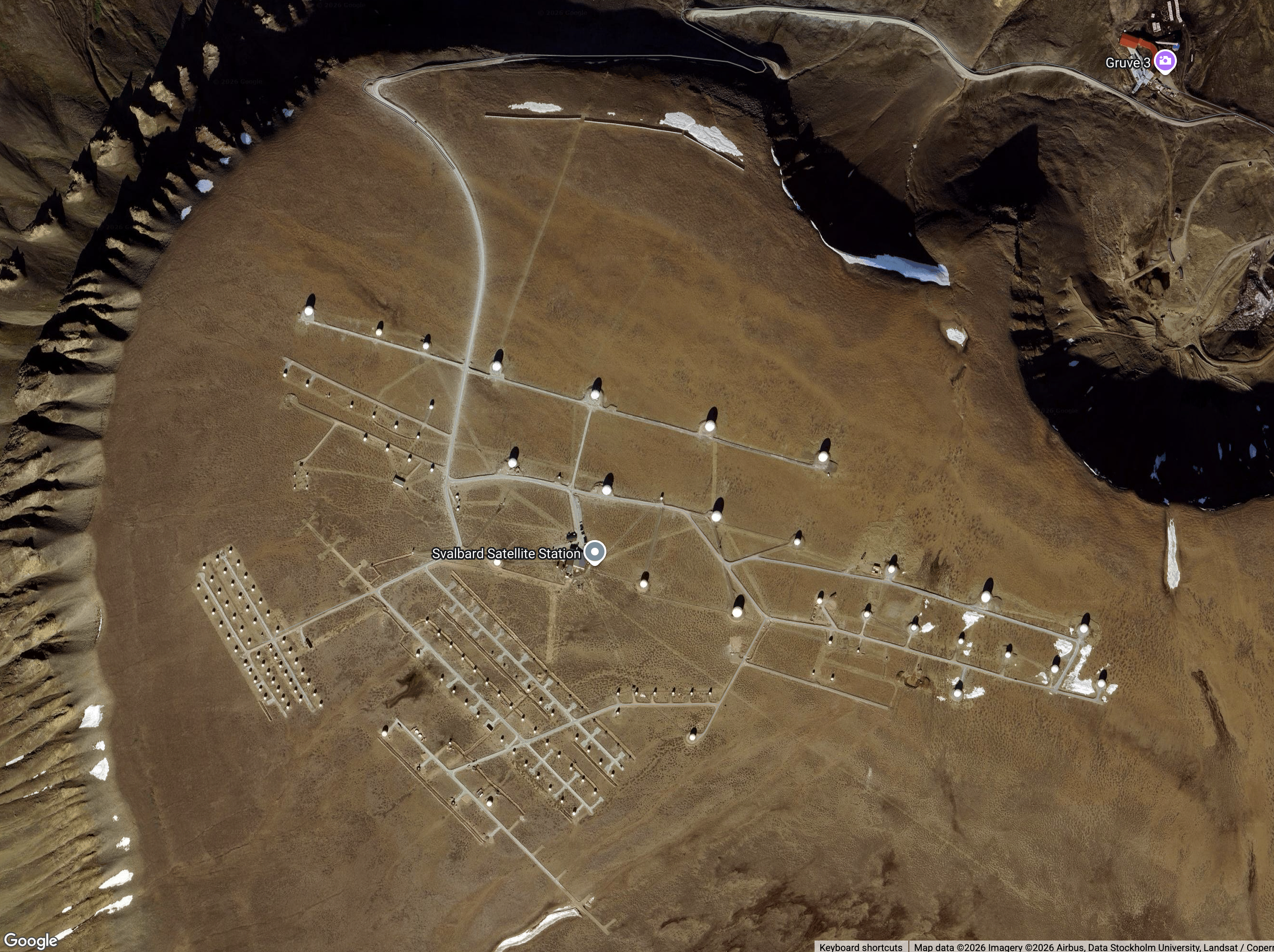
No longer a mining town, Longyearbyen now makes its living as a hub for tourism and scientific research. Indeed, dozens of nations have scientific centers located here. (Yesterday I saw a group of university students trekking into the wilderness, pulling sleds of scientific equipment to study reindeer.) On the plateau above the seed vault is the massive Svalbard Satellite Station with more than a hundred dishes allowing contact with polar-orbiting and geostationary satellites. This, and a similar facility in Antarctica, are the “only ground stations that can see a low altitude polar orbiting satellite (e.g., in Sun-synchronous orbit) on every revolution as the Earth rotates.” Dozens of organizations (including, for example, NASA and NOAA) share access to this site, whose uses are limited to non-military activities. There is no public access, but Google Maps (image below) gives you an impression of the extent of this facility. (The Global Seed Vault is at the pin in the upper-right.)
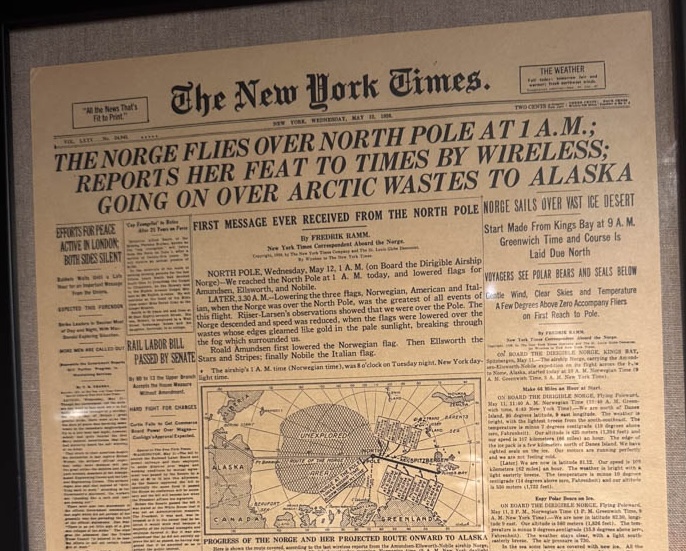
The open, multi-national atmosphere here is refreshing! As I strolled further, I learned more about the importance of this island to science and exploration. Around 1900 it was often used as a base for expeditions hoping to reach the North Pole. I spent an interesting hour exploring the tiny-but-informative and well-designed North Pole Exploration Museum. I had never known there were so many attempts to reach the pole using dirigibles, resulting in the “first consistent, verified, and scientifically convincing attainment of the Pole” on May 12, 1926 [Wikipedia].
On the other hand, I noted strains in this multi-national atmosphere. Other than a few remote research stations, there are only two other settlements in Svalbard, both located in the same fjord as Longyearbyen: Barentsburg and Pyramiden. Both are company towns, founded (and still operated by) mining companies based in Russia. Although the three towns have long had a warm relationship, and I’ve spoken with tourists today who had enjoyed visiting those towns in the past, I heard from a local guide that the people in Longyearbyen stopped associating with people in Barentsburg and Pyramiden when Russia invaded Ukraine. (Gone is the annual indoor football tournament!) The Svalbard tourism board explained its position in a statement.
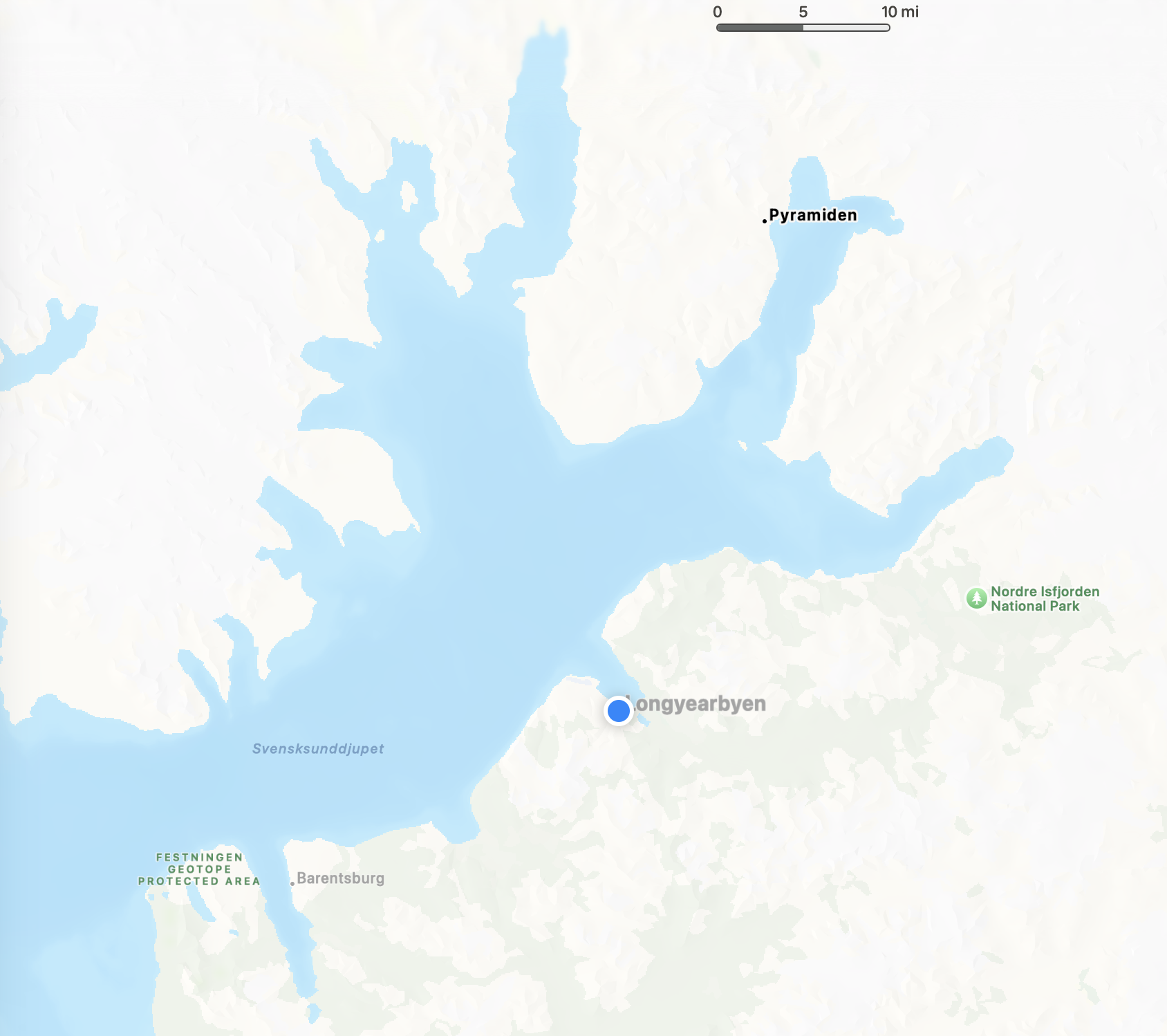
The open sea is at left.
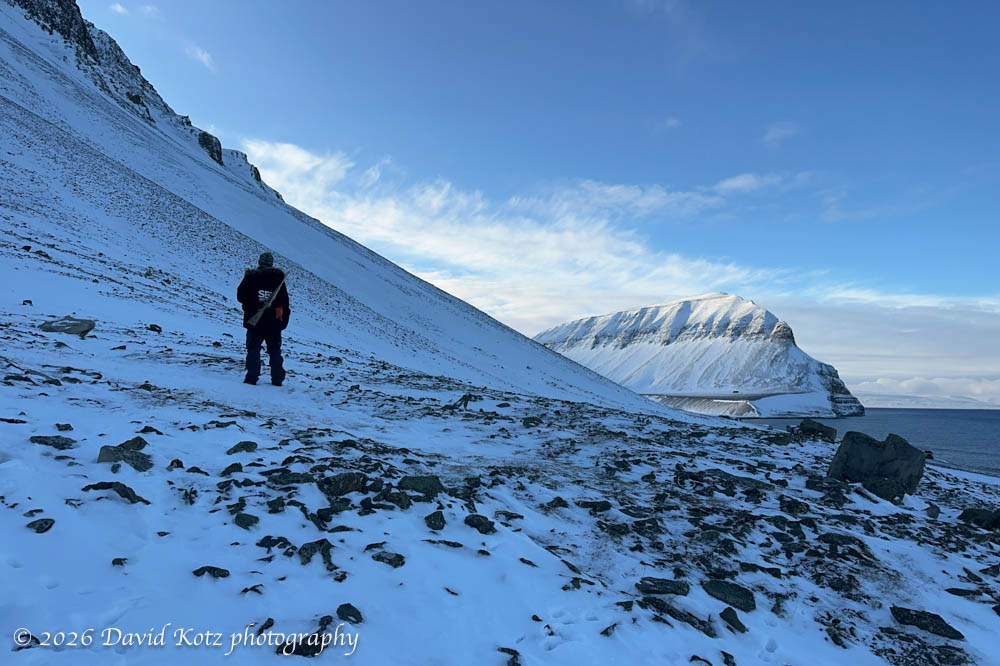
Yesterday, I spent the morning with a small group and a guide on a short hike outside Longyearbyen, with the aim of seeing some local wildlife. Iver, a local man whose family has been leading such tours for a decade, was especially eager to find an Arctic fox, and he took us to his favorite location in a sparsely-populated valley to the west of Longyearbyen. We hiked along the gravel road – now covered in ice and snow and passable only by snowmobiles – scanning the rocky cliffs to our left and the stony shoreline to our right. Although fox tracks and reindeer scat were plentiful, we encountered no wildlife. (Iver carried a rifle, just in case we encountered a polar bear that was not open to polite negotiation.) The scenery was nonetheless spectacular!
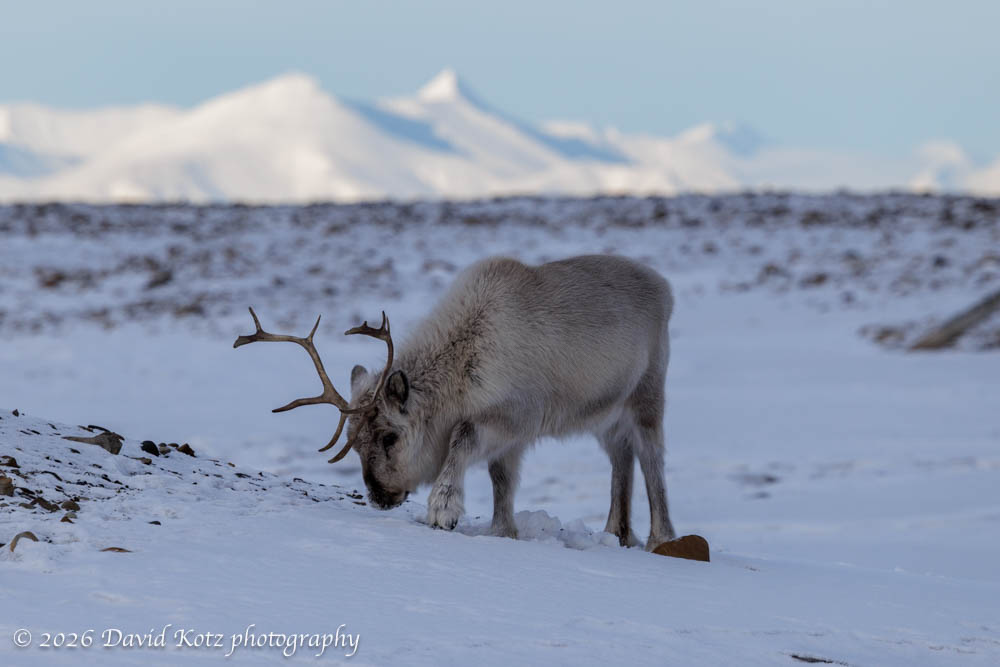
On the drive back we encountered a group of four reindeer, which are common and indeed often seen wandering through town. (All reindeer on Svalbard are wild, a distinct subspecies from those on the mainland, where most are raised in farms.) The two females and two males pawed at the snow to expose grass and lichen to eat [video]. Fun fact: in winter, only females have antlers (so they can chase away males in competition for food); in summer and fall, only males have antlers (so they can fight among themselves). They have no natural predators, but food is so scarce that starvation keeps the population in check.
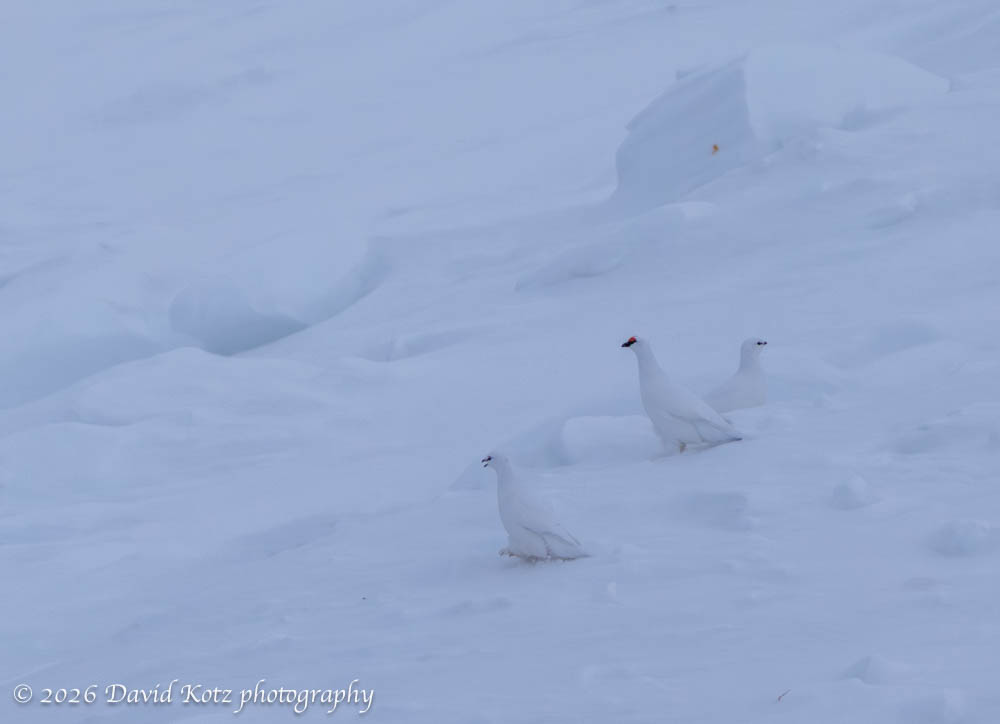
Before breakfast this morning I walked up the valley to the end of the road, past the last house. Iver had suggested this location as a place where Arctic fox are sometimes seen, and (because it is within the settled part of town) one can walk there without polar-bear protection. It was quite cold (–7ºC when I left the hotel) but the air was calm and the sun was beginning to shine on distant mountaintops. I met another photographer and we teamed up to scan the rocky terrain for motion – most Arctic fox are white, during winter, and thus impossible to spot when they are stationary against a snowy background. We neither saw nor heard any fox, but a female ptarmigan perched on a nearby rooftop, offering to pose for photographs. Minutes later, hearing their call, we watched a male ptarmigan seeking attention from two females. He tried one, then the other, before giving up and flying off. Despite zooming to the limit of my 800mm lens, I had to crop tight to see the action. This subspecies of ptarmigan is one of the few birds to live year-round in Svalbard, and is nearly all-white in winter. They are even hard to see in the photo below! They have large, furry feet that allow them to walk atop the powdery snow.
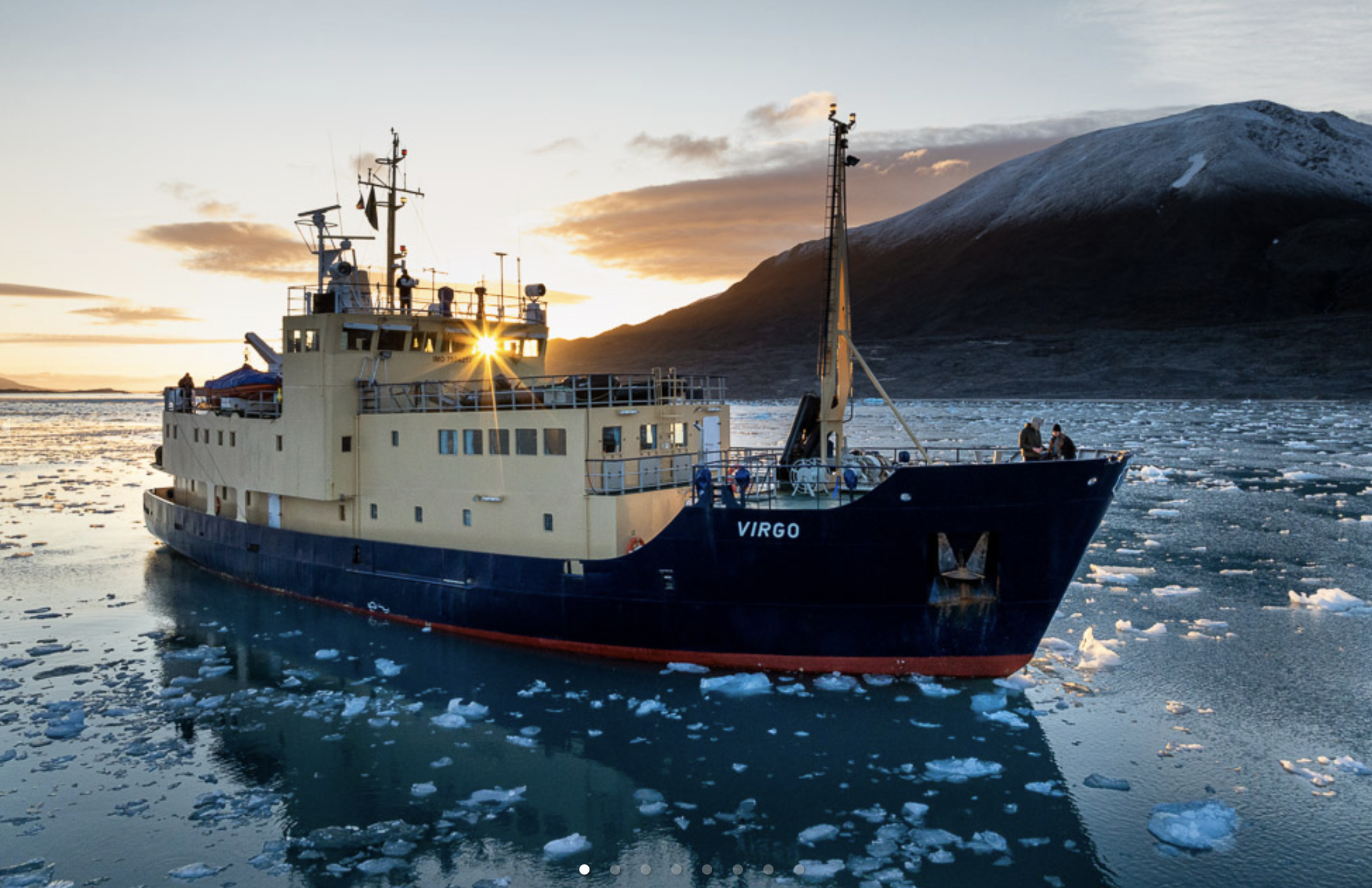
Anyway, why I am here? for a week-long photography workshop with Muench Workshops. (Regular readers will recall my prior trips with Muench in the Blue Ridge Mountains (2025) and the Katmai Peninsula (2022)). On this trip, we’ll be cruising aboard a small Arctic vessel so we can explore the fjords of the Svalbard archipelago, looking for polar bears, seals, walrus, and stunning landscapes. This afternoon we board the MS Virgo, shown below. I’m looking forward to it!
As photographers, we’re always looking for great light. With the spring equinox just three days ago, the days are getting longer, fast… from 12 hours of day and 12 hours of night (equal-night, equinox, get it?) four days ago to 10.5 hours of night tonight. (Longyearbyen is gaining 15 minutes of daylight, every day, so there will be two hours more daylight when we disembark eight days from now!) Here’s the key, though: because the setting sun never goes far below the horizon, twilight lasts for hours after sunset and begins hours before sunrise, leading to incredible opportunities for blue-hour photography.
Be sure to check the gallery for more photos from Longyearbyen. I’ll get back to you in a couple of weeks with more stories and lots of photos! For now, I’ll leave you with a sense of the scale of Svalbard.

 David Kotz
Ohhhhhh – I’m so envious! But thank you for bringing us along on this latest adventure.