
When offered the opportunity to serve as the faculty host for a Dartmouth Alumni Travel group tour of Yellowstone and Grand Teton National Parks, in mid-winter – highlighting the opportunity to observe wolves and other wildlife in these majestic national parks in mid-winter – I jumped at the chance. This trip, billed as the Wolves of Yellowstone, was operated in partnership with Orbridge Travel and led by two fantastic guides from Wildlife Expeditions, a unit of the non-profit Teton Science School in Jackson, Wyoming.
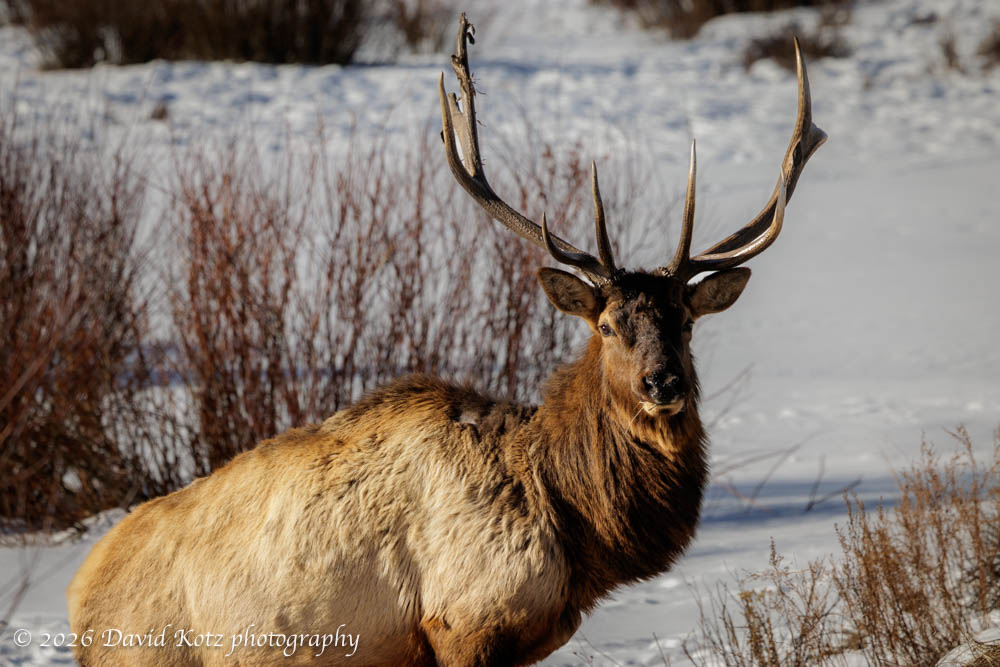
The resulting trip was an outstanding opportunity to see some of the nation’s most spectacular scenery, up close to incredible wildlife, during a season when there are few other tourists. We were able to see, from the roadside, herds of elk, pronghorn antelope, and bison. We watched bighorn sheep navigate treacherous cliffs. We paused while moose browsed young willow in the frozen wetlands. We spotted wolves around a carcass, albeit at a great distance. We learned about the indigenous cultures who lived on this land, and saw evidence of their ancient hunting camps. And we marveled at the steaming hot springs while massive geysers spit superheated water high into the frigid winter air. I snapped over 3,500 photos, so let me see if I can summarize and share just a few of my favorites.
After meeting in Bozeman, Montana – where I’d spent two days visiting a friend to do a little hiking and exploring – we drove southeast to the gateway town of Gardiner, Montana. Yellowstone National Park, which the U.S. National Park Service notes is the world’s first national park, is a massive expanse of land in the northwest corner of Wyoming, overlapping slightly into the northeast corner of Idaho and the southern edge of Montana. We spent two nights in Gardiner, and one night at Old Faithful hotel in the center of the park, exploring the roads by van and snow-coach. It felt like a safari, as our focus was primarily on spotting wildlife, though we also had several opportunities to explore the hot springs, mud pots, and geysers at Mammoth, Old Faithful, and West Thumb. In the map below, Yellowstone is a rectangle shaded in light green (nestled in the darker green forests that surround it), and I’ve labeled the colored tracks for each of our visit days.
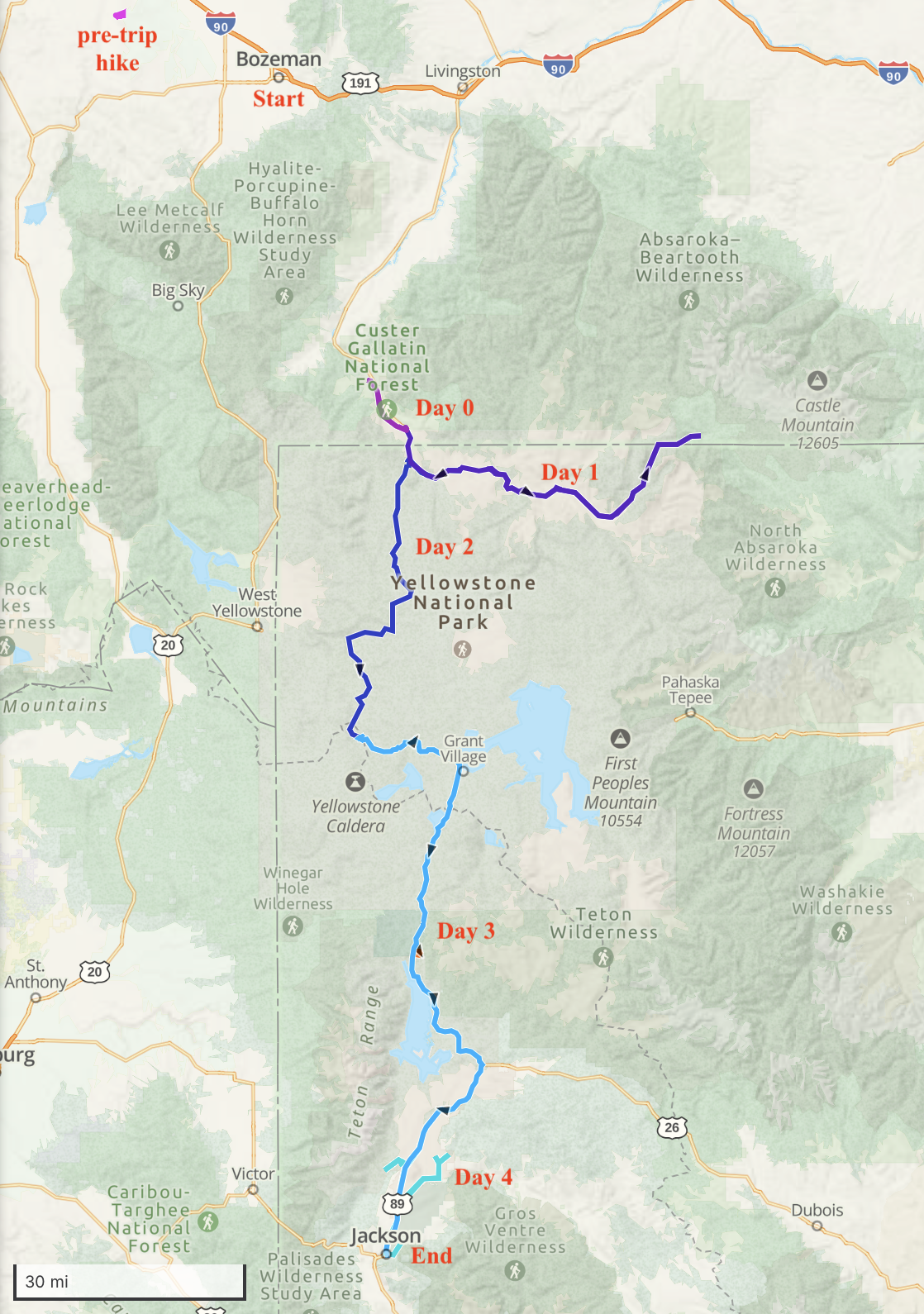
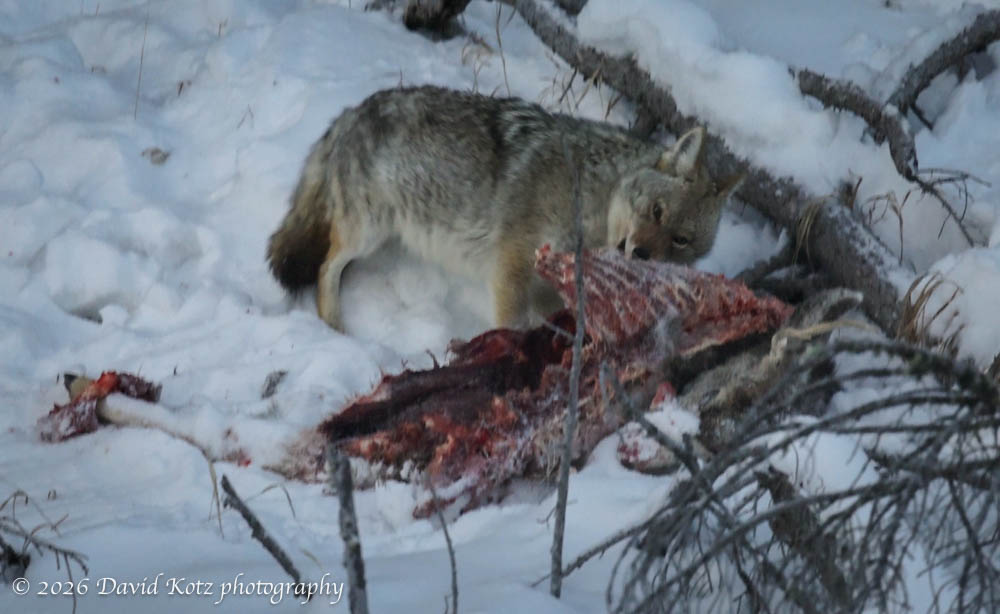
In our first few days (Days 0,1,2) we explored from Gardiner, inside and outside the park boundaries. We encountered several herds of pronghorn antelope, elk, and bison. We were so excited that we lingered at each our first sightings; by the end of the trip, we’d roll right by. (“Oh, another herd of bison, how nice.”) On Day 1 we were especially fortunate to come across a coyote, dining on the carcass of a mule deer alongside the road. (Although it may seem a bit morbid, animal carcasses offer the best opportunity to see scavengers and carnivores, who may otherwise be roaming far from the road.)
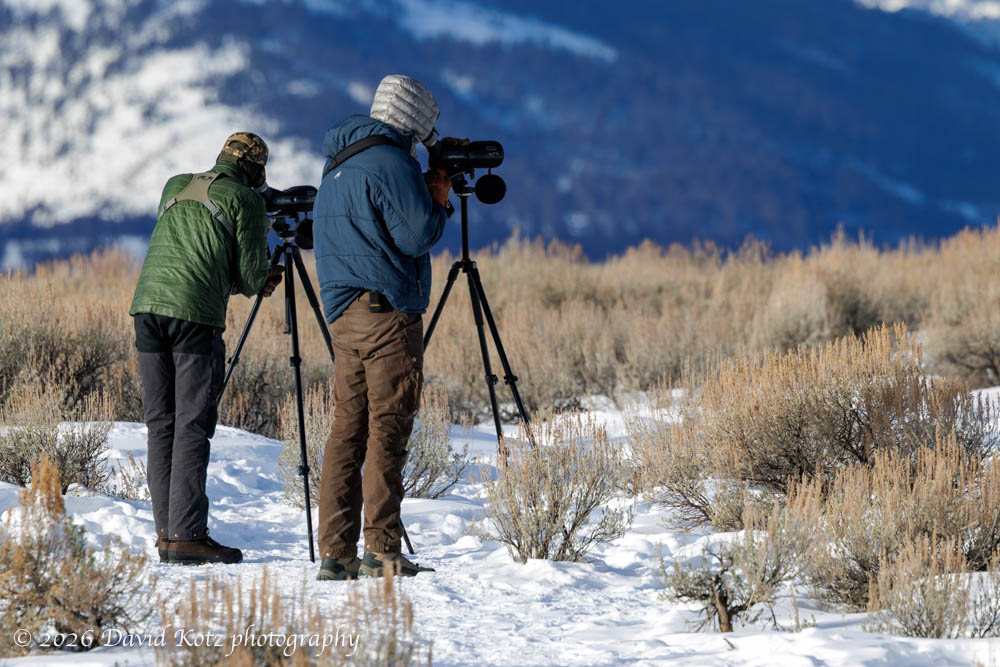
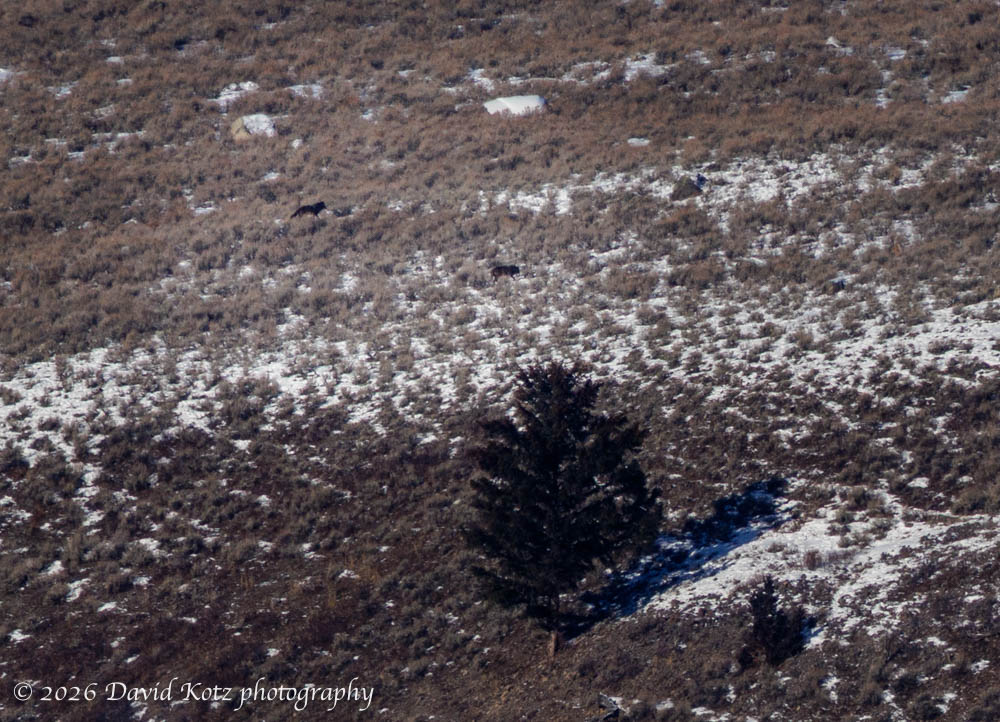
Perhaps the most exciting wildlife sighting was in the Lamar River valley, during our extended tour to the east (Day 1), when we hiked to the top of a small knoll and pulled out the spotting scopes to view a group of four wolves around a carcass almost two miles away. At this distance, even my biggest camera lens struggled to make a clear photo. Exciting, nonetheless, because I’ve never seen wolves in the wild. (They were re-introduced to Yellowstone in 1995; though that move is still controversial, several wolf packs are thriving and stabilizing the ecosystem. According to that site, “the population currently hovers around a stable 90 to 110 wolves within the park. Approximately 500 wolves are present throughout the Greater Yellowstone Ecosystem.”)
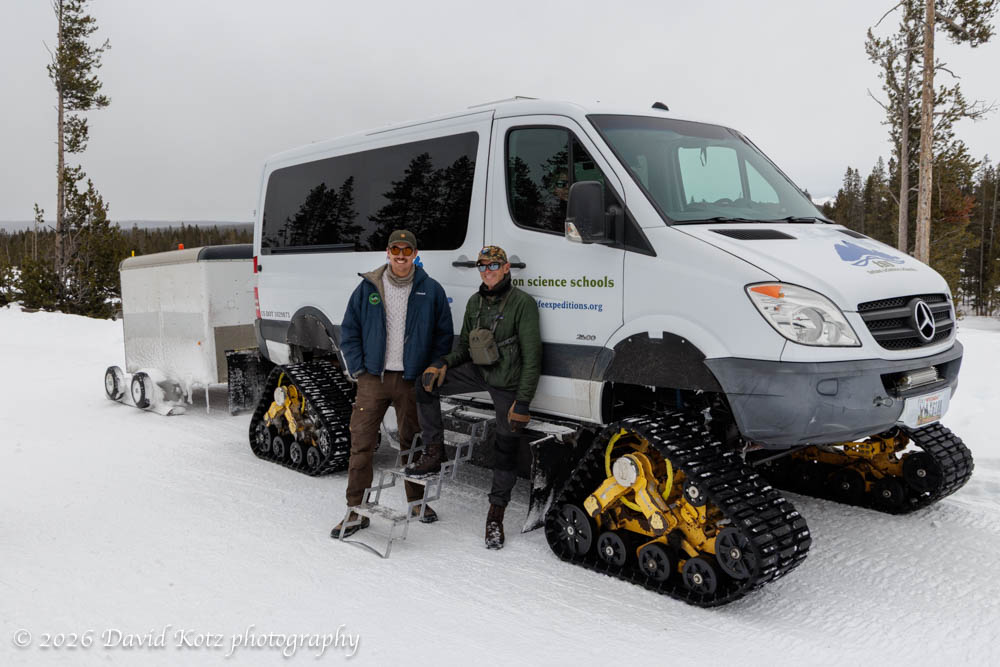
In winter, most of the roads in Yellowstone are closed, or are converted into snow roads. The main north-south road, which we followed from Mammoth to the southern entrance, is a snow road groomed for snow coaches, snowmobiles, and skiers. Thus, on Day 2, we transferred from regular coaches (vans) to snow coaches – identical vans mounted on rolling tracks instead of wheels. These rigs, towing luggage trailers on skis, allowed us to explore deeper into the park, stay overnight at the Old Faithful hotel, and continue south past Yellowstone Lake and over the continental divide to the south.
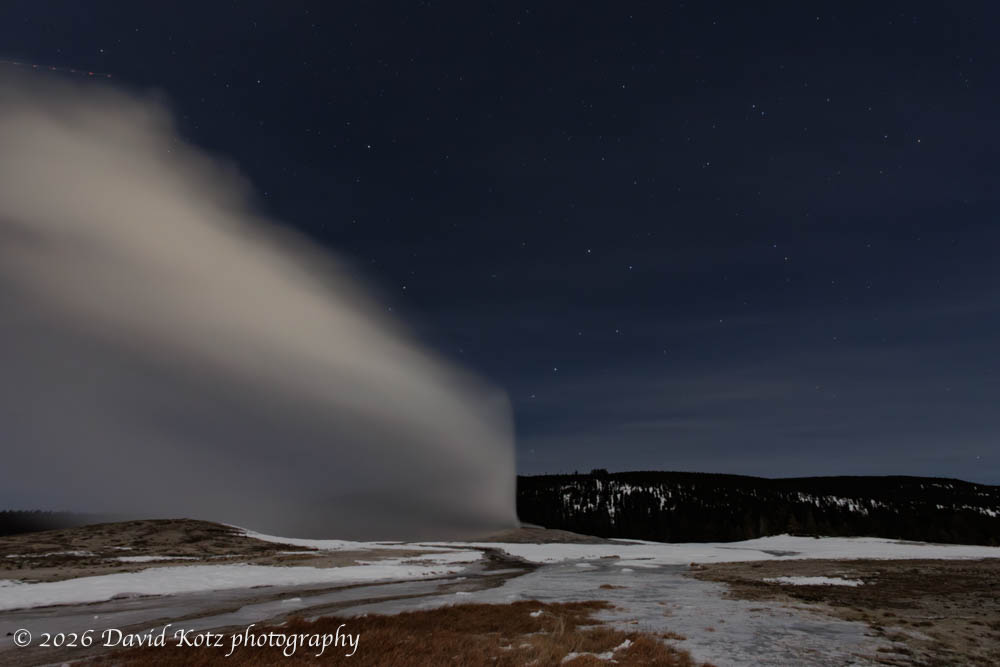
I enjoyed our stay at Old Faithful. Our hotel – a modern facility with a rustic ambience, is a short walk from the famous geyser… which is accessible 24 hours a day. Although I had the opportunity to see it erupt shortly after our arrival, and shortly before our departure, I was excited to photograph it well after dark – under the stars – and again the next morning around sunrise. After sunset and before sunrise I was entirely alone, which is rather pleasant for a site that might be surrounded by two thousand people in the summer. Perhaps my solitude was due to the single-digit temperatures (5ºF, -15ºC) 🥶, but it was beautiful to experience this natural wonder in peaceful quiet, under the stars.
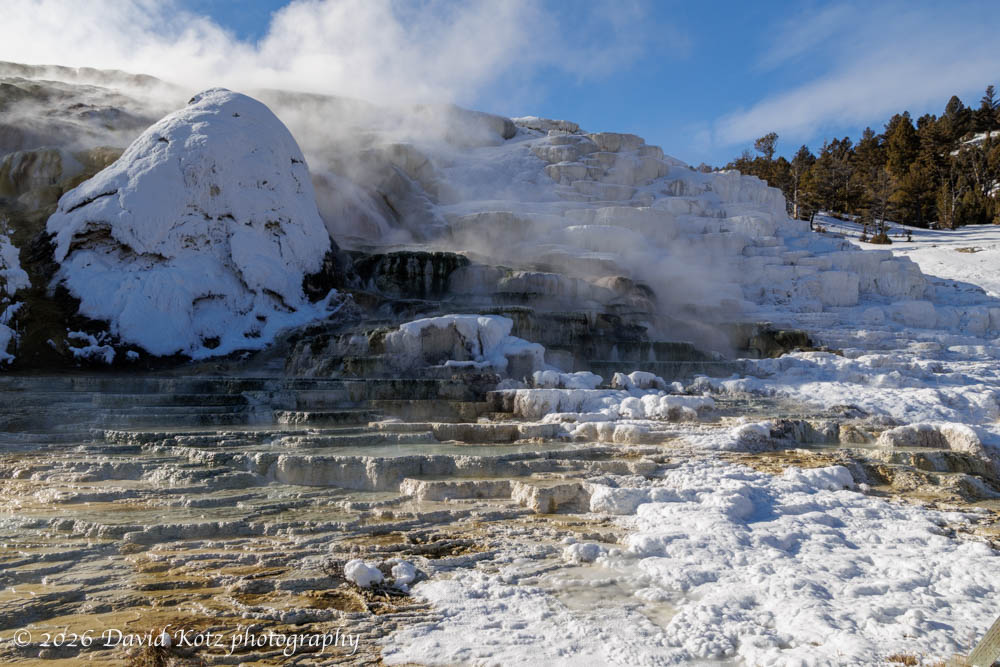
Although most of our tour was focused on the wildlife, we also had the opportunity to learn more about the geology. A significant portion of Yellowstone National Park is a vast caldera, created by the Lava Creek eruption of the underlying supervolcano 640,000 years ago. (One of my Dartmouth friends is a volcanologist who, on behalf of the USGS, led the team monitoring this volcano and its potential for future eruptions.) As a result, the park is sprinkled with hydrothermic activity. We visited the hot springs and travertine terraces at Mammoth…
… the steaming hot springs at Old Faithful…
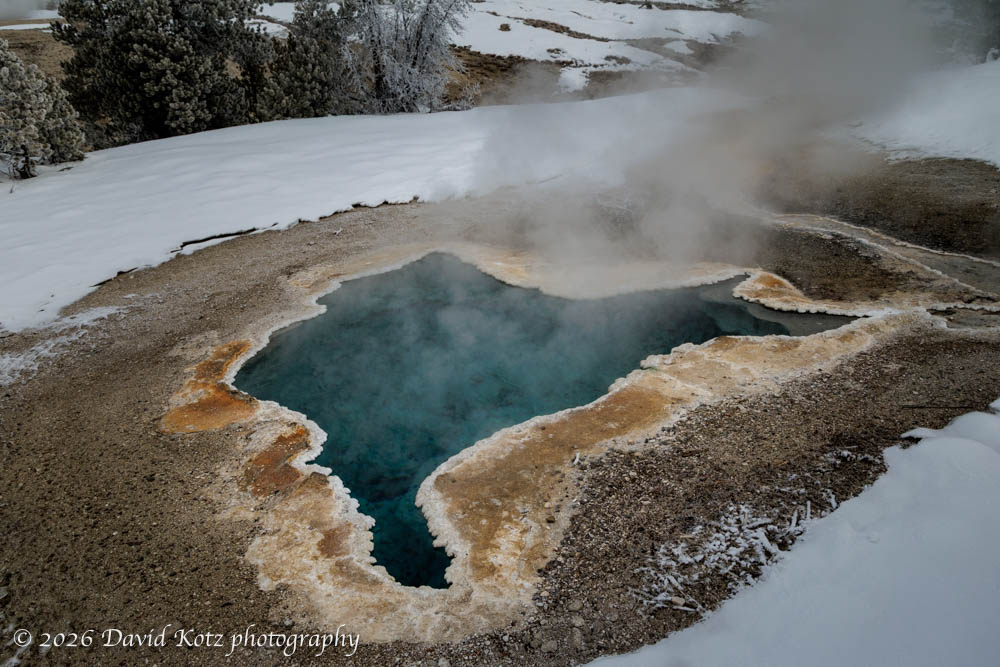
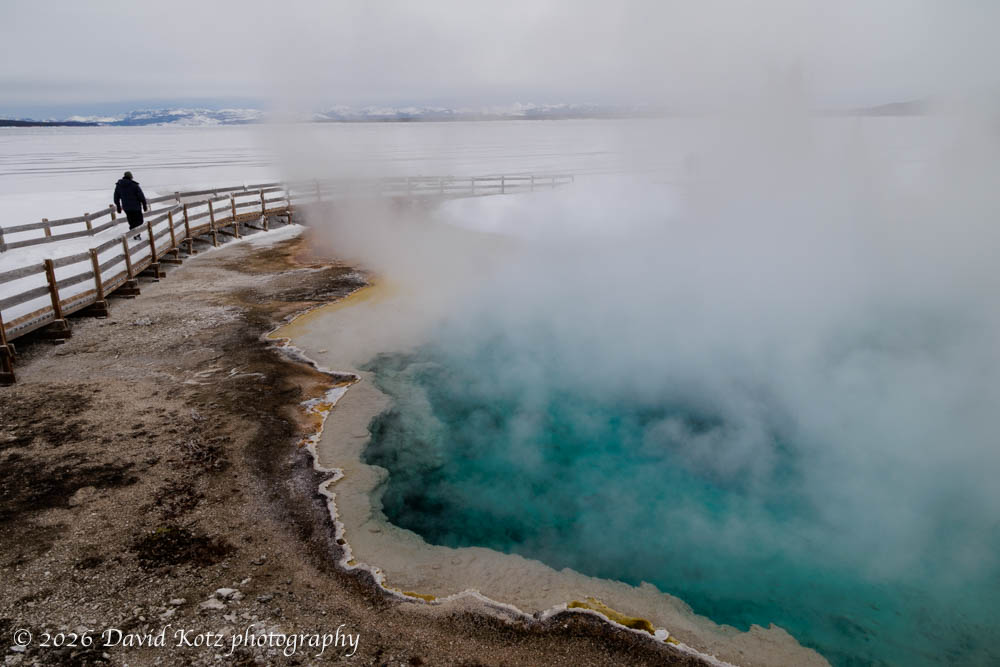
and the hot springs and mud pots on the shore of Yellowstone Lake at West Thumb. It was remarkable to see the kaleidoscope of colors in some hot springs, a result of the different micro-organisms thriving in various temperatures surrounding these hydrothermal phenomena. These pools were especially beautiful when surrounded by pure-white snow and rime ice.
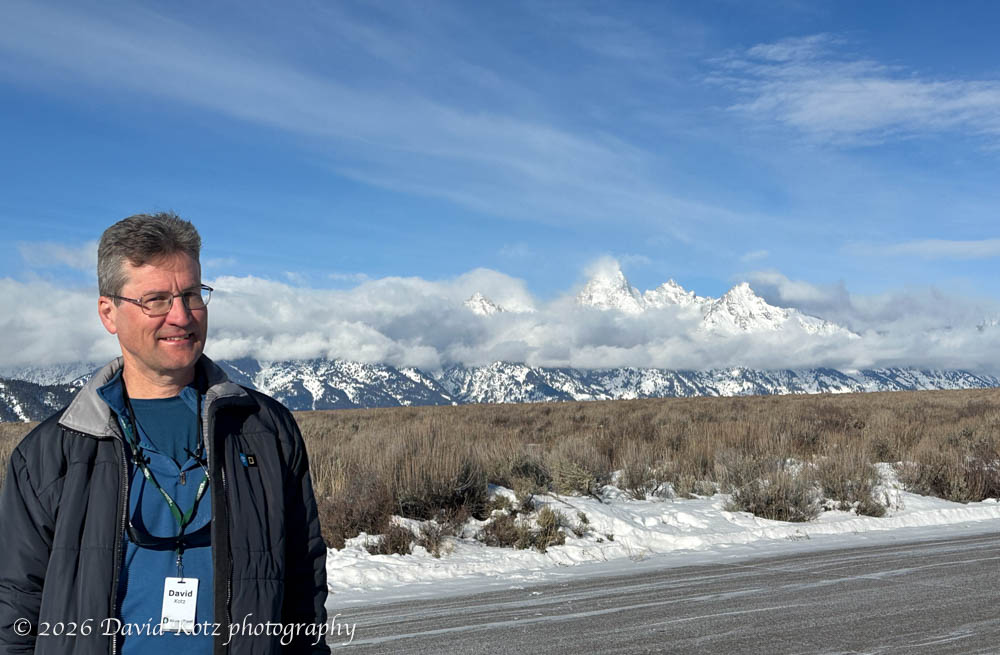
On our final day (Day 3) in Yellowstone National Park we exited through the southern gate, heading for the Teton range and the town of Jackson, Wyoming. To ensure a coherent ecosystem and passage for migrating elk and other wildlife, the philanthropist John D. Rockefeller purchased, and later donated, sufficient terrain to create a ‘land bridge’ (now named for him) between the southern edge of Yellowstone and the critical habitat provided by other protected lands to the south, east, and west. We kept a close eye out for wildlife as we descended from the high country in Yellowstone to the sagebrush flats of the Snake River Valley outside Jackson, also eager for a glimpse of the stunning peaks of the Teton Range.
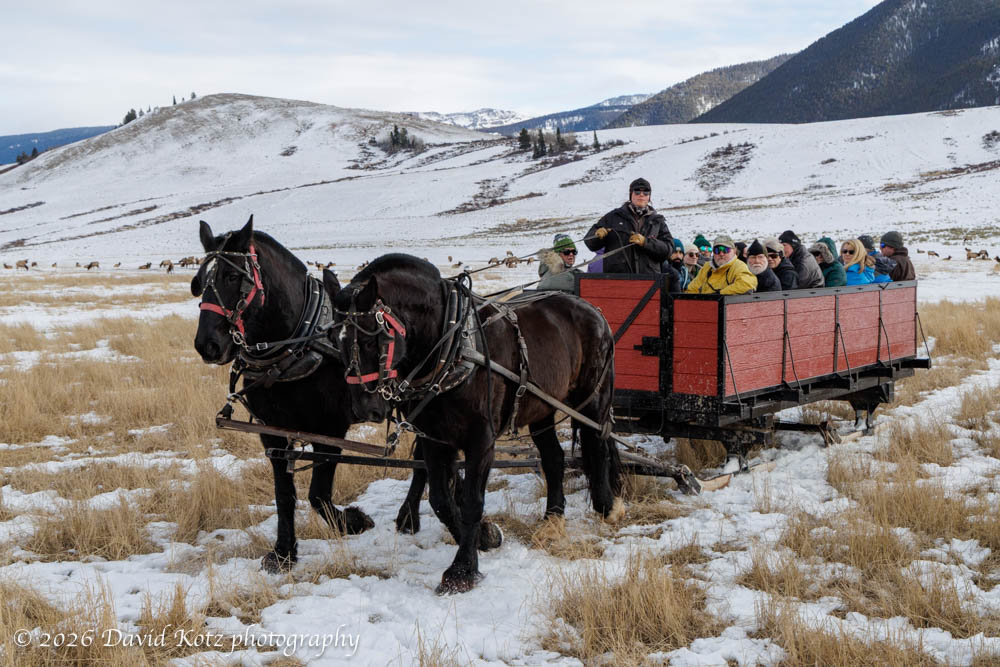
We spent our final day (Day 4) in the National Elk Refuge, which comprises nearly 25,000 acres of grassland connecting the southern edge of Yellowstone National Park, the eastern edge of Grand Teton National Park, the western edge of Bridger-Teton National Forest, and the northern outskirts of the town of Jackson, Wyoming. Although it includes only a quarter of the elks’ historical wintering grounds, these grasslands are vital to the survival of the Yellowstone-area herds. They congregate here in such numbers, and so close to the roads, that it is routine to see hundreds (perhaps thousands) of elk from the roadside. Our group took a tour into the refuge on a horse-drawn sleigh, with dedicated guides who pulled the sleigh into the midst of the grazing herd. The elk were quite used to the sleighs and horses, and barely looked up from their business. We were even treated to the sight of two boxing does!
It was very hard to select just a few photos to share with you, above. I encourage you to visit the gallery – which includes many photos as well as some video of wildlife, geysers, and more. Enjoy!

 David Kotz
2 thoughts on “Yellowstone + Teton in winter”