
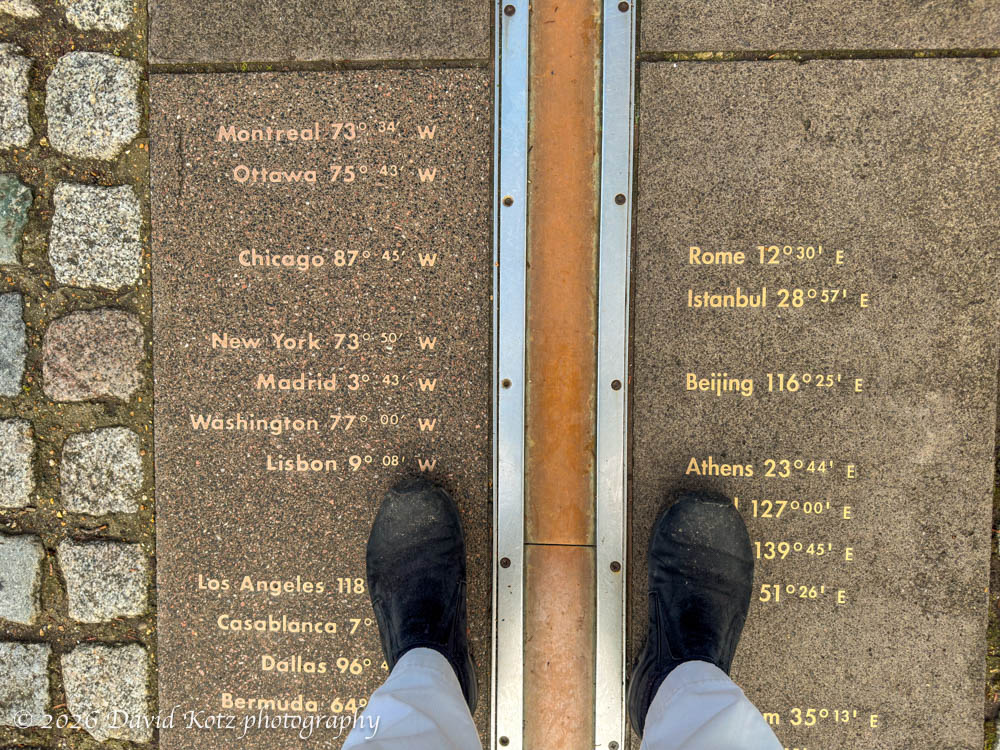
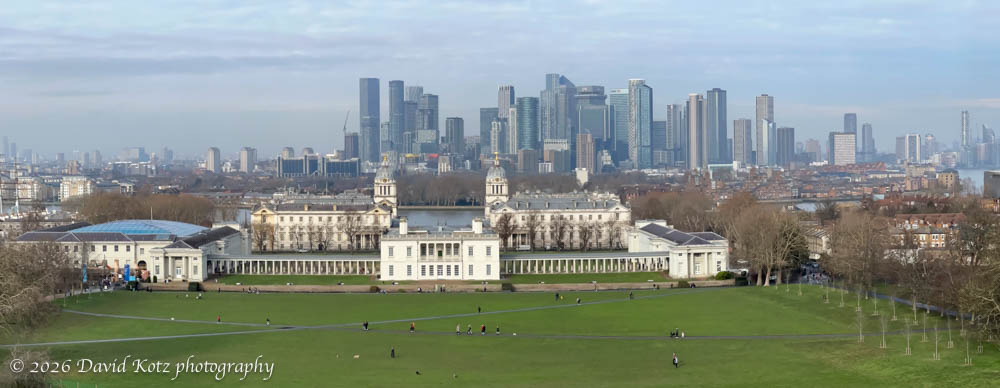
Today we visited Greenwich, and the Royal Observatory Museum that sits atop the hill in Greenwich Park. It has an expansive view across the park, past the Old Royal Naval College and the River Thames, to the skyscrapers in the Canary Wharf financial district of London. This observatory is where the question of longitude was studied – and in particular, a decades-long challenge to find a reliable means for mariners to estimate their longitude while at sea. As a result, it was later selected as the zero point – the reference point for 0º0’0″ longitude, aka the Prime Meridian. Given the importance of measuring time for measuring longitude, Greenwich was also designated as the basis for universal time – hence Greenwich Mean Time (GMT), now known as Universal Time (UTC). We and the other tourists had fun standing on the meridian, one foot in the Western Hemisphere and one foot in the Eastern Hemisphere.
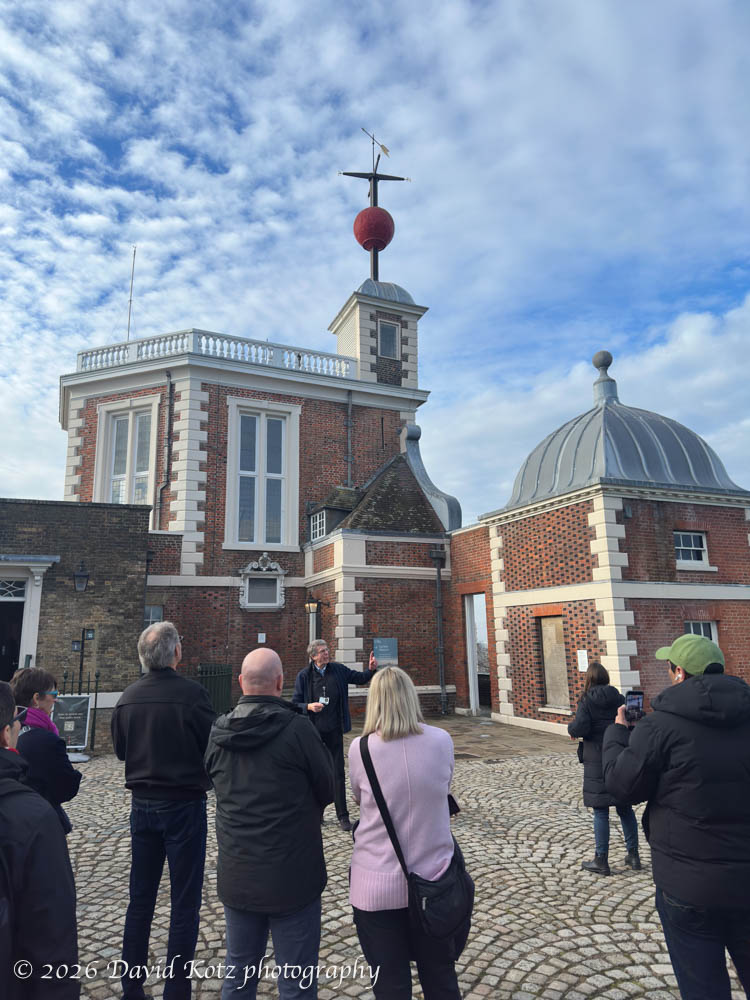
Sir Christopher Wren – the famous architect behind St. Pauls Cathedral and 50 other churches in London after the Great Fire of 1666 – designed this building to house the first Royal Astronomer and his telescopes. The museum does an excellent job of explaining the need to solve the challenge of longitude, and the two methods ultimately derived – tables of the moon and stars, and reliable chronometers. To this day, they still raise and drop the “time ball” at precisely 1pm, so mariners on the River Thames could calibrate their on-ship chronometers to official Greenwich time.
See the gallery for more photos of the museum and its surroundings. Beautiful day, fascinating place!

 David Kotz
One thought on “Prime Meridian”