
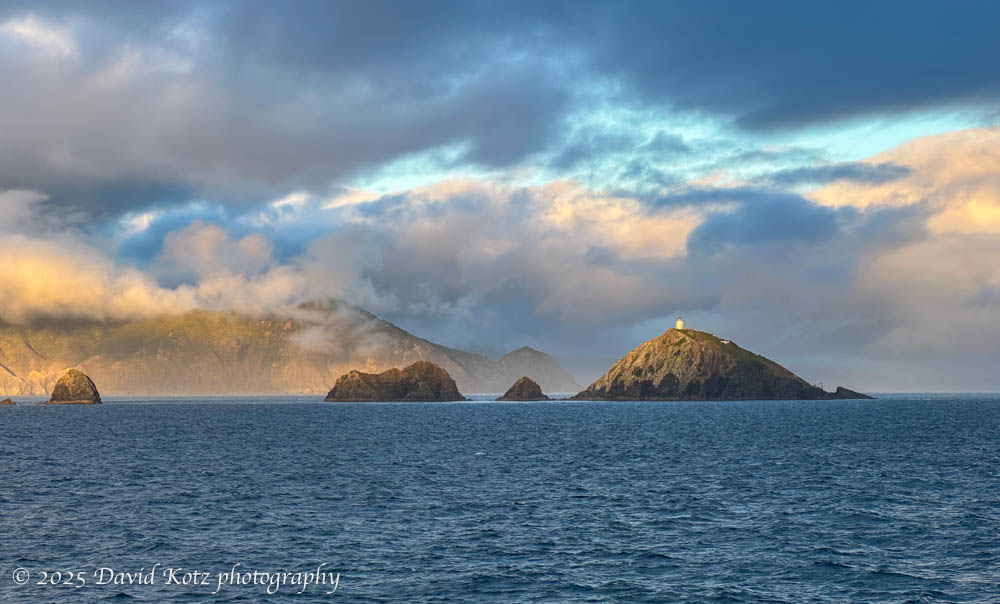
We woke to a beautiful morning as we sailed into Cook Strait, the passage between south and north New Zealand. The Heritage Adventurer nestled into the archipelago on the northern tip of New Zealand’s South Island, a region known as Marlborough Sound. This anchorage gave us an opportunity to spend the day visiting the tiny island of Motuara Island – now a pest-free nature sanctuary – and the nearby Meretoto / Ship Cove, best known as the location where Captain Cook had encamped during his three circumnavigations of the globe. This visit gave us an opportunity to delve deeper into the historic encounters between Europeans and the Māori, and to enjoy the birds, a waterfall, and the beautiful landscape.
I especially enjoyed the short, steep hike to the summit of Motuara Island, because I could hike at my own pace and really stretch my legs. On the way down, then, I could stop (often) at my own pace to photograph the beautiful flora and fauna, like these massive tree-sized ferns.

The visit to nearby Ship Cove, though it offered a beautiful waterfall, was especially exciting for its historic interest. On Captain James Cook‘s first circumnavigation of the globe, in January 1770, he was the first European to understand that New Zealand (which had been sighted, but not mapped thoroughly, by the Dutch over a century earlier) was actually a pair of islands (and not a great southern continent, as had been suggested).


He and his crew had good relations with the local Māori, and spent weeks here to rest, repair, and resupply. He visited again on his second voyage in 1773-74, and again on his third voyage in 1777. It is that third voyage, though, that I find most interesting… because of one member of the Cook party: John Ledyard, Dartmouth class of 1776.
Ledyard is well-known in Dartmouth circles because he joined the three-year-old college in 1772 but famously dropped out in 1773 by carving a canoe from a local tree and paddling down the Connecticut River to return to his home in the Connecticut colony. His name is thus immortalized in the name of Dartmouth’s Ledyard Canoe Club, the nearby Ledyard Bridge, and the local Ledyard Bank. But Ledyard had been widely known in his own time, because he was an inveterate traveler and adventurer, and he had an incredible knack to network with the most important figures of his day. By 1789 Ledyard was probably the most well-traveled human ever to have lived.
I’m re-reading American Traveler: The Life and Adventures of John Ledyard, the Man Who Dreamed of Walking the World, by James Zug [Basic Books 2005; available on Amazon]. I highly recommend this book, as it is an incredible story and it is beautifully told. Here’s an excerpt from the Prologue:
He had the uncanny ability to appear in the most exciting places with the most amazing people of his time. He sailed with Captain James Cook on Cook’s third voyage and wrote vividly of Cook’s murder on a Hawaiian beach. He formed fur-trading companies with Robert Morris, the Philadelphian financier, and John Paul Jones, America’s notorious sea captain. He helped launch the China trade and the Northwest fur trade, bringing the U.S. economy into the Pacific for the first time. He visited Egypt before Napoleon’s invasion opened the country up to Western travelers. Sir Joseph Banks, the celebrated botanist, engaged Ledyard as the first explorer for his African Association, a society for which such legends as Mungo Park and Johann Burkhardt later traveled. He delighted Paris’s pre-revolutionary expatriate society in the 1780s, becoming close friends with the Marquis de Lafayette and the U.S. ambassador, Thomas Jefferson. He so thoroughly convinced Jefferson of the need to explore the American continent that Jefferson asked him to do the job twenty years before Lewis & Clark. The plan called for Ledyard to go overland through Russia, cross at the Bering Strait and head south through Alaska and across the American West to Virginia. This expedition failed after fifteen months of traveling when Catherine the Great had him arrested in eastern Siberia, but Ledyard’s trip across Russia was historic: it was one of the three failed attempts that preceded the Lewis & Clark expedition and one of the first known attempts by a person to walk around the world.
Curious tidbit: as I write this post, a British man is about to complete his 27-year journey to walk around the world, from the southern tip of South America to Alaska, across the Bering Strait, across Eurasia, and back to England. [Washington Post]
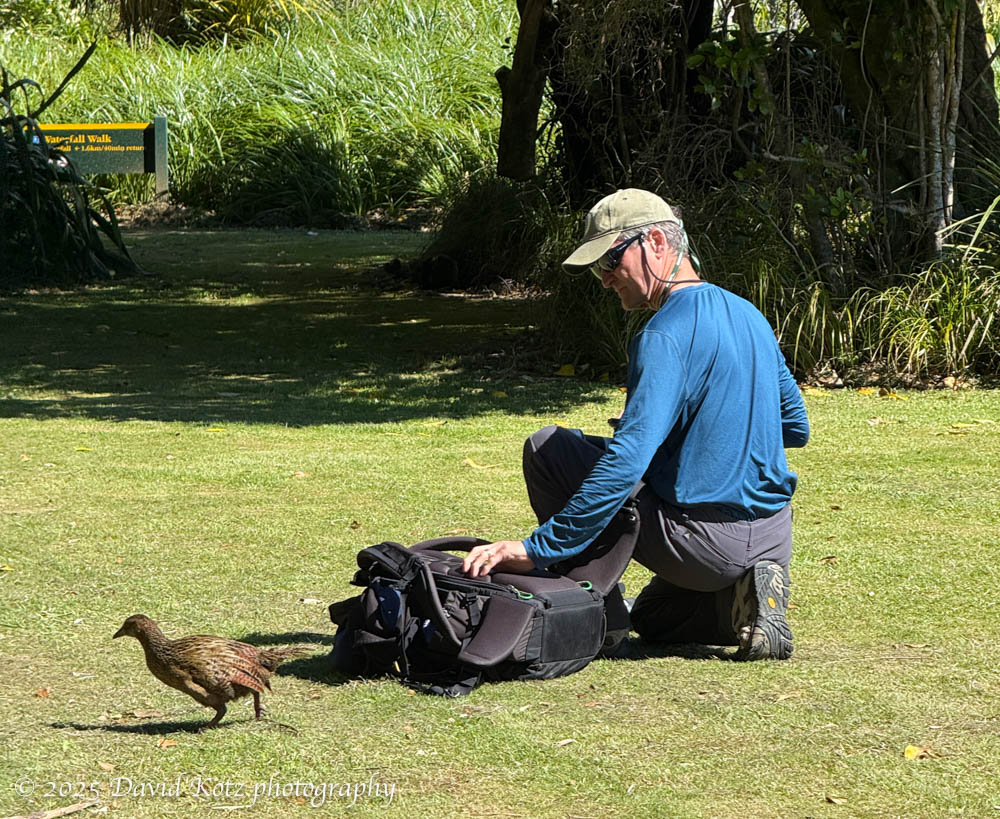
Please enjoy the photo gallery – which includes more wildlife as well as photos of all the on-site posters explaining the history of this lovely site.


 David Kotz
3 thoughts on “New Zealand – Marlborough Sound”