
[part of a series of posts beginning here]
In addition the expedition staff, two Greenlanders joined us for the entire cruise: an Inuk cultural ambassador, and a businesswoman born in Iceland but descended from Greenlandic grandparents and whose career includes service as an elected council member in the capital city of Nuuk. From listening to their formal presentations and from informal conversations, we had an opportunity to learn more about the indigenous traditions as well as modern Greenlandic culture and politics. We also had the opportunity to visit contemporary communities – two tiny settlements and a large town. Read on for more!

After our visit to the historic settlement of Hvalsey (see prior post), we had an opportunity to visit a larger town nearby, Qaqortoq. Founded in 1775 as a Danish trading post, it is now a bustling, modern town of over 3,000 people. We used our free time to stroll the streets and visit the shops – I found it particularly interesting to wander through the grocery store, where various local meat and fish products (many unfamiliar to me) were available. A local guide gave us a short tour, including an opportunity to taste local foods (bread and butter, lamb and gravy, dried seal, dried catfish, dried arctic char, fish soup, and beluga bits; I tried them all!). Qaqortoq photos begin here in today’s gallery.

In my prior post I also mentioned our visit to a small settlement known as Qassiarsuk, where we saw ruins of the earliest Norse settlements in Greenland. In Qassiarsuk we met Ellen, a local woman whose late father-in-law had established a sheep farm here, decades earlier. A tiny community grew up around the farm and now includes a school, a church, and a small but growing tourism business (we passed a youth hostel and a tiny café). Ellen had been the schoolteacher for many years while her husband continued the sheep-farming business. In her retirement, she is launching a small wool-processing business to card, spin, and knit wool products, and to teach others to do so. Last year, Lindblad National Geographic arranged the donation and delivery of the necessary equipment. While in the village we had a chance to meet the current schoolteacher, who told us about the tiny school and its eight K-8 pupils; when children reach 9th grade, they go to one of the bigger towns for boarding school. It was fascinating to see, in one place, a site that has been settled (on and off) for thousands of years. Qassiarsuk photos begin here in today’s gallery.

Finally, we visited the abandoned village of Qoornoq, nestled on an island in Nuup Kangerlua, also known as Nuuk Fjord. “Once home to a fishing and sealing community, it thrived in the early 20th century before being abandoned in the 1970s during a period of government-led centralization. Today, many of its colorful houses are used as seasonal summer homes, their bright colors standing out against the stark mountains and deep fjord waters” [NatGeo]. Although the morning fog was so dense we could not see the shore from the ship, or the ship from shore, the fog rose throughout the sunny morning… slowly unveiling beautiful scenes of colorful homes, rocky shores, and grounded berglets. Qoornoq photos begin here in today’s gallery.

On our last hour in Greenland we passed briefly through Kangerlussuaq on a bus to the airport; it has an interesting history. “Kangerlussuaq was founded … [f]ollowing the fall of Denmark to Germany in World War II, [when] US forces assumed responsibility for the security of Greenland, building several bases including Bluie West-1 to the south in Narsarsuaq. The base briefly came under Danish control in 1950, but following mounting concerns about the Cold War threat, a new agreement saw the United States reopen Bluie West-8 under the name of Sondrestrom Air Base in April 1951. It served as one of the Distant Early Warning (DEW) Line bases and a supply station for similar early warning facilities. Following the fall of the Soviet Union, the usefulness of the base diminished; the last U.S. Air Force personnel left the base in 1992.” [NatGeo] It has since been Greenland’s primary international airport and air-freight center, although Nuuk has just expanded its airport and is now capable of international travel.

Sadly, we did not get to visit Nuuk, the capital city and largest settlement in Greenland. The itinerary included a few hours in Nuuk before our flight back to Iceland, but our final-day plans changed dramatically (see my introductory post) and we flew out of Kangerlussuaq instead of Nuuk. I do have one photo of Nuuk as we passed by ;-).
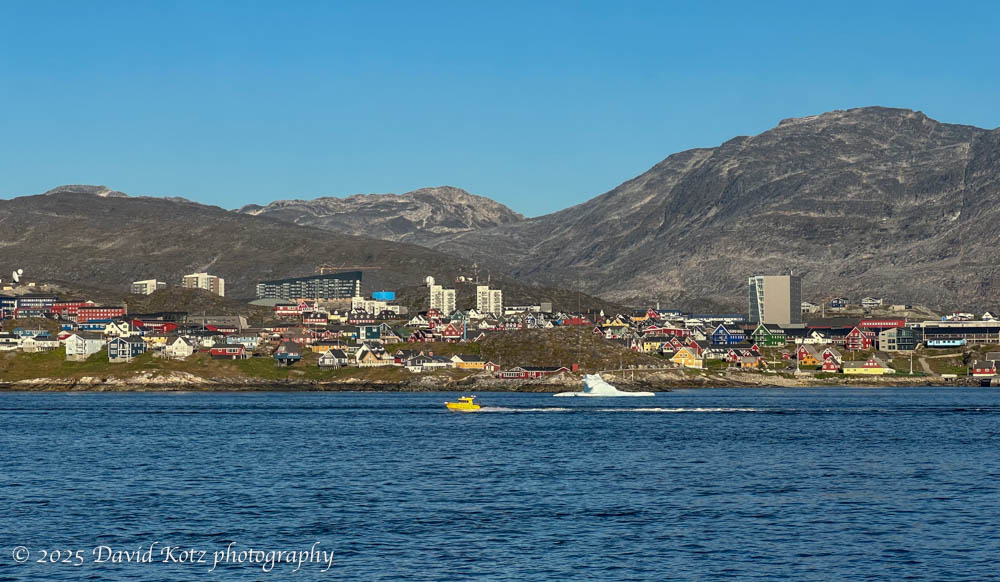
You can see homes and businesses, a yellow water taxi, and a passing iceberg.
All the photo links above point to one photo gallery.

 David Kotz
One thought on “Greenland – contemporary human settlements”