
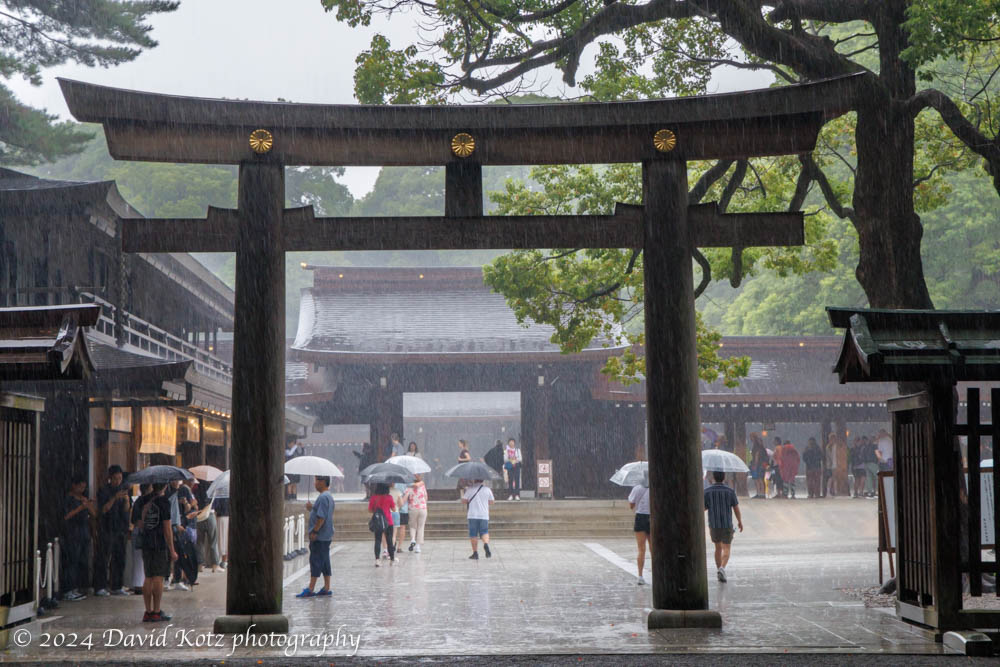
For our only full day in Tokyo we boarded buses to visit the Meiji Shrine, a Shinto shrine meant to memorialize Meiji, who ended the Shogun period and became the architect of Japan’s modernization. He died in 1914, and the city built the Shrine in 1920. Unfortunately, it (and much of Tokyo) was destroyed in WWII, but quickly rebuilt after the war. Today, despite pouring rain, it was crowded with tourists, as well as many young families with babies; it is customary to bring a newborn (at 30 days of age) to pray for their good health. Read on to see where we went in the afternoon!
We then went to the Asakusa district to visit the Senso-ji temple. The streets around the temple are closed to traffic and dense with restaurants and vendors of souvenirs and street food. After a brief tour of the entrance gate Kamanarimon, we spent most of our time around the massive middle gate Houzoumon (below) and the Buddhist temple Senso-ji. Near the temple was the tall Gojyuunotou Pagoda (itself a Buddhist symbol – traditionally the place to keep ashes of Buddha) and a Shinto shrine, Asakusa-Jinya.

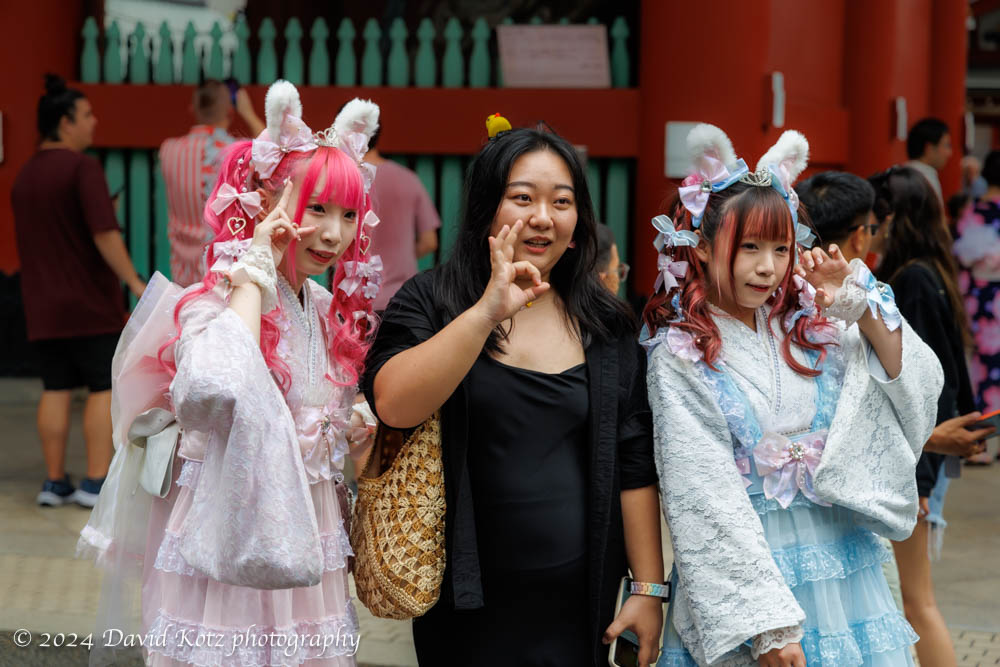
There the guides set us free to explore and to find our own lunch – we chose some street food: fried savory cakes. The area around the temple, and all the nearby streets, were extremely crowded, almost wall-to-wall with tourists and festival goers. There were many women (and some men and children) in traditional dress, easily available for rent from some nearby shops, and they were enjoying the opportunity visit the temple and to take photographs. There were others in Anime dress, as seen here:
Many visitors dropped 100 Yen for a chance to learn their fortune – shaking a metal container until a stick emerged – shaped like a chopstick, but with a number written on it; that led them to one of many numbered drawers, in which they retrieved a paper note with their written fortune. I saw many smiles and giggles among visitors and their friends as they read their fortunes. Fortunately, there was a nearby fence to which one could tie disappointing fortunes, which would keep them in the temple and thus not affect the visitor.

In the afternoon we drove back toward the hotel to visit the neighboring Hama-rikyu Gardens, an expansive space created by the Tokugawa shoguns, over several generations. {More on these gardens, with photographs, tomorrow!}
Finally, we spent the evening at Hotel Gajoen where we ended our trip with a final banquet (an elaborate six-course Japanese meal), while enjoying entertainment provided by three local performers: two Geisha and one Maiko (an apprentice Geisha). They were very kind to explain their art, including their song, dance, clothing, hairstyle, and lifestyle, and then to come around to each table for photographs. What a grand way to end our two-week trip!

Be sure to check out the gallery for more photos. (Lots more!)

This post is part of a series about our Japan trip; the series starts here.

 David Kotz
Thanks for these emails. A nice chance to remember and re-see the trip that we did together. It was a great trip, and especially nice to have you along.
Mom
>