India has been voting, in phases, over the past two months. This process is amazing – it is the largest democracy in the world, and it is conducted 100% with electronic voting machines. Turnout was high; indeed, more people in India voted than the entire population of the US.
Manmohan Singh will serve another term as Prime Minister. (Photo from the Times of India.)
The voting proceeded for weeks, during which exit polls indicated an extremely close race between the incumbent UPA coalition (led by the Congress party) and the NDA coalition (led by the BJP).
Photo by Times of India.
Today, the election results were announced. The results are surprising: not only did the UPA retain power, but the Congress party itself swept 201 seats – the most any party has received in over 25 years. Thus, it seems, Congress will be able to lead without needing to compromise so often with smaller coalition parties. It appears that India has chosen stability over change.
Manmohan Singh will return as Prime Minister, the first person since Nehru to return after completing a five-year term. Singh, an economist and one-time professor, is widely credited as responsible for the 1991 reforms that led to India’s IT and BPO boom, and more recently, to its relative fiscal stability in the face of the world economic recession.
This post was transferred from MobileMe to WordPress in 2020, with an effort to retain the content as close to the original as possible; I recognize that some comments may now seem dated or some links may now be broken.
An incredible spectacle, encountered by coincidence.
It’s 6:30am and I’m standing barefoot in the middle of the street. Men dressed in wild, colorful costumes dance and flow around me, as others with drums and trumpets pound out a mesmerizing beat. I’m photographing as fast as the camera will go, and the men smile and are thrilled. This morning, and this evening, are possibly the most sensory experience I’ve had in India – incredibly visual, with vibrant costumes and crowds of revelers, pulsing music from roaming bands of drummers, smells of flowers and incense, and the overwhelming crowds, heat, and humidity. Read on and do not miss the photo gallery!
I’m not sure that I have ever visited a more inspiring and impressive place. Inspiring, because the Aravind Eye Hospital mission is “to eliminate needless blindness by providing appropriate, compassionate and high quality eye care to all” – and they actually do it, for thousands upon thousands of patients, most of whom can barely afford bus fare to the hospital, let alone cataract surgery. Their task is incredible, because India has over a quarter of the world’s blind people, and much of that blindness are curable or preventable. Their vision is audacious, because they have 5 hospitals today and aim for 100 hospitals within 10 years. Read on! and check out the photo gallery.
We have been blessed with wonderful staff to help us in our household here at IISc.
Our family with our IISc apartment staff:
Venkatama, Vijayalakshmi, and Geetha.
Geetha comes daily (except Sundays) to clean the floors and bathrooms, and wash the dishes. Sometimes her mother, Venkatama, comes to help.
Venkatama, Vijayalakshmi, and Geetha.
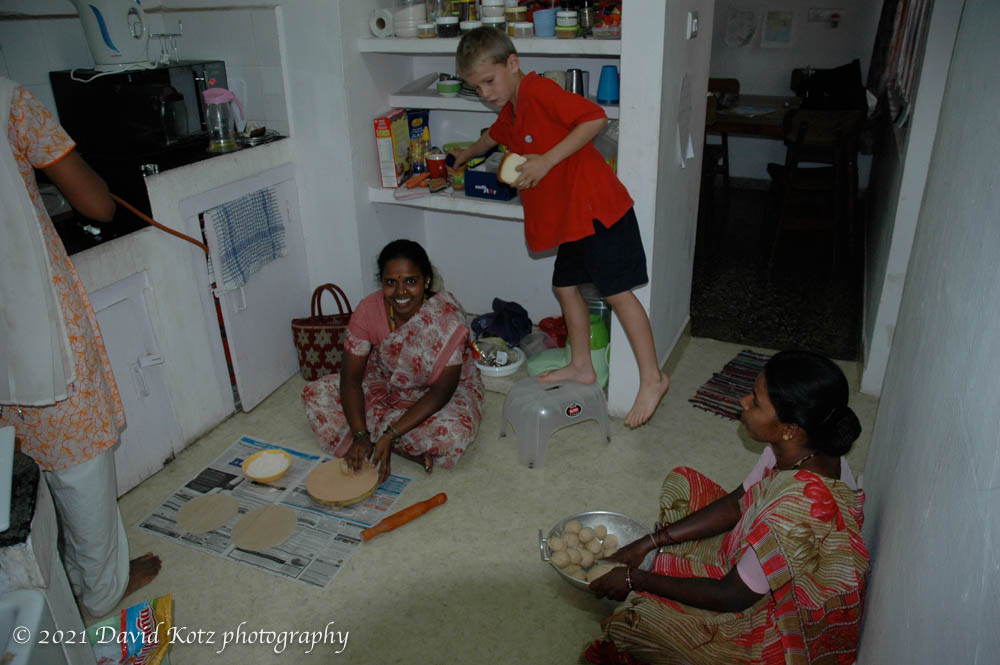
Vijayalakshmi cooks dinner for us 5-6 days per week, and speaks workable English. Her food is excellent, local South Indian veg cuisine, a variety of curries and dals and soups. Every now and then they make chapatis, as shown below.
Vijayalakshmi and Venkatama making chapattis on the floor.
This post was transferred from MobileMe to WordPress in 2020, with an effort to retain the content as close to the original as possible; I recognize that some comments may now seem dated or some links may now be broken.
The Indian Institute of Science turned 100 this year. Although not the oldest university in India, most universities were founded within the past 100 years, and indeed, most within the 62 years since independence. I’ve had many interesting conversations with professors during my travels around academia in India. In addition to meeting faculty from several departments at IISc, I have visited IIT Kanpur, IIT Kharagpur, IIT Madras, IIT Bombay, IIT Delhi, IIT Guwahati, MIT at Anna University, the National Degree College, and the REVA Institute of Technology.
Most of these universities are primarily focused on undergraduate education, and indeed the IIT system is legendary in the US because we get so many of our great graduate students from IIT. (Or, at least, we used to, before India’s technology boom started luring many of those same students into staying home for lucrative jobs, instead of going to graduate school). But IISc is graduate-only, and the IITs also have a limited number of MS and PhD students.
IISc conducts world-class research in many fields. The IITs struggle, however, to attract strong graduate students. (Their best undergrads go to graduate school in the US, Europe, or perhaps IISc, but rarely to an IIT.) Unlike the US, federal grant money is plentiful. As I hear it, if you submit a decent proposal for a good idea, you’ll get a grant. The hard part is spending the money: grad students already receive stipends, faculty already receive their salaries, and most IT projects need little equipment. Their real limitation is a lack of smart students and good staff. Since pay for tech staff is limited by government pay scales, it is hard to attract and retain strong technical staff… once they learn the skills, they tend to leave for lucrative industry jobs. Still, there is strong demand for these positions; there may be dozens of applicants for a single programmer position. They give out written exams to weed out the skilled applicants, because a degree from an IT-oriented school does not necessarily mean the student really knows their stuff.
The government is about to double the size of the IIT system. There are five classic IITs; within the past 10 years they built a brand-new campus to found IIT Guwahati, and upgraded an existing university to IIT status in Roorkee. Thus, there are seven established IITs. Now, in the space of a few years, the government is opening 9 new IITs around the country.
This expansion is dramatic and, frankly, somewhat overwhelming. I’m told that there is already a shortage of 700 faculty in science and engineering, within the IISc and IIT system (although that number may also include the IIITs, I’m not sure). To establish 9 new universities at the same time, when it is already hard to recruit good science and engineering faculty, is a daunting task: there is 5x-10x pay difference between IIT salaries and corporate salaries. (That’s 5-10 times, not 5-10 per cent!)
Apparently, faculty are paid on the same government pay scale as police or military or whatever. A sort of tenure comes after a year or two, and pay raises are based on time in the job and not on merit. Thus, there is not a lot of incentive to go into academics, or to excel if you do. (That said, I’ve met many very smart, very skilled, very motivated faculty!)
Where would all these new faculty come from? There is no shortage of engineering schools; I heard that there are hundreds in Tamil Nadu alone. Thus, there are plenty of graduates. The problem is that the vast majority of such graduates are not well qualified, despite their degree. The very best undergrads go to IIT, the best graduate students go to IISc or Europe or North America; the quality of the grad students going to IITs is thus highly mixed. Although there are highly motivated, bright Indians – as grad students, junior faculty, or employees – many may need remedial coursework and time, to learn the background needed for graduate work, and need to learn research skills. Few are ready to be self-starters in grad school. Even Infosys, which hires 25,000+ engineers every year, has its own internal school system teaching 1,000 courses to over 30,000 employees a year, to polish the skills of its new-hires and to continually retrain its existing employees.
There is thus a shortage of PhDs produced in India. As a result, the faculty that staff these hundreds of universities are not, as a whole, well qualified. So the need is not so great to increase the quantity of graduates, but to improve the quality of education in the existing schools.
India needs to produce more PhDs and to retain more of their quality PhDs as faculty. All of the IIT, IIIT, IISc (combined) have 250 professors and only 350 PhD students (December 2008). Per Raghavan published article in Forbes magazine, 2007, about PhD production in CS, CE, IT: US 1400/year, India only 40/year. France and Germany are at about 80/year, so India has some catching up to do.
These observations are based on conversations with many other faculty and do not necessarily represent my own opinion and certainly not the opinion of all faculty in India. Furthermore, I have not been able to verify all the facts above.
This post was transferred from MobileMe to WordPress in 2020, with an effort to retain the content as close to the original as possible; I recognize that some comments may now seem dated or some links may now be broken.
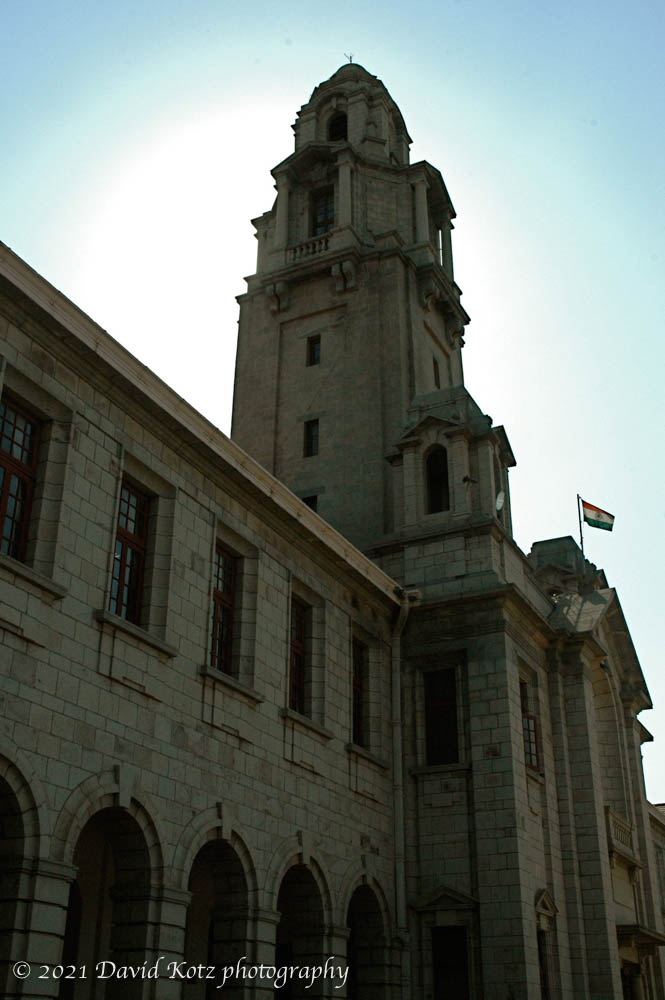
Today I visited the Reva Institute of Technology and Management, a new school on the outskirts of north Bangalore. Opened just five years ago, they offer undergraduate (and some graduate) programs in computer science and engineering, electrical engineering, mechanical engineering, as well as an MBA. Their brand-new campus is beautiful and architecturally interesting.
I was invited to open their day-long series of student research presentations with a keynote lecture. The event was very formal and I was treated like a VIP. The event was a day full of student research presentations, and I was the keynote speaker.
The event began with a school song, sung by one of the students. Then the event’s student MC introduced first a professor, then the department chair, then the principal, and then the chairman, who each made a few remarks. Then they presented each of us with a bouquet of flowers, and presented me with a memento – a basket of fruit and an elegant Reva desk clock.
Finally, we inaugurated the day with the lighting of the lamp, an ornate brass oil lamp with five wicks and wrapped in fresh flowers.
As the hour was late, the day was hot and the acoustics in the room poor, I moved quickly through my talk so the students could get on with their program. I enjoyed the rest of my visit, meeting with faculty and graduate students who were involved in interesting research related to portable healthcare sensors.
This post was transferred from MobileMe to WordPress in 2020, with an effort to retain the content as close to the original as possible; I recognize that some comments may now seem dated or some links may now be broken.
It is election season here in India – all of Parliament is up for re-election and the Congress-led government is hotly contested by the BJP. India conducts its voting in phases, shifting security personnel and electronic voting machines from state to state and district to district over the course of two months. This phased approach provides security that has dramatically reduced the violence that used to occur, and the electronic voting machines have dramatically reduced the ballot-box-stuffing and other fraud that used to occur.
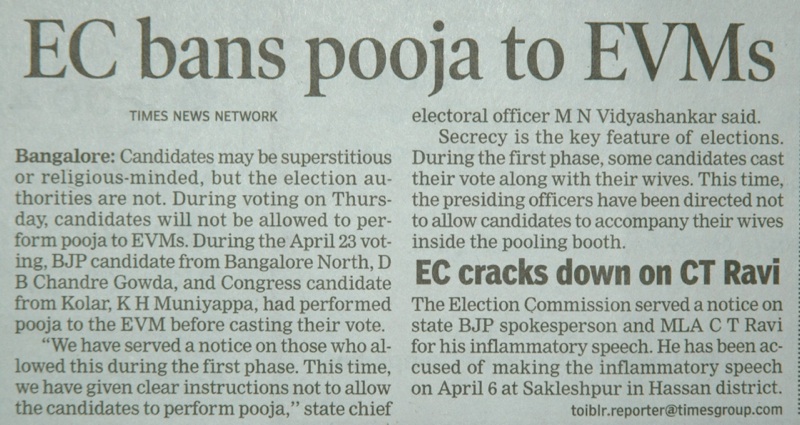
I was tickled by the following article in the newspaper this week, in which the election officials declared that candidates, when they come to vote, cannot perform a pooja (religious blessing) on the electronic voting machine (EVM). A pooja usually involves incense, a diya (small oil lamp), bells, chants, and colored powder used to mark the person or object being blessed.
This post was transferred from MobileMe to WordPress in 2020, with an effort to retain the content as close to the original as possible; I recognize that some comments may now seem dated or some links may now be broken.




 David Kotz