We share the IISc campus with a large troup of monkeys.
When we moved into our apartment on campus, I noticed that there were bars on all the windows, even though we live on the second floor. Indeed, there are bars on all the windows of the academic buildings, too. People warned me about theft, and I assumed the bars were to keep out thieves.
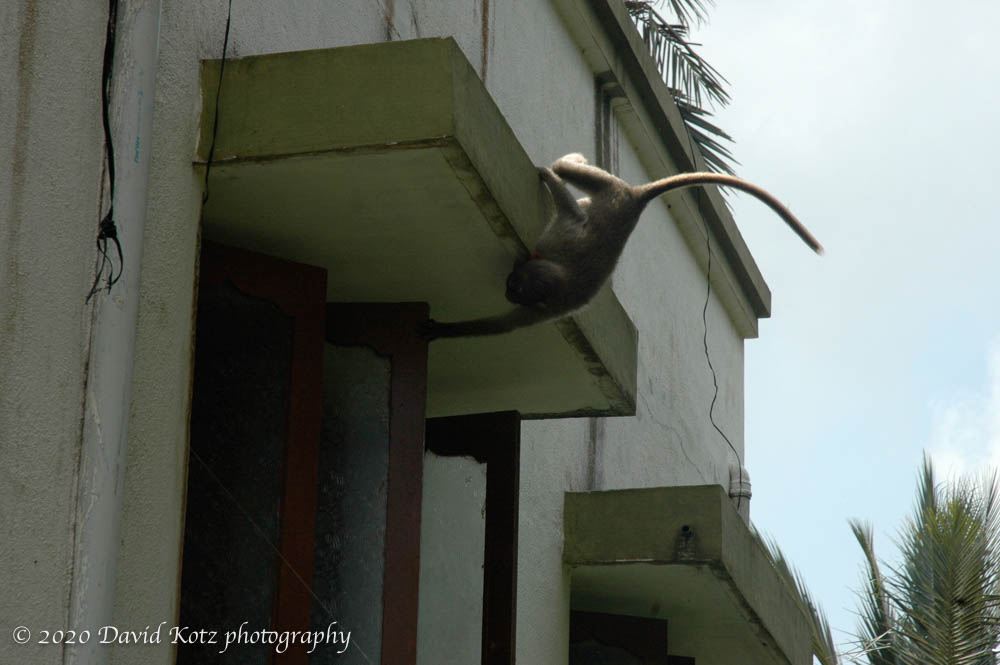
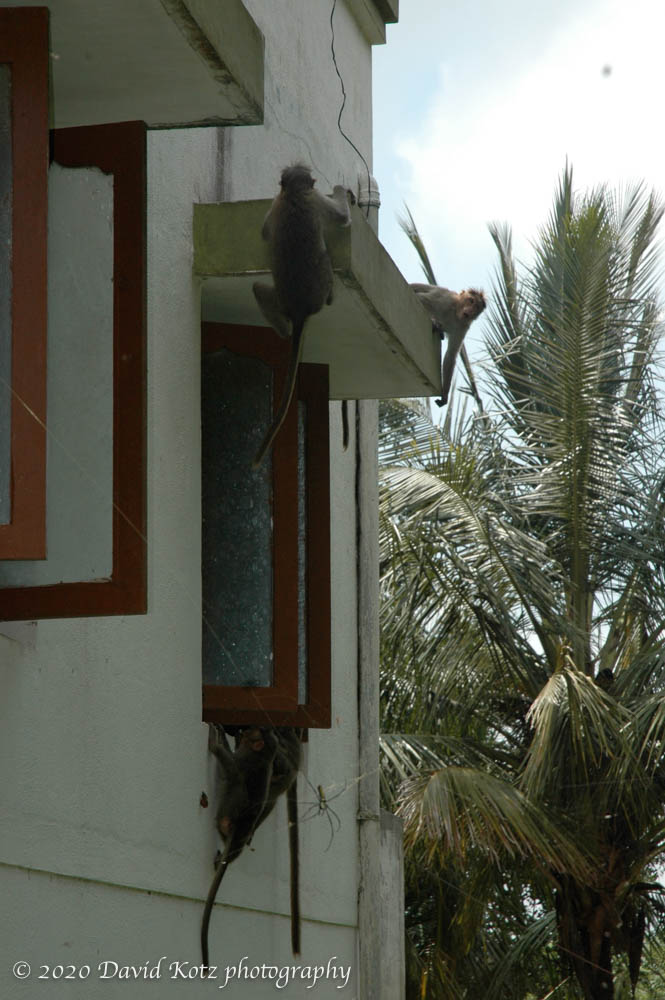
The monkeys of Chamundi Hill attempt to raid a kitchen in Mysore.
The monkeys of Chamundi Hill attempt to raid a kitchen in Mysore; if you click and look closely, you can also see a huge spider that happened to be between me and the scene of the crime.
I was half right. The bars are there to keep out thieving primates, but not specifically humans. These pictures are from off-campus, but there is a band of monkeys that lives on campus and we have had one hanging on the bars of our dining-room window, eyeing the bananas on the table. Our neighbors tell stories of monkeys strolling into the house, opening the fridge, and walking off with whatever tastes good. We often see them poking through the outdoor trash bins (there are no covered dumpsters here).
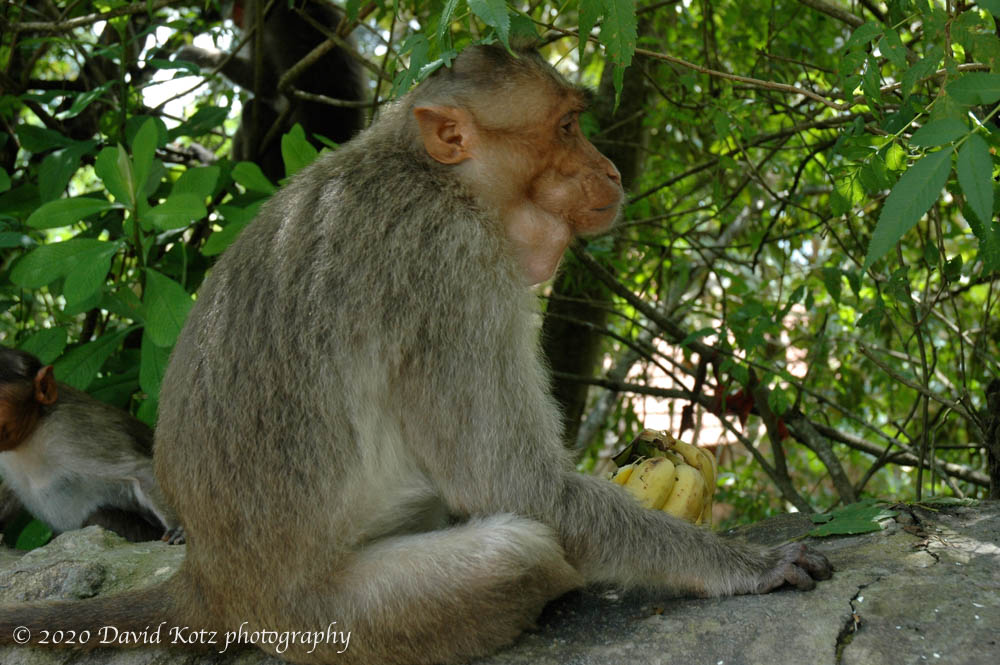
When I stopped to take these pictures, on Chamundi Hill in Mysore, Pam and the kids continued walking. Pam was carrying a small bunch of bananas we had brought for our snack during the outing. Zip! they were gone from her hand, before she had even noticed the monkeys. The following photo shows the monkey stuffing its cheeks with our bananas.
This monkey grabbed the bananas right out of Pam’s hand, while she was walking to Chamundi temple in Mysore. His mouth is stuffed with banana.
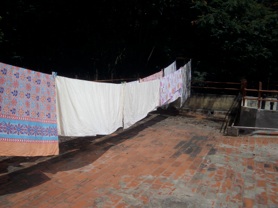
Update: the next day, a dozen monkeys lumbered by while I was out hanging laundry on the roof.
This post was transferred from MobileMe to WordPress in 2020, with an effort to retain the content as close to the original as possible; I recognize that some comments may now seem dated or some links may now be broken.
Diwali is one of the most beloved festivals in India.
The neighbors just fired a cannon. Or, at least, that’s what it sounds like. I nearly jumped out of my chair. Boom! there goes another one.
It is Diwali, or more traditionally, “Deepavali”. “While [it] is popularly known as the ‘festival of lights’, a more appropriate significance is ‘the new year of luck and wealth’.” “The festival marks the victory of good over evil, and uplifting of spiritual darkness.” [Wikipedia] It marks the end of the harvest season, and for many businesses, the start of a new fiscal year. Read on!
I had my last haircut just before we left NH, and it was getting desperately shaggy. Fortunately, IISc has many services available on campus. Most or all are independent vendors, who set up shop in rented nooks here and there. Travel agents, banks, tailors, beauty salons, photocopies, vegies, milk, bread, you name it. So, I tried the men’s salon at the little marketplace near our apartment. I was nervous that either a) it would be unsanitary or b) they would not understand my request and I’d get a bad haircut.
Arish, who appears to be the owner, speaks good English, though his partner (who cut my hair) does not. Arish translated and explained what I wanted. The other man snipped away with what seemed to be 100-year-old scissors, while Arish chatted and worked on another customer. He asked where I was from, how long I was staying, how old I am, and why I have a scar on the back of my neck. In general, I find Indians to be much more willing to ask such questions than Americans, who avoid such “personal” questions.
Anyway, the result was a very good haircut. When that was done, he pulled out his straight razor – those things always make me nervous – and shaved the back of my neck. Finally, he dusted me off with a gentle brush and talcum powder. The price? 20 rupees! (40 cents, at today’s rate.) On the other hand, they used the same dirty scissors and comb as for the previous guy, so as a precaution I washed my hair when I got back home.
This post was transferred from MobileMe to WordPress in 2020, with an effort to retain the content as close to the original as possible; I recognize that some comments may now seem dated or some links may now be broken.
Some photos of our new campus home (Aug-Dec 2008).
I’ve been playing with my new digital SLR camera; I’m just starting to get the hang of it. The IISc campus is a rich opportunity for photographs. Here are a few photos from around campus; this gallery expanded to include more photos taken in 2008. The original 2008 galleries, posted when this blog was on MobileMe, were split into several albums and may have included a slightly different set of photos. In 2020 I re-created them as best I could when that blog was migrated here to WordPress.
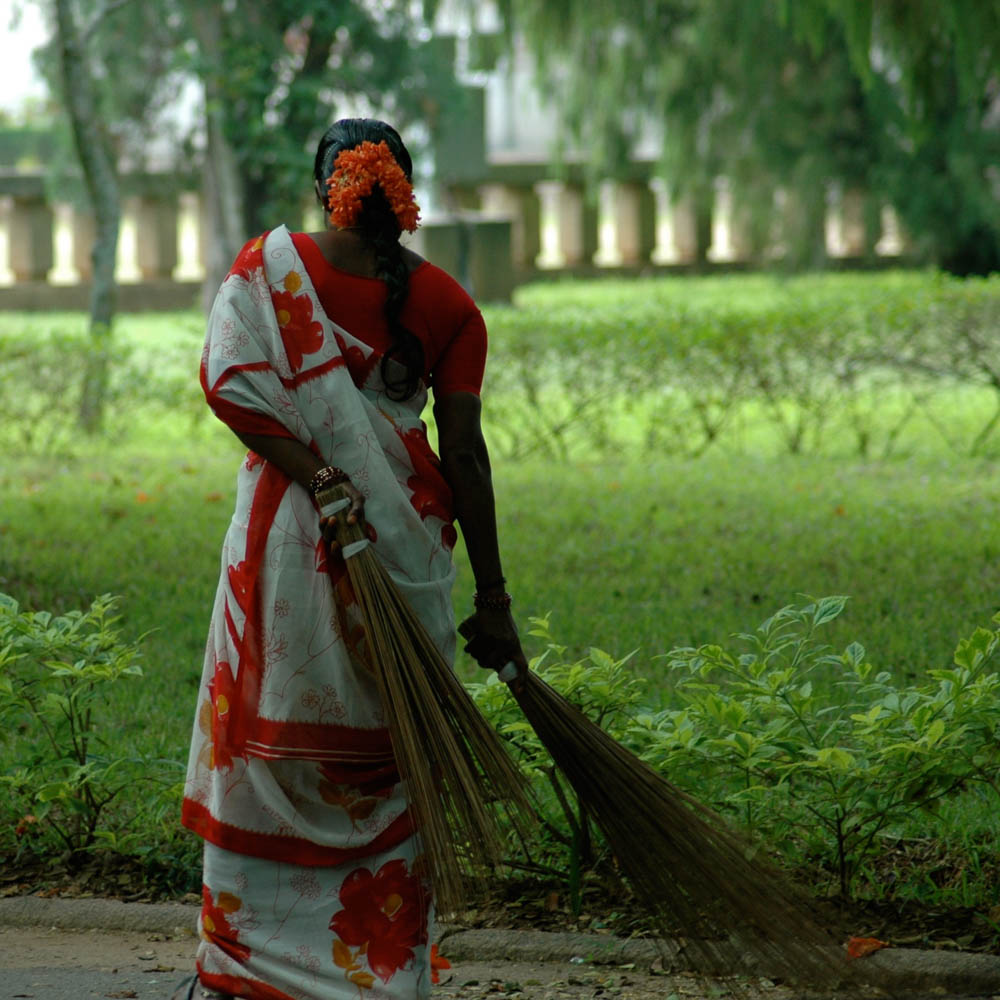
IISc street sweeper.
This post was transferred from MobileMe to WordPress in 2020, with an effort to retain the content as close to the original as possible; I recognize that some comments may now seem dated or some links may now be broken.
To give a sense of where we live at IISc, I captured a brief video walking down the street to our apartment.
This post was transferred from MobileMe to WordPress in 2020, with an effort to retain the content as close to the original as possible; I recognize that some comments may now seem dated or some links may now be broken.
Internet service is cheap and easy to get in the apartments here at IISc.
Although it took a few weeks, we finally have Internet service. We get 2Mbps broadband service via DSL, which works quite nicely. Internet service is cheap and easy to get in the apartments here at IISc. It’s quite a contrast to the near absence of broadband Internet at home in Lyme.
The telephone man came one day with his assistants. The telephone and cable lines enter the house in the living room, but I really wanted the Internet to arrive in the back bedroom, where I would place my Wi-Fi router. No problem, they said.
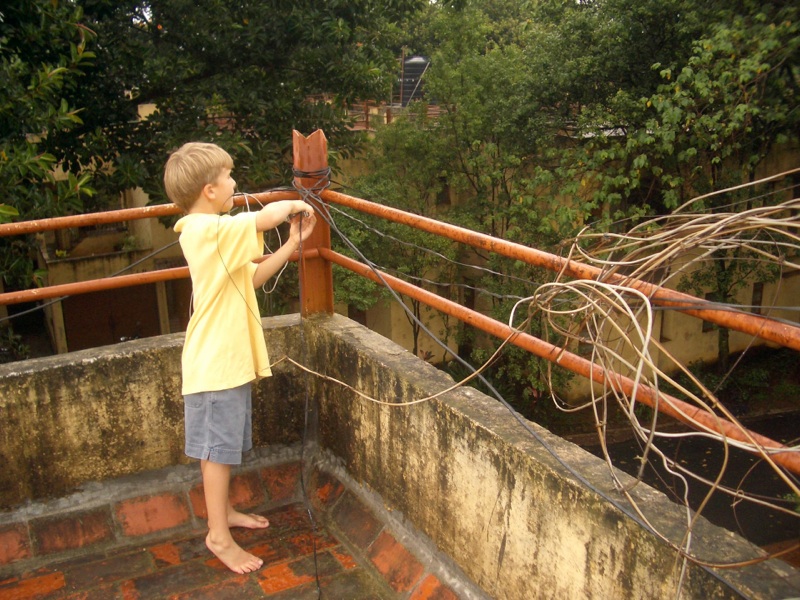
Ten minutes later I saw a cable dangling outside the back bedroom window. They were on the roof – which is flat and which we use frequently because it has the clothesline – and they had cut a splice into the telephone wire and run a new cable across the roof and down the outside to the window. Below, I show the job after adding some electrical tape over the bare copper; their motus operandi seems to be to leave the copper splices open to the elements.
Indeed, this is how all the telephone, Internet, and cable television wiring works; a jumble of ad hoc wires strung across the roof, dangling down the walls and into various apartment windows. Below, Andy cuts some extraneous wire off the tangle – he loves to play with wiring.
This post was transferred from MobileMe to WordPress in 2020, with an effort to retain the content as close to the original as possible; I recognize that some comments may now seem dated or some links may now be broken.
We arrived during the “rainy season”, June through October.
It is rainy in Bangalore. It has rained nearly every day since we arrived, although it is generally quite sunny throughout the morning and early afternoon – saving the downpour for the late afternoon or evening. On occasion, it rains all night.
View of rain in traffic.
The weather in many parts of India is dominated by the monsoons. Bangalore generally does not get the dramatically wet and dry weather of some other parts of the country, but nonetheless we arrived during the “rainy season”, June through October.
The campus, and many of the streets, are designed for heavy rain; on either side of the road there are gutters, at least 6” deep and often as much as 18” deep, to carry away the rainfall. On city streets, these are sometimes covered, with large stone blocks teetering over the gutter and making a sidewalk. Keep a sharp eye, though, because sometimes one will be missing!
August 2008 turns out to be the wettest in 10 years, with over 309cm of rain more than double the average August rainfall of 147cm! Some neighborhoods of Bangalore have flooded this week, although the situation is not nearly as desperate as that in northern India, where huge regions are flooded, thousands are displaced, and dozens or hundreds have died.
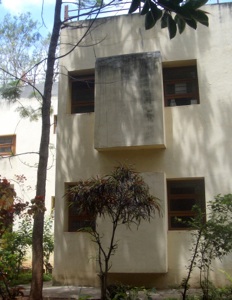
September, traditionally the wettest month of the year in Bangalore (over 200cm average), has just begun, and I’m concerned. I just met with the director of housing at IISc, showing him how the rain has seeped into each of our three closets, dampening our clothes and the paperwork we store. The photo below shows how the closets stick out from the main building; since they have their own (flat) roof they catch rain and it seeps inside. Mildew is clearly visible on the outside the top closet, which happens to be the one for the kids’ room.
The closets seem to be an architectural afterthought.
This post was transferred from MobileMe to WordPress in 2020, with an effort to retain the content as close to the original as possible; I recognize that some comments may now seem dated or some links may now be broken.
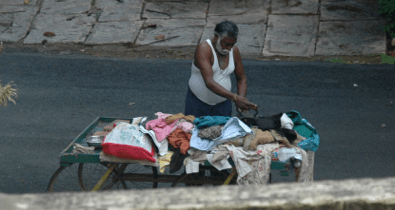
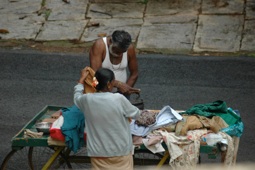
I saw this man in the street outside our apartment one day. He rolls his cart from block to block, ironing the clothes brought to him by apartment housekeepers. I don’t know how he heated his iron, which was the heavy old-fashioned type.
A man stops his cart along our street, about once a week, to iron the neighborhood laundry.
The norm, apparently, is for one’s housekeeper to do laundry every day, scrubbing garments by hand on a rough stone bench in the small courtyard between apartments. Our apartment has a washing machine, so we chose to do our own wash.
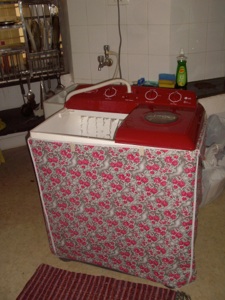
The washing machine (above) has two hoses; you hook one hose to the sink and places the other next to a floor drain. You insert the electrical plug into a wall socket. You add clothes on the left side, turn on the water until you think you have enough, and turn a mechanical dial that causes the machine to agitate for a while. Then you turn another dial to cause it to drain. Then you move the clothes to the right side, which is for spinning; another mechanical dial times the spin. Usually, the water drains too fast and floods the kitchen a little. This process takes a little practice, and a deft touch in the dials.
Either way, the clothes dry on a clothesline strung on the roof. (The roof is flat, with a tiled floor and walls, plus a clothesline on poles.) Of course, this is the rainy season, so it is very humid and rains nearly every day, so we have to keep a sharp eye on the weather.
Someday, we may learn more about the man with the mobile ironing service.
This post was transferred from MobileMe to WordPress in 2020, with an effort to retain the content as close to the original as possible; I recognize that some comments may now seem dated or some links may now be broken.
The IISc campus is, in effect, a wildlife sanctuary.
The IISc campus is, in a way, a huge park with large forested areas, grassy paths, and quiet lanes. The campus is surrounded by a wall, with guards that limit access through the gates; thus, the campus is an oasis from the noise and chaotic traffic of Bangalore.
I am just beginning to explore this campus, which you can see on the Google Map (zoom in) is covered in large forested areas. The main roads are paved, but there is a large central wooded section that is cris-crossed by well-defined walkways. These walkways appear to have been cobblestone, long ago, though today are largely dirt and grass. The space reminds me of a much larger version of the Dartmouth Green, but covered in trees. Although much of the campus seems to be left rough and relatively wild, several buildings on campus (such as my department, ECE) have carefully tended formal gardens out front.
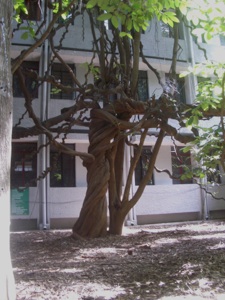
It is apparently illegal to cut trees in India, without a government permit, and the IISc campus has countless varieties of trees – many with numbers and labels that imply they are tracked or studied carefully, All of them are unfamiliar to me, and I look forward to learning more about them. Today I saw an amazing tree; from one tree grew countless twisted vines (branches?) that spread and were suspended on nearby trees. It was impossible to capture the incredible spread of this tree’s vines in single image; they stretch the length of the building and across the street. IISc had even built support poles to hold the branches where they cross the path and cross the road.
As a result of all this green space, there is a lot of wildlife. There are countless birds – my birding eye is not sharp enough to spot them, but every morning there is a cacophony of birdsong. Today we saw some sort of weasel poking around the leaves on the side of the road. I’ve seen small lizards, and I’ve heard there are snakes (and even a “snake rescue” club). There is, I’m told, an entomology group that looks out for the welfare of the insects on campus.
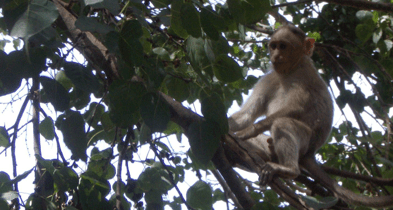
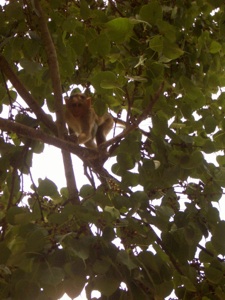
Our kids are delighted by the resident population of monkeys, which we have encountered twice. The first time, there were two adults and two tiny babies on the ground – but we unfortunately had no camera. Today, we spotted three monkeys eating the fruits of a nearby tree (pictured above, and below right). Apparently they will try to steal your food if you are having a picnic, and have been reputed to climb through windows and open the fridge.
IISc is blessed with a verdant, forested campus. We are lucky to live here.
And yet, the IISc campus is a study in contrast. One the one hand, they have a nursery and some staff that tend the trees, shrubs, and gardens. On the other hand, it is not uncommon to see, next a well-tended garden, a large pile of trash, an old pile of bricks, or discarded sinks and other debris. I recognize that I do not understand the whole picture, but it puzzles me that a campus with such inherent beauty is left unkempt in so many places.
This post was transferred from MobileMe to WordPress in 2020, with an effort to retain the content as close to the original as possible; I recognize that some comments may now seem dated or some links may now be broken.
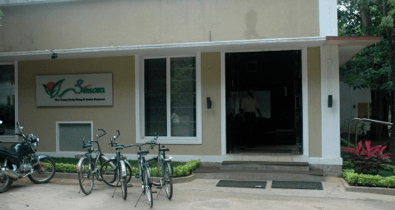
A short way across campus is the Nesara restaurant.
The IISc campus sprawls across a large area; it was founded 100 years ago and at the time was on the outskirts of Bangalore. Large sections of the campus are woods, with some pleasant walking paths. The campus is green, full of trees and birds, and as we discovered today, monkeys (or some other sort of primate).
The kids loved discovering new things, especially the huge millipedes (6 inches long) and 24” seed pods from some of the huge old trees. They quickly made up some new games to play outside the house. Soon I expect they will connect with the many other children who play in the neighborhood.
There is little traffic within the walls of this campus, and lots of people out walking or biking, so it is a very pleasant oasis from the hubbub of Bangalore.
A short way across campus is the Nesara restaurant (below), which has very good Indian food, a friendly family atmosphere, and yet is inexpensive. (The five of us ate a big lunch, with dessert, for $8 total.)
This post was transferred from MobileMe to WordPress in 2020, with an effort to retain the content as close to the original as possible; I recognize that some comments may now seem dated or some links may now be broken.







 David Kotz