India is great – we do like it here – but of course we do miss some things from home.
Mara misses snow already. (Pretty good, since NH has yet to see Fall!)
John misses his friends, his cats, and his house.
Andy misses his favorite toys, particularly a box of electrical parts he uses to make contraptions.
Pam misses a soft bed and fitted sheets.
David misses good beer, rowing, and foggy September mornings. And all the above 😉
This post was transferred from MobileMe to WordPress in 2020, with an effort to retain the content as close to the original as possible; I recognize that some comments may now seem dated or some links may now be broken.
Ganesh Chaturthi is an important holiday, “a day on which Lord Ganesha, the son of Shiva and Parvati, is believed to bestow his presence on earth for all his devotees” [Wikipedia]. We luckily chose to visit one of the major Ganesha temples in the city and got to experience the whole ceremony.
Ganesha is seated at center right.
When we learned that school was closed for the day, so that families could celebrate Ganesh Chaturthi, we decided that we should explore and find a way that we could learn more about this festival celebrating the birthday of Lord Ganesha. We headed out mid-morning, and noticed that the majority of shops had been closed for the day.
We arrived at the Bull Temple, usually one of the more interesting but rather quiet tourist attractions in the south-central part of Bangalore. Ah! But right next to the Bull Temple is a Ganesh temple, lavishly decorated for the occasion, with a huge crowd and a long line to get in.
Ganesh temple near the Bull Temple
We waited in line for an hour, with many other families – no other tourists like us. The mood was festive, and children in line were dressed in their best. Near the front of the line we passed many sidewalk vendors, doing a brisk business offering the goods you might need to make an offering, and a few beggars.
We passed through the temple, receiving the blessing of Ganesh and then a small meal – a rice curry served in a bowl handmade from dried banana leaves, plus a modakam (a sweet ball of coconut, dried fruits, and sugar).
Bull Temple
We visited the Bull Temple too, though it was decidedly less crowded on this day, Ganesh’s birthday.
Tonight, as I write this at home on the IISc campus, I can hear many fireworks displays; at 10pm a rowdy truckload of students passed by, chanting something about Ganesha.
Ten days from now, as I understand it, all the families who have purchased a Ganesha figure for their home (like these) will take it to a nearby waterbody for submersion. [Read more on Wikipedia.]
This post was transferred from MobileMe to WordPress in 2020, with an effort to retain the content as close to the original as possible; I recognize that some comments may now seem dated or some links may now be broken.
Internet service is cheap and easy to get in the apartments here at IISc.
Although it took a few weeks, we finally have Internet service. We get 2Mbps broadband service via DSL, which works quite nicely. Internet service is cheap and easy to get in the apartments here at IISc. It’s quite a contrast to the near absence of broadband Internet at home in Lyme.
The telephone man came one day with his assistants. The telephone and cable lines enter the house in the living room, but I really wanted the Internet to arrive in the back bedroom, where I would place my Wi-Fi router. No problem, they said.
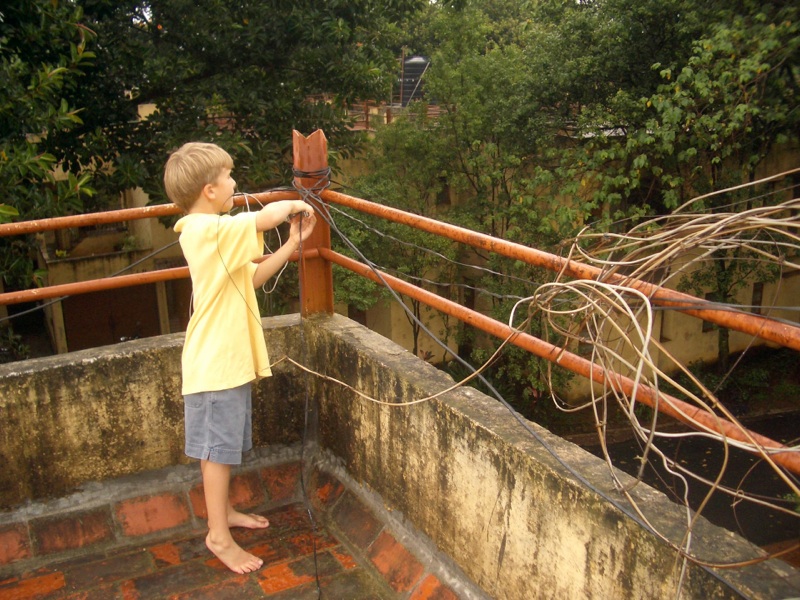
Ten minutes later I saw a cable dangling outside the back bedroom window. They were on the roof – which is flat and which we use frequently because it has the clothesline – and they had cut a splice into the telephone wire and run a new cable across the roof and down the outside to the window. Below, I show the job after adding some electrical tape over the bare copper; their motus operandi seems to be to leave the copper splices open to the elements.
Indeed, this is how all the telephone, Internet, and cable television wiring works; a jumble of ad hoc wires strung across the roof, dangling down the walls and into various apartment windows. Below, Andy cuts some extraneous wire off the tangle – he loves to play with wiring.
This post was transferred from MobileMe to WordPress in 2020, with an effort to retain the content as close to the original as possible; I recognize that some comments may now seem dated or some links may now be broken.
We arrived during the “rainy season”, June through October.
It is rainy in Bangalore. It has rained nearly every day since we arrived, although it is generally quite sunny throughout the morning and early afternoon – saving the downpour for the late afternoon or evening. On occasion, it rains all night.
View of rain in traffic.
The weather in many parts of India is dominated by the monsoons. Bangalore generally does not get the dramatically wet and dry weather of some other parts of the country, but nonetheless we arrived during the “rainy season”, June through October.
The campus, and many of the streets, are designed for heavy rain; on either side of the road there are gutters, at least 6” deep and often as much as 18” deep, to carry away the rainfall. On city streets, these are sometimes covered, with large stone blocks teetering over the gutter and making a sidewalk. Keep a sharp eye, though, because sometimes one will be missing!
August 2008 turns out to be the wettest in 10 years, with over 309cm of rain more than double the average August rainfall of 147cm! Some neighborhoods of Bangalore have flooded this week, although the situation is not nearly as desperate as that in northern India, where huge regions are flooded, thousands are displaced, and dozens or hundreds have died.
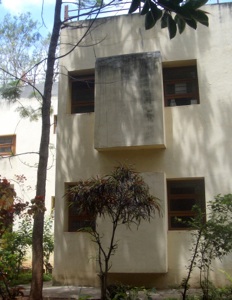
September, traditionally the wettest month of the year in Bangalore (over 200cm average), has just begun, and I’m concerned. I just met with the director of housing at IISc, showing him how the rain has seeped into each of our three closets, dampening our clothes and the paperwork we store. The photo below shows how the closets stick out from the main building; since they have their own (flat) roof they catch rain and it seeps inside. Mildew is clearly visible on the outside the top closet, which happens to be the one for the kids’ room.
The closets seem to be an architectural afterthought.
This post was transferred from MobileMe to WordPress in 2020, with an effort to retain the content as close to the original as possible; I recognize that some comments may now seem dated or some links may now be broken.
Perhaps the most challenging part of our move to India: the Foreigners’ Registration Office (FRO).
Many of my friends and colleagues warned me about the bureaucracy in India. I never imagined it could be as dense and frustrating as it was this week. All the same, it’s part of the cultural-exchange experience!
I just completed the process of registering at the Foreigner Registration Office (FRO), which is required within 14 days of arrival (for anyone staying more than 180 days). The point, it seems, is to inform the government about where you are living. The process was far more complex than what I expected, given the instructions from Fulbright India. (They tell me that Bangalore is notoriously picky and I expect that recent terrorist activity has made the FRO become even more careful.)
In my case, it took four visits to the FRO, three visits to a notary, two visits to a helpful IISc Professor, one visit to a bank, six visits to a photocopier, and over 70 pages of documents. Many of these visits took 1-4 hours, not to mention 30-45 minutes travel from place to place. I estimate that the process consumed about 25 hours of my time over four days.
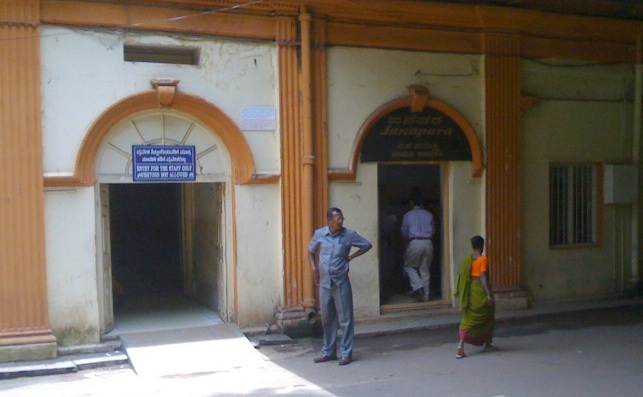
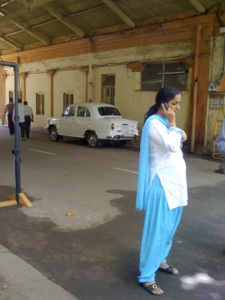
In Bangalore, there is no FRO, so one must register at the Commissioner of Police; I got to know the CoP/FRO office very well last week. I’ll give you the abbreviated instructions about how to with the FRO game, along with some local color I discovered during the process.
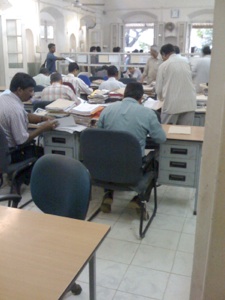
You must achieve success in four lines (some of them more than once) before you win the game. I number the lines here, although no such numbers exist at the FRO and you pretty much have to figure out the process as you go along. A lot of handwaving and gesticulating by various FRO officials is required. In my visits, I interacted directly with at least 8 officials, and there is a roomful of paper-pushers that no doubt were involved somehow as well.
When you arrive, wait in line to sign your name in the reception book. It’s a lot like a hotel reception book, and the smiling woman who holds out the book for you asks, each day, whether you’ve brought your cute children with you again.
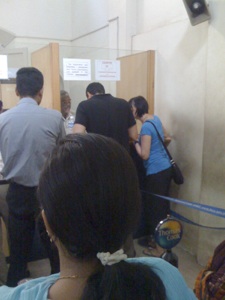
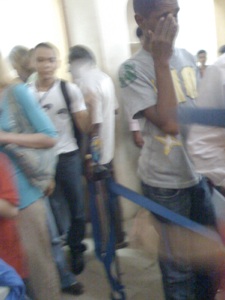
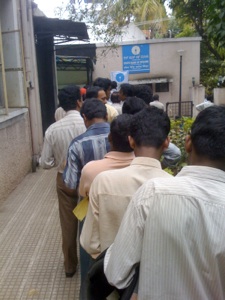
Go through the metal detector and into the door marked ‘Janapara’. I don’t know what that means, but the subtitle is “Single Window.” Inside are four windows, a waiting room, and various desks and various lines. Hmm. Which line is for you? Ah, there’s a line behind the sign “Enquiry and assistance”, but you’ll later learn that really means “You can’t make it to the next line until we like all your documents and sign your paper.” We’ll call this line 2. Be patient but be a little pushy or others will cut in line in front of you. Tell your children, through gritted teeth, to be quiet and stop arguing about their card game in front of all these people starting at you. When you get to the front of the line, keep pushing your papers in front of the two men there, because others will cut in from the side and do the same. Revisit this line many times until you succeed in him stapling and signing your papers. If you don’t have your wife and children with you, go back to the end of the line, as their presence is required.
Go outside and around the building and into the other entrance. Wait in line to meet the assistant commissioner of police. Tell the kids to quit squirming and that this nice man will throw them in jail if you don’t first. When you sit in front of him, smile and hope he signs your papers.
Go back around to the first entrance, push through line #2, and look for the teller-like window at the far right (Counter #1). Wait in line. Wait for the attendant to stop fiddling with his mobile phone. Tell the kids to stop pushing each other and not to knock over the lady in line behind them. Give him your papers.
Wait in the chair for him to call your name. Get your signed receipt.
Come back the next afternoon. Wait in this same line again. Get your residency permit!
Wait, did I say there was a fifth line? No, I didn’t, but neither did they! In step 4.2, you can get your permit, and your spouse’s permit, but not the childrens’ permits. They send you around to the other office, near line number 3, where a man hands you the passports and asks you to make two copies of each. More work!
Go across the street, wait in line to make copies.
Come back, wait in line to give the man your copies. The copies and passports disappear. Ask where to go next.
Oh, I see! Back outside, around to the other office, wait in line 4 at counter #1. Wait some more, until the passports arrive from the other office. Sign the papers, and receive the passports.
If you make it to this point, you win the game!
Of course, at any step you may be told that your documents are not correct, in which you must leave, fix the problem, and come back tomorrow and start again. If you need photocopies, there is a tiny stand across the street that does a booming business making paper for people to bring to the paper-pushers at the CoP. Don’t copy anything back-to-back: single-sided only! This cost me one trip to FRO and another trip to the photocopier.
I sure wish the above process was all there was. Doesn’t it look simple? Not so fast.
On my first visit to the FRO I learned that I needed to have 1 reporting form (provided by them), with photo attached, one registration certificate (another form provided by them), in quadruplicate with your photo attached, two copies of my passport, two copies of my visa, two copies of the passport stamp I received on arrival, two copies of proof of local residence, two copies of my letter of affiliation to IISc, and two copies of a financial guarantee affidavit. And that was just for me; Pam needs all that too, and the kids need all that and a bona fide certificate from their school.
Financial guarantee affidavit? What is that? The FGA is a notarized document, on official government “stamp paper”, in which an Indian citizen guarantees that they will assume financial liability for you if you become destitute. This document was a huge challenge. Put the FRO game on pause, and play the FGA game!
To get the FGA:
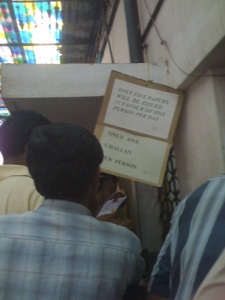
Get stamp paper (Rs.20 denomination). What is stamp paper? It is special blank paper, issued by the government, with a colorful heading. This can be obtained only at State Bank of Mysore, which is not far but not close to the FRO. Wait in line, outside the bank. Expect to spend 1-2 hours waiting in this line (hope that it does not rain). As you get close to the head of the line, holding your “challan” (a slip of paper on which you have written your request for stamp paper), everyone in line is clearly excited that their wait may be over. People push more tightly. Push your challan and money through the first bank window, and then hang out with the other men (they are all men) waiting for their stamp paper. Wait some more. Hope that the man behind the second window will say your name loudly and clearly. Watch 25 men all crowded around the window, so that nobody can reach their paper when it comes out… but everyone is nice and hands the paper back through the crowd to the person named on the paper.
Find an Indian citizen to be your guarantor. [I was very lucky on my first visit to the FRO, because another IISc researcher was trying to register and his host was with him. They explained the FGA process to me and this professor was extremely generous with his time. He took me through the whole process, driving me to the bank and the notary, putting himself legally on the line for me, and exposing personal details such as his salary.] Using the form from the FRO, have him type up the formal language in which he assumes financial responsibility for you, and print it onto the stamp paper. Don’t mess up, or you go back to the bank.
Find a notary. Guarantor signs and stamps, and notary signs and stamps, the FGA. Pay Rs.100. In my case, I was again very lucky. The IISc professor’s father has been using a local notary for years, and they are old family friends. So, on Saturday morning, after filling out the FGA, he drove me over to the notary’s house. (We drove past two camels being ridden down the main street. Nobody but me seemed to notice.) She asked about his father’s health, and there ensued a 20-minute conversation about his father’s recent surgery, etc. This personal communication is clearly an important part of the business process. The actual notarization took 2 minutes and we were on our way.
It’s now Saturday afternoon. You’re still waiting for the kids’ school to to produce bona fide certificates, which the kids will pick up on Monday at school. Rest a little for the weekend, though with some stress because the deadline is Tuesday. If you miss the deadline, your penalty is another trip to the bank (to pay the fee) and the chance to stand in several “bonus” lines at the police station.
On Monday pick up the kids from the school bus and head to the FRO. Forget to make copies of the bona fide certificates, so leave the FRO, cross the street, and make your copies. Each time you cross the street, of course, you spin the wheel of chance and may find yourself out of this game and instead starting the hospital game.
So, back in line number 2 at the FRO. Although the FGA form never indicates, and the FRO staff never tells you, the FGA must mention you and all of your dependents by full legal name. My FGA mentions me by name, and we added “and his wife and three children” for good measure. Sorry! not good enough. I was about to cry. The kids have waited in line for a second day, and despite all the logic which indicates who are my wife and children, the FGA must be changed. We will need to come back tomorrow – and keep the kids out of school so they can visit for a third time. They told me to change the notarized document (did I hear that right?), have the guarantor sign and stamp it again, have the notary sign and stamp it again.
I meet our Fulbright-appointed facilitator, who was able to come to the FRO this time. He suggests that we take an auto-rickshaw directly to the notary, even though she is not answering her phone. Perhaps by the time we arrive she will be there. This auto ride was fascinating, because we took numerous twists and turns through tiny alleys, attempting to find the right address. People’s wet laundry wiped the side mirrors of our auto – which is itself a very narrow vehicle, so that tells you how narrow were the alleys. Many times we asked passers-by or other drivers for directions. The great thing about these open-air autos is that it is a very social experience.
We wait. Wait some more. Wait 2 hours, no notary. Meanwhile, I watch the construction site next door. A small crew of workers is building a new house. Women carry baskets of sand and concrete on their heads over to the portable cement mixer. A boy, perhaps 12, helps out and pushes the mixer to the truck at the end of the day, My assistant tells me that they are paid little: Rs200 for men, Rs100 for women, and Rs25 for children, despite the ban on child labor, and work 8-10 hard hours. Most are barefoot or wearing flip-flops. This is typical of construction workers I’ve seen.
We give up and I go back to campus. It’s now evening, and pouring rain. I walk over to the professor’s office and we tamper with, er, modify the notarized document as instructed. A tricky business involving white-out and some tricks of Microsoft Word to put the new words in the right place.
The next morning, I call the notary and ask if I can come again. She asks me to be there in 30 minutes, nigh impossible given the traffic. I race out and try to find an auto driver willing to take me. Often, they refuse because they don’t know the neighborhood around the destination, and they are paid by km not per hour.
Phew, it takes a few hours, but I get the document notarized and I’m off to the FRO to rejoin line #2. Remember the FRO?
Although I found it extremely frustrating, and downright tiring, I tried to keep reminding myself that this process was just another part of the cultural exchange, and that I was experiencing – full force – one part of the culture of India. The process is tedious, sweaty (lots of people crammed into old offices waiting in lines for hours), and difficult (imagine three fidgety children waiting in line with you, for hours, three days in a row). On the way, however, I experienced the generosity of Indians – like the professor, who volunteered half a day of his time to help me, or the people on the street who helped my auto driver find the house where the notary lives; I enjoyed the conversation between the professor and the notary, in which they discussed the health of his father and other family matters for 20 minutes before conducting business for 2 minutes; I was awash in the sights and sounds and smells of the back alleys of Bangalore as I took the auto from place to place; I saw two people riding camels down the street; and I enjoyed a lot of people-watching at the police station, people who were each trying to get their own paperwork for one purpose or another.
So, that’s done. Now I’m resting up for the next challenge: our visas were accidentally one month too short for our stay, so we need to extend the visas. I hate to think what that will require!
This post was transferred from MobileMe to WordPress in 2020, with an effort to retain the content as close to the original as possible; I recognize that some comments may now seem dated or some links may now be broken.
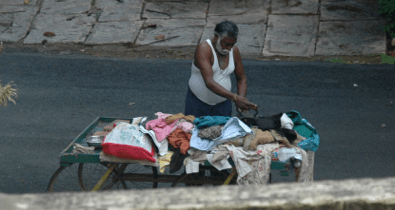
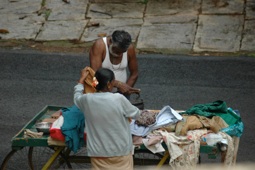
I saw this man in the street outside our apartment one day. He rolls his cart from block to block, ironing the clothes brought to him by apartment housekeepers. I don’t know how he heated his iron, which was the heavy old-fashioned type.
A man stops his cart along our street, about once a week, to iron the neighborhood laundry.
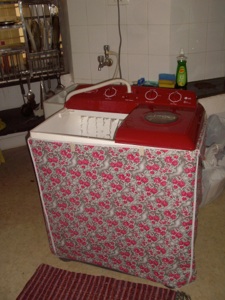
The norm, apparently, is for one’s housekeeper to do laundry every day, scrubbing garments by hand on a rough stone bench in the small courtyard between apartments. Our apartment has a washing machine, so we chose to do our own wash.
The washing machine (above) has two hoses; you hook one hose to the sink and places the other next to a floor drain. You insert the electrical plug into a wall socket. You add clothes on the left side, turn on the water until you think you have enough, and turn a mechanical dial that causes the machine to agitate for a while. Then you turn another dial to cause it to drain. Then you move the clothes to the right side, which is for spinning; another mechanical dial times the spin. Usually, the water drains too fast and floods the kitchen a little. This process takes a little practice, and a deft touch in the dials.
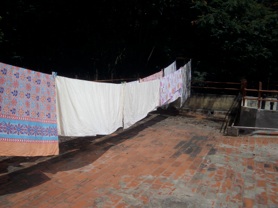
Either way, the clothes dry on a clothesline strung on the roof. (The roof is flat, with a tiled floor and walls, plus a clothesline on poles.) Of course, this is the rainy season, so it is very humid and rains nearly every day, so we have to keep a sharp eye on the weather.
Someday, we may learn more about the man with the mobile ironing service.
This post was transferred from MobileMe to WordPress in 2020, with an effort to retain the content as close to the original as possible; I recognize that some comments may now seem dated or some links may now be broken.
The IISc campus is, in effect, a wildlife sanctuary.
The IISc campus is, in a way, a huge park with large forested areas, grassy paths, and quiet lanes. The campus is surrounded by a wall, with guards that limit access through the gates; thus, the campus is an oasis from the noise and chaotic traffic of Bangalore.
I am just beginning to explore this campus, which you can see on the Google Map (zoom in) is covered in large forested areas. The main roads are paved, but there is a large central wooded section that is cris-crossed by well-defined walkways. These walkways appear to have been cobblestone, long ago, though today are largely dirt and grass. The space reminds me of a much larger version of the Dartmouth Green, but covered in trees. Although much of the campus seems to be left rough and relatively wild, several buildings on campus (such as my department, ECE) have carefully tended formal gardens out front.
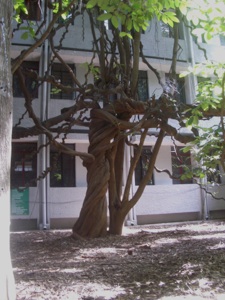
It is apparently illegal to cut trees in India, without a government permit, and the IISc campus has countless varieties of trees – many with numbers and labels that imply they are tracked or studied carefully, All of them are unfamiliar to me, and I look forward to learning more about them. Today I saw an amazing tree; from one tree grew countless twisted vines (branches?) that spread and were suspended on nearby trees. It was impossible to capture the incredible spread of this tree’s vines in single image; they stretch the length of the building and across the street. IISc had even built support poles to hold the branches where they cross the path and cross the road.
As a result of all this green space, there is a lot of wildlife. There are countless birds – my birding eye is not sharp enough to spot them, but every morning there is a cacophony of birdsong. Today we saw some sort of weasel poking around the leaves on the side of the road. I’ve seen small lizards, and I’ve heard there are snakes (and even a “snake rescue” club). There is, I’m told, an entomology group that looks out for the welfare of the insects on campus.
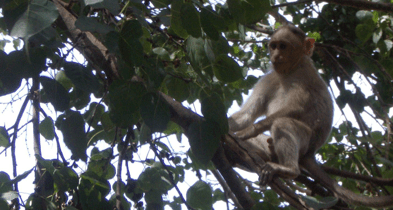
Our kids are delighted by the resident population of monkeys, which we have encountered twice. The first time, there were two adults and two tiny babies on the ground – but we unfortunately had no camera. Today, we spotted three monkeys eating the fruits of a nearby tree (pictured above, and below right). Apparently they will try to steal your food if you are having a picnic, and have been reputed to climb through windows and open the fridge.
IISc is blessed with a verdant, forested campus. We are lucky to live here.
And yet, the IISc campus is a study in contrast. One the one hand, they have a nursery and some staff that tend the trees, shrubs, and gardens. On the other hand, it is not uncommon to see, next a well-tended garden, a large pile of trash, an old pile of bricks, or discarded sinks and other debris. I recognize that I do not understand the whole picture, but it puzzles me that a campus with such inherent beauty is left unkempt in so many places.
This post was transferred from MobileMe to WordPress in 2020, with an effort to retain the content as close to the original as possible; I recognize that some comments may now seem dated or some links may now be broken.
We arrived during the monsoon season, which in Bangalore means that it rains every day, usually as a brief downpour in the afternoon, but sometimes as a drenching rain overnight.
It’s impossible to characterize the weather of India, which is a huge subcontinent with ecosystems that range from the tropics to the Himalayas. Bangalore is at 3000’ above sea level, so it is considerably cooler than most of south India; we arrived during the cool part of the year, aka the monsoon season. Lots of rain, and as a result the IISc campus is awash in greenery.
During the week we have been here the weather has been extremely pleasant, highs in the 70s and lows in the 60s. It is humid, of course, because it rains every day. (Well, almost every day: yesterday was the first day it did not rain at all.) It is usually cloudy, or overcast, and strong sunlight is rare. This afternoon, when it was sunny, was the first time it seemed somewhat hot.
Of course, come March and April it does get hot here, with highs in the 90s. Although we have no A/C in the office or apartment, we have numerous ceiling fans and many windows.
This post was transferred from MobileMe to WordPress in 2020, with an effort to retain the content as close to the original as possible; I recognize that some comments may now seem dated or some links may now be broken.
Cell phones are pervasive in Bangalore, and in most urban areas of India.
Cell phones (“mobiles”) are pervasive in Bangalore, and in most urban areas of India. (iPhones go on sale here at end of August.) One can find tiny shops everywhere that offer “top-up” services to add more rupees to your prepaid cell plan. Getting a SIM card, however, is a lot of work!
The first day, we tried to arrange for cell-phone service. Unfortunately, because of concerns about terrorism, one cannot simply buy a SIM card like you do in Europe. You must present proof of residency and identification, because each SIM card (and its phone number) must be registered to a named person.
This week, I took a letter from the department chair attesting to our residency, and our passports, to one of the many phone shops downtown. I had to fill out a lengthy form, listing both my US and India address, passport number, and attach photocopies of my passport, NH driver’s license, and letter of residency. Unfortunately, I had not brought photocopies. The shop owner sent his “boy” to photocopy them. Not wanting to let go of my passport, I tagged along. We went outside, across the street, up the road, and down a muddy, trashy alleyway to a tiny shop that provides a photocopier, telephones, and internet terminals for a few rupees. All this paperwork must be filed with Airtel, and effectively, with the government, before my phone is ready to us.
Cell service is inexpensive: 1 rupee (2.5 cents) per minute to anywhere in India, and a penny to send an SMS within India. Incoming calls are totally free.
This post was transferred from MobileMe to WordPress in 2020, with an effort to retain the content as close to the original as possible; I recognize that some comments may now seem dated or some links may now be broken.
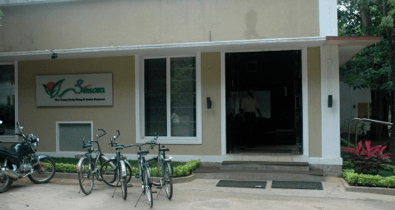
A short way across campus is the Nesara restaurant.
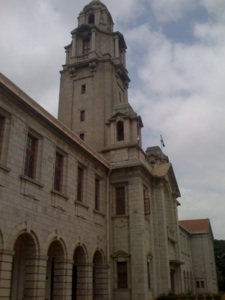
The IISc campus sprawls across a large area; it was founded 100 years ago and at the time was on the outskirts of Bangalore. Large sections of the campus are woods, with some pleasant walking paths. The campus is green, full of trees and birds, and as we discovered today, monkeys (or some other sort of primate).
The kids loved discovering new things, especially the huge millipedes (6 inches long) and 24” seed pods from some of the huge old trees. They quickly made up some new games to play outside the house. Soon I expect they will connect with the many other children who play in the neighborhood.
There is little traffic within the walls of this campus, and lots of people out walking or biking, so it is a very pleasant oasis from the hubbub of Bangalore.
A short way across campus is the Nesara restaurant (below), which has very good Indian food, a friendly family atmosphere, and yet is inexpensive. (The five of us ate a big lunch, with dessert, for $8 total.)
This post was transferred from MobileMe to WordPress in 2020, with an effort to retain the content as close to the original as possible; I recognize that some comments may now seem dated or some links may now be broken.







 David Kotz
