
Part of a series of posts about my travel in Iceland, including visits to eleven waterfalls.
Although the trigger for this visit to Iceland was to board the National Geographic Endurance for an expedition cruise to southern Greenland, photography was the focus of my extended stay in Iceland. This post highlights photos from my first stop in Iceland: Jökulsárlón (aka Glacier Lagoon) and its adjacent Diamond Beach. While I’m at it, Fjallsárlón lagoon is just down the road and offers equally enthralling scene of an adjacent glacier calving bergs and berglets into a tidal lagoon. Read on to see photos!
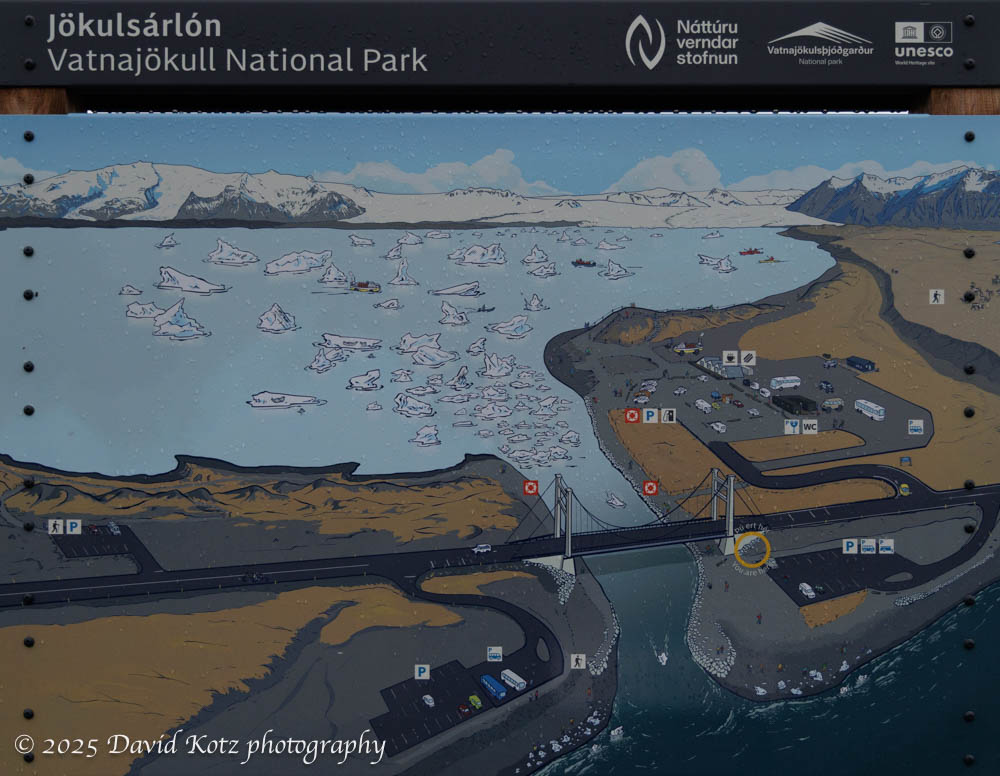
These lagoons formed when the Breiamerkurjökull glacier began to retreat about 100 years ago, leaving a terminal moraine (now the beach, and supporting the Ring Road) with a shallow lagoon trapped between the glacier and its outlet through the moraine. Ice calves from the glacier, leaving bergs large and small floating around the lagoon; eventually, the tide carries them out to sea, where waves often wash them up on shore. The beach here is comprised of black, gritty sand resulting from the centuries of the glacier’s efforts to erode the volcanic bedrock. As a result, the all-black beach is littered with white (or clear) chunks of ice in beautiful shapes and all sizes, while waves pound the larger bergs that are grounded in the inter-tidal zone.

spurting through a hole in the berg’s center.
Anticipating that I would want to visit Diamond Beach at sunrise – in hopes the early-morning light would accentuate the crystalline on-shore bergs, and to avoid the throngs of tourists who show up later in the day – I actually spent my first day after returning from Greenland driving the Ring Road east, to stay at Hótel Jokulsarlon – Glacier Lagoon. It’s brand-new, beautifully appointed, with fine dining, and only a five-minute drive from Diamond Beach and the Glacier Lagoon. Perfect for an early start!

Anticipating sunrise at 0535 and high tide at 0700, but waking to heavy cloud cover, I reached the beach at a leisurely 0545. Three other photographers were already there, tripods deployed, exploring a spectacular scene littered with thousands of bergy bits. I thought back to the guidebook’s description of this beach as “one of the most dangerous places to photograph in Iceland”, because unusually large waves can appear without warning. “Many people have both ruined their equipment on this beach and put themselves in serious danger.” I kept a keen eye on the conditions, snapping almost 1,000 photos and videos in just over an hour. I selected just a handful of my favorites for the photo gallery, including a composite video that attempts to capture the drama of this rugged beach. The cloudy conditions were perfect for photographing ice!

After a brief breakfast at the hotel, I was back – this time, to visit Glacier Lagoon (aka Jökulsárlón) and Fjallsárlón lagoon. I mention Jökulsárlón above; it feeds ice to the Diamond Beach. Just 10km further down the road, the Vatnajökull glacier spills into Fjallsárlón lagoon. Here, I watched as Zodiacs brought tourists out into the lagoon, around the icebergs, and close to the face of the glacier. In the photo below you can see two of those Zodiacs, one a mere black speck in this landscape of water and ice… giving a small sense of the vastness of this glacier. Indeed, I expect the Zodiac stayed a safe distance from the glacial face, meaning (due to the perspective) that face is even larger than it appears in this photograph. Check out the photo gallery for a close-up view, and more scenes from Jökulsárlón and Fjallsárlón.

Note the two Zodiac tourboats at distant center!
Gallery: All the photos mentioned above are in one photo gallery; I recommend visiting in slideshow mode!
Reference: above I refer to a guidebook, Photographing Iceland, by Einar Guðmann and Gyða Henningsdóttir; translated by Abigail Charlotte Cooper. JTV útgáfa 2019.

Jökulsárlón (aka Glacier Lagoon) and its adjacent Diamond Beach are at lower right;
as you can see, this tidal glacier drains the largest icecap on Iceland.

 David Kotz
2 thoughts on “Iceland – Diamond Beach”