
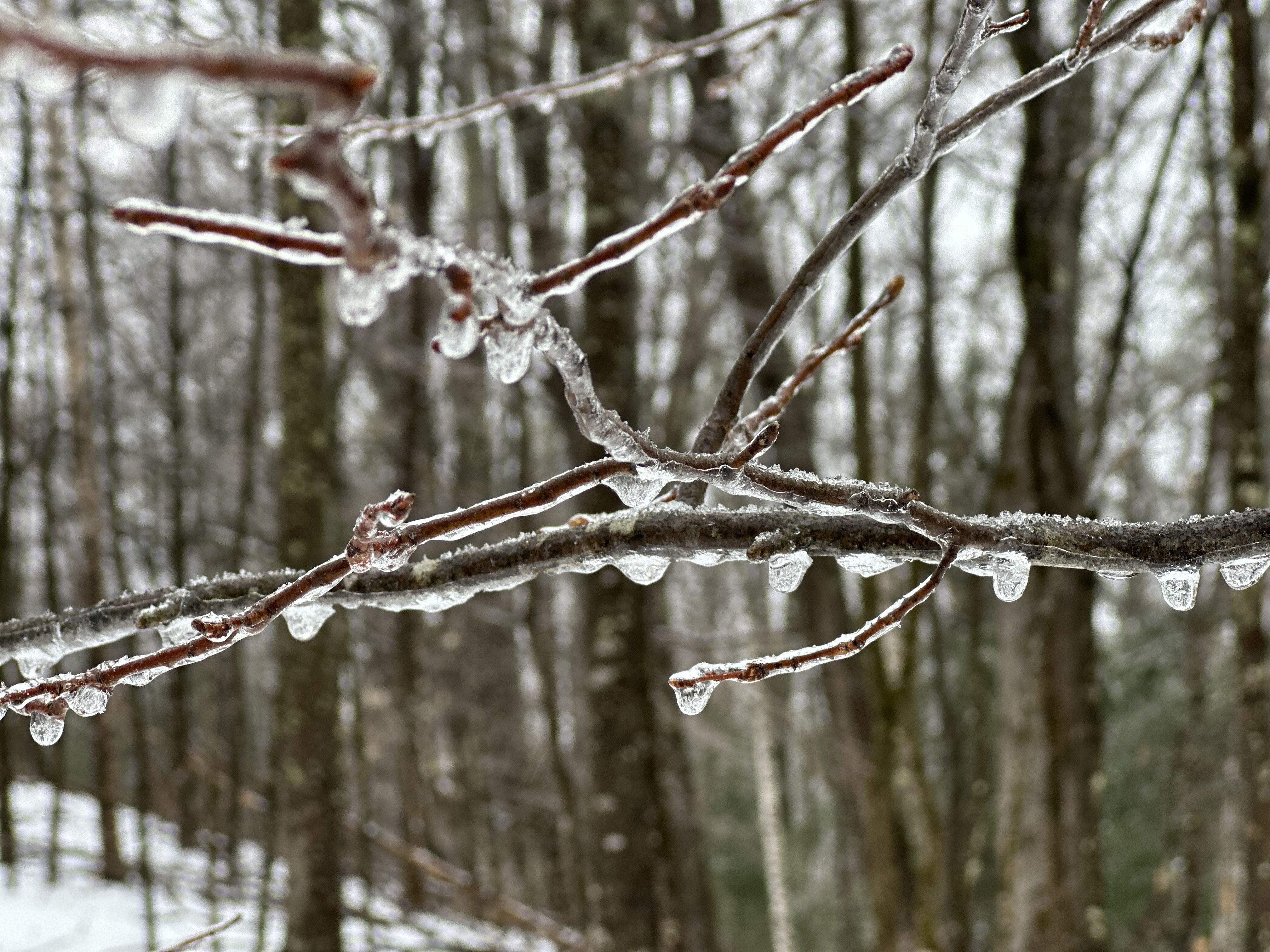
It was like a switch had flipped. February here in New Hampshire was snowy and consistently cold – the temperature never rose above freezing, which led to a fantastic season for outdoor winter activities. But on the first of March the weather immediately started to warm. The lower elevations of Lyme, where I deploy my wildlife cameras, lost all their snow — only to see the snow return twice in brief snowstorms. My wanders through the forests of Lyme led me to discover exciting new locations to capture video of wildlife activity… and to meet some of these critters face to face! Read on.
Last weekend, I was scrambling up a steep, rocky slope here in the Connecticut River Valley, not far from the center of Lyme. (This is the “new location” I highlighted in last month’s video posts.) The granite cliffs here have weathered over millenia, leaving boulders strewn about the slopes of this small hill. The jagged boulders lay in piles, forming crevices, nooks, and small caves that are ideal dens for coyotes, bobcats, porcupines, and more. I was here to check on my cameras, deployed two weeks earlier, but today I was distracted by following a set of fresh tracks. I wanted to find out where they might end.

Sure enough, the tracks ended in one of the many nooks and crannies, above. A porcupine den, judging by the pile of porcupine scat near its front entrance. I took some photographs and started descending, choosing careful footing on the fresh, wet snow that covers loose, dry leaves from last fall – a sure recipe for an unexpected and undesired slide down the steep slope. I glanced down the slope to see a big ol’ porcupine, lumbering slowly but steadily up the slope, directly toward me.

I was standing still, holding to a tree for balance while filming its approach. He had yet to notice me, and I wondered whether it might be courteous to say something… but what? “Excuse me, porky, but I was just passing through and noticed your fine home. I’ll be moving along now. Don’t worry about me.” I won’t deny that, at this point, I was thinking about his pointed spines, ultra-sharp claws, and sharp teeth, and whether it might not be such a great thing to be standing between him and his home.

Eventually, when he was close, he noticed me. He paused, mid-stride, and considered what to do. He went onward, with a bit more spring in his step. As he passed I had to twist my torso, until I could twist no more; I whirled around to continue filming his path up the hill… and that motion caused him to sprint toward home. Porcupines normally move very slowly, but this guy really hoofed it up the hill. (You can see all this action in the video below!)
I resumed my careful descent. After another few meters I decided to stop and don my gloves. After several minutes riffling through my pack, mumbling to myself as I slipped on warm gloves, I shouldered my pack and began again down the hill. Just then, I heard a loud crackle and rustle to my right. There, between two huge boulders, was a crevice filled with dry leaves, sheltered from last night’s snowfall and today’s dripping tree branches. Standing in the middle was a coyote, looking directly at me, ears perked. After studying me a few moments, it turned and galloped away, up the hill and out of sight. Clearly, it had been napping in that cozy bed of dried leaves. The encounter happened so fast I did not have time to pull out my phone to capture a photo or video. But I did explore the crevice, and record video to include in this month’s installment.

Wow. I’ve enjoyed watching hundreds of video recordings from my wildlife cameras, but had yet to come face to face with some of my subjects, in the field.
My attention turned to a different pile of boulders where I had placed several cameras a few weeks earlier. There, I knew, I would find dozens of video clips as a pair of porcupines came and went from their den. There, I knew, was an open-faced cave that I hoped would be used by coyotes or bobcats to enjoy the morning sunshine. There, I recalled, I had placed one camera on top of the boulder pile, where I’d seen tracks during my last visit. Little did I know that I would see the local bobcat so often – or watch it try to enter the porcupine’s den! Click on the following to see a sampling of videos for this area – which I now call “Region two” – including a video of my personal encounter with the porcupine, and the coyote’s napping spot.

Region one. Meanwhile, back in my traditional locations, I have two videos to share with you. The first is from the forested hillside that is home to most of my prior videos – and this month brings us video of deer leaping, coyotes hunting, and a turkey looking for mates. I especially like the daytime video of coyotes – at least three different coyotes this month.

Riverside. Meanwhile, the frozen river acts like a wildlife superhighway. My riverside camera remained there for the first nine days of the month; in this video you’ll see an animal I’ve never before captured on camera: the river otter! And, a red fox, a skunk, and a bobcat, all passing by.

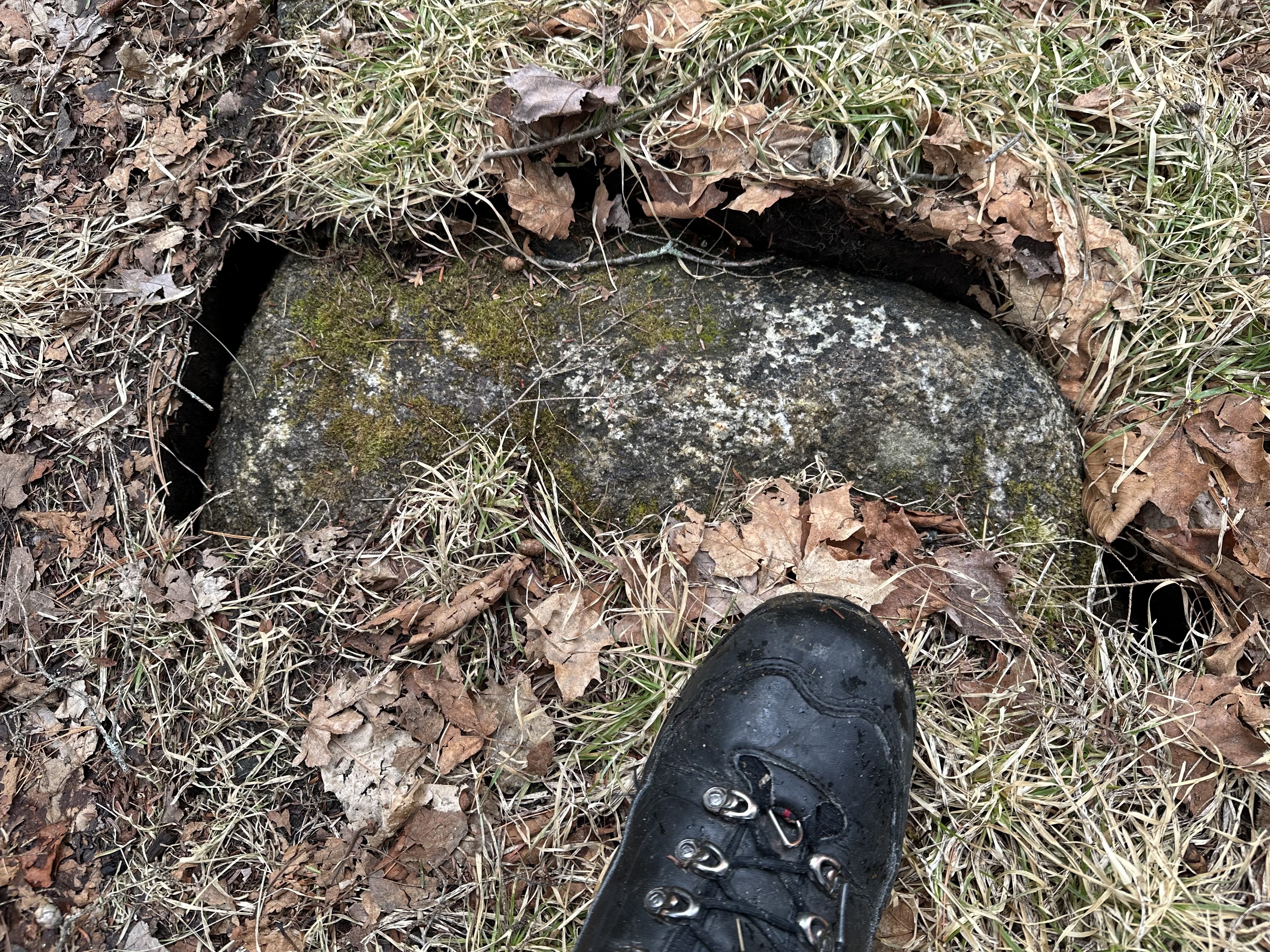
One final tidbit. Spring is a time of freeze-thaw cycles. The ground has been frozen all winter, and thaws as the spring warms – but often refreezes on cold nights, and thaws during the day. The wet soil expands as it freezes, and contracts as it thaws. The result seems to pump rocks toward the surface. One day in mid-March, I was walking down the trail and noticed how the near-surface rocks appear to have been pushed up by frost, then settled back down, leaving a gap to the soil around them. Nifty!

More about bobcats, coyotes, and porcupines
NH Fish & Game has very interesting web pages about bobcats and coyotes. (What’s the difference between Bobcats and Canada Lynx? Are we seeing coyotes or coydogs? read their website!)
On March 7, NH Public Radio (NHPR) broadcast an interesting story about The fragile balance of deer and coyotes in late winter. The deep snow gives coyotes an advantage over the deer.
I’ve been thrilled to see bobcats in my video captures. This month, though, the Upper Valley Land Trust (UVLT) posted an even cooler video from one of their cameras, aimed at a bobcat den. Wow! Very cool.
The UVLT also posted about how porcupines eat bark from young saplings; I didn’t see exactly this sort of evidence, but I saw plenty of sapling twigs nibbled off. UVLT posted a video and wrote
During the winter, porcupines often chew through the rough outer bark of various trees, including pines, fir, cedar, and hemlock, to get at the cambium (the inner bark). Sugar maples, young beech trees, basswood, apple, and aspen are some favorite trees. To learn more about porcupine feeding techniques, read this article from Mary Holland’s blog ‘Naturally Curious’.
Until next month!

 David Kotz