
As I walked through the hotel gates on Sunday morning, Raju was there, as arranged after yesterday’s outing. I reminded him I had less time today, and asked to go to Old Delhi. I suggested he drop me at Jama Masjid (the largest mosque in Delhi and, I think, in India), because I knew that neighborhood involves many small streets and alleys filled with tiny stalls in which vendors sell every imaginable product or service. It was Sunday morning, so it would be less crowded than usual … but no doubt full of interesting sights and sounds. Read on!
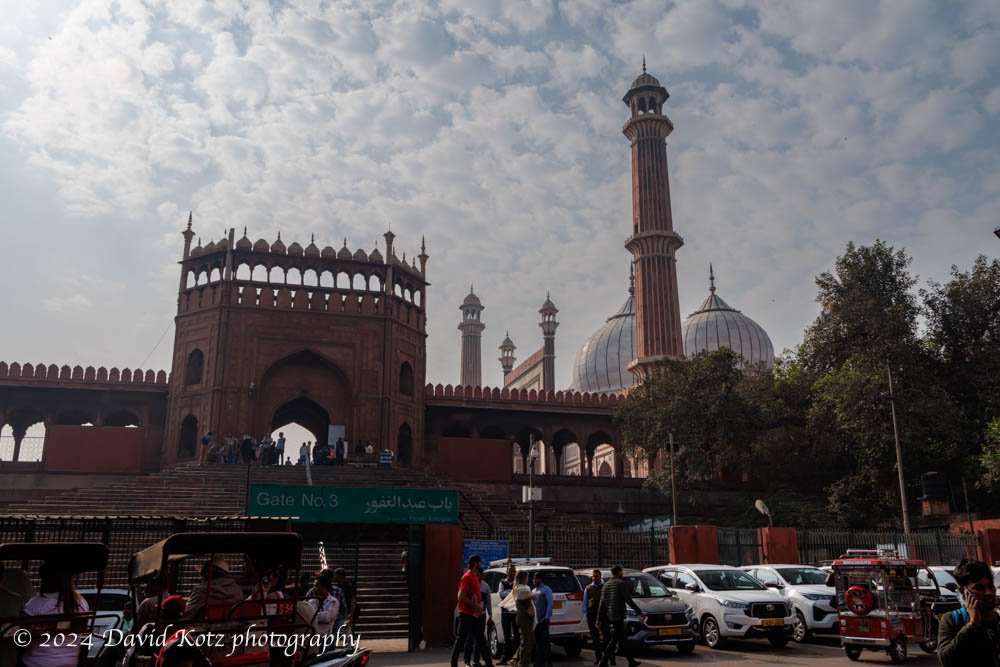
In light traffic we zipped through the broad streets of New Delhi and soon were wending our way through the busier, narrower streets of Old Delhi. Once we were close enough, I hopped out and started walking the streets [video], dodging the cars, two-wheelers, tuk-tuks, bicycle rickshaws, stray dogs, and busy people setting up shop for the day. I passed shops with live chickens, in cages, next to an open counter piled with chicken meat… then another shop with counters stacked high with what appeared to be lamb’s feet (yes, just the feet). In this neighborhood, you can find anything. Need a new horn for your tuk-tuk? An old man sat on the sidewalk, a small table in front of him, covered in what appeared to be bare speakers, each with wires dangling and likely extracted from scrap autos. Two men watched while he touched two wires to a car battery; HONK! – the speaker blared, just like a tuk-tuk.

I wound my way through a maze of alleys, sometimes following the wide-eyed tourists sitting in the back of a three-wheeled, two-passenger bicycle rickshaw, its driver pedaling them through this neighborhood just as I had experienced during my first visit. The buildings here are old, with electrical and telephone cables strung every which way above the alleys, which seem to have no discernable layout.

I popped out of this warren of narrow streets onto Chandni Chowk, a main street where there are bigger shops, a Sikh temple, a Hindu temple, and some government buildings. It was busy with shoppers and tourists. I was chased by a bicycle rickshaw driver – more than once – who wanted to offer me his service, to take me to see a spice market or the Jama Masjid or whatever. They were quite persistent! I just wanted to walk.
Everywhere I went I noticed the street vendors now all take mobile payments. Cash is increasingly rare, and at some places, I noted the cash price was higher than for a mobile payment… specifically to discourage use of cash. There are multiple platforms – PayTM and PhonePe seemed most common – and they seem to be used even for tiny payments like Rs30 ($0.35) for a cup of chai. Many small vendors use a small battery-powered box, with a QR code on the front; when a customer pays, the box speaks – literally – articulating the amount paid so both the vendor and the customer can hear it. Impressive.

I walked to the head of Chandni Chowk, across the main road from the Red Fort, near where I was to meet Raju after my walk. I encountered a very busy open-air market, with some vendors in established stalls and others who had simply laid out their wares on a blanket along the sidewalk. At one point, people suddenly started shouting, and I saw many apprehensive faces as the informal vendors quickly bundled their wares into their blankets and scurried away. I had the sense that a warning shout was passed from vendor to vendor, perhaps about the impending arrival of an inspector who may fine those who were not authorized to sell there. Interesting.
I walked down the busy road to a place where Raju could pick me up, and we headed back to the hotel. He had hopes I would visit another market, as I did yesterday, “just to look”. I am thankful for Raju’s kindness and efforts to help me experience Delhi, and to appreciate his religion and his family, and bade him well, but was not interested in yet another shopping experience.
Please check out the gallery for a few more photos.
Food. After my two days of exploration, I had two days of meetings at academic and research organizations in Delhi. And I had some outstanding meals, including a seven-course dinner at Dhilli inside the Oberoi, a delightful Mediterranean dinner with an old friend at MED, and a five-course lunch at Indian Accent. At the latter the lunch concluded with an elaborate presentation (shown below) of daulat ki chaat, a unique Chandni Chowk specialty I’d seen on the streets just two days earlier, a chilled dish made of fluffy whipped milk and sugar with saffron flavoring. These two meals alone were worth a visit to Delhi! I include a a few photos in the same gallery, including the menu at Dhilli.

Postscript. While in Delhi I noted the smoggy air, and it was often a topic of conversation among the locals. It was bad (AQI 166), but bearable. I left Delhi on Tuesday 10 December. Less than a week later, I learned the air quality was really bad, and getting worse: “the Air Quality Index (AQI)… crossed the 450 mark late on 16 December. AQI levels in the [national capital region] are expected to worsen over the coming weeks due to adverse meteorological conditions. Expect disruption to flights, rail services and road journeys due to low visibility caused by heavy smog.”

 David Kotz
Oh man – now I’m hungry! I’ve never heard of daulat ki chaat, but now I Must Find Some Somewhere.