
India is one of my favorite places to visit. After we spent a year living in Bangalore, I used to visit at least once every year… until Covid interrupted. As a result, I have been away for six years. This week I had the opportunity to return to India on Dartmouth business… spending a few days in Delhi and a few days in Bangalore (Bengaluru). I arrived in Delhi two days early, giving me time to explore some of my favorite places. Although this blog post covers only one day, there is a lot to say… read on!
After flying over 13,200km to Delhi via Dubai, I was glad to see my name on a Oberoi Hotel placard as I exited customs in Delhi’s international airport. After a comfortable ride downtown (it was 3am and there was none of Delhi’s notorious traffic), and we arrived at the Oberoi, a bellhop led me directly from the car to my room – no need to stop at the desk, I was already checked in. It was now 4am and I was glad to settle in for some sleep.
I was determined to wake in time for breakfast, despite the ten-and-a-half hour timezone change. I pulled open the curtains to a broad view of New Delhi, with Humayan’s tomb visible not far away. Unfortunately, the air was incredibly smoggy. Delhi struggles with notoriously bad pollution; AQI about 166, but yesterday it was 258 and last week it was over 300. (At my New Hampshire home, for reference, the AQI was 18.) I pulled out my KN95 masks, for use while outside.
After my favorite south-Indian breakfast – idli and sambar, masala dosa, masala chai, and local fruits – I grabbed my camera and was out the door at noon. I was eager to walk to India Gate and Humayan’s Tomb – partly to revisit these famous sights, and partly to shake off the jetlag with exercise and sunshine.
As I exited the hotel gates an autorickshaw (tuk-tuk) pulled up almost immediately. A very pleasant older man stepped out to inquire if I would like a ride, or even better, a tour. I refused, explaining that I would prefer to walk.
After walking several blocks, along the tree-lined sidewalk, I found myself strolling alongside another man. He made a friendly comment in English, and we struck up a conversation. Chatting as we walked, I learned he is a chef at my hotel, and he was heading home after the breakfast shift. At the point where he needed to turn aside for his ride on the Metro, he was giving me directions to the first of the major sights I hoped to visit. Another tuk-tuk pulled up… and my companion explained to the driver that I wanted to see this sight, and that sight, and a traditional market, and another sight, and so on. He insisted that I not pay more than 100 rupees. He was trying to be helpful.
Here’s the catch: it was the same tuk-tuk, the same driver, who had first approached me. Was this driver following me, all this time, hoping I might tire of my walking and look for a ride? Or perhaps my conversational companion was not a chef, but a friend of this driver… and was setting me up? Sigh.
What the heck, I thought, I’ll go along with it. I can always pay off the driver and go my own way if I later decide I’ve had enough. So off we went… me and this pleasant man named Raju, whose English was quite good. We ended up spending the better part of two days together.
We soon reached the long ‘mall’ that stretches from the Rashtrapati Bhavan (the president’s palace) to the India Gate – much how the U.S. National Mall stretches from the Capitol to the Washington Monument. I’m not sure whether was a national holiday, or just a Saturday, but in any case there were hundreds of schoolchildren on the mall, all in school groups with matching uniforms and guided by their teachers. Field trips!
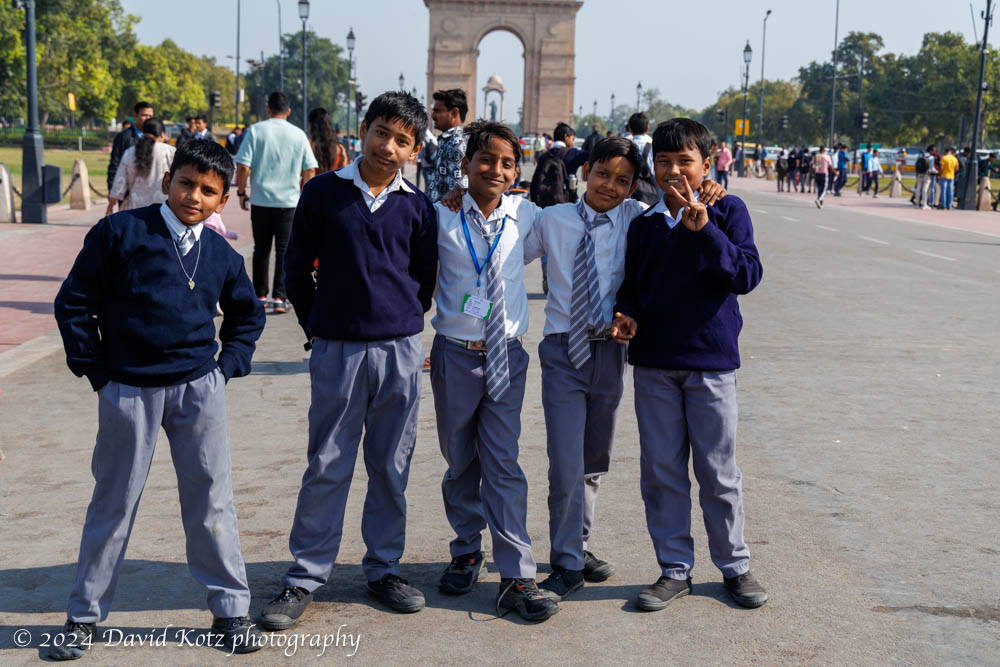
The mood was festive as I walked through the crowds toward the India Gate. I encountered several young men using professional-looking DLSR cameras, offering to snap photos of tourists and sell them the digital files for sharing with friends and family. When one approached me, I waved him off with my Canon R5 and explained I had my own camera, thank you.
Back in the tuk-tuk, we headed toward Humayan’s Tomb, but he suggested we stop at a traditional market “on the way”. I had hopes that it was truly an open-air market with tiny stalls; such markets are a delightful (and photogenic) experience. Not today. We pulled into the parking lot of a second-rate handicrafts market… the kind that sells everything from woodcarvings to silk scarves to wool carpets. Sigh, I know this trick – having been subject to it numerous times before, a driver suggesting that I “just take a look”. I was not in the mood for shopping, but explored the whole store, escorted by the (polite but persistent) storekeepers. I did ultimately make a purchase, to my surprise – a nice Indian-style vest.
After I had completed my purchase – and deflected the shopkeepers’ many polite (but persistent) offers to “just take a look” at yet another room of carpets, silks, carvings, or other crafts – I settled back into the tuk-tuk. Raju offered that today was a special festival at the Sikh temple. That sounded interesting, so off we went. Humayan’s tomb could wait a bit longer!
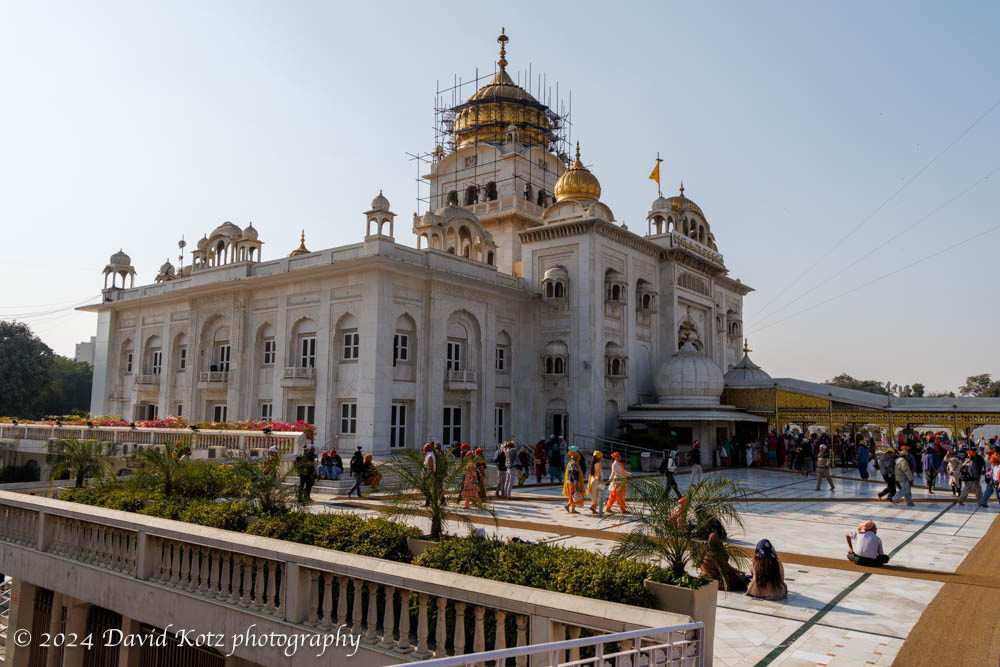
On arrival, Raju led me from the parking garage into the temple grounds. As he showed me to a guest center where I could borrow a scarf to cover my head, and stow my shoes and socks, I realized I had been to this temple before, during a Dartmouth Alumni trip in 2017. Gurudwara Bangla Sahib, the largest Sikh temple in Delhi, is truly impressive. Impressive architecturally – very beautiful inside and out – and operationally. They provide all-day prayers, open to anyone of any faith, as well as opportunities to receive holy water from an elaborately decorated tank, or to bath in a holy pond; they provide a low-cost charity medical clinic; and they provide free meals to anyone who needs a meal. On a typical day they will serve over 15,000 meals, he told me – rice, dal, potatoes, chapati. Himself a Sikh, Raju proudly took me on tour – inside the temple, where pilgrims sat quietly on the floor while the holy men chanted prayers – around the pond, and into the dining facility. In a large, elegant dining hall, people sat quietly on marble floors in neat rows. One man laid a stainless-steel tray in front of each diner; another followed with a bucket of rice, another with a bucket of dal, and so on, efficiently serving several hundred people at each sitting.

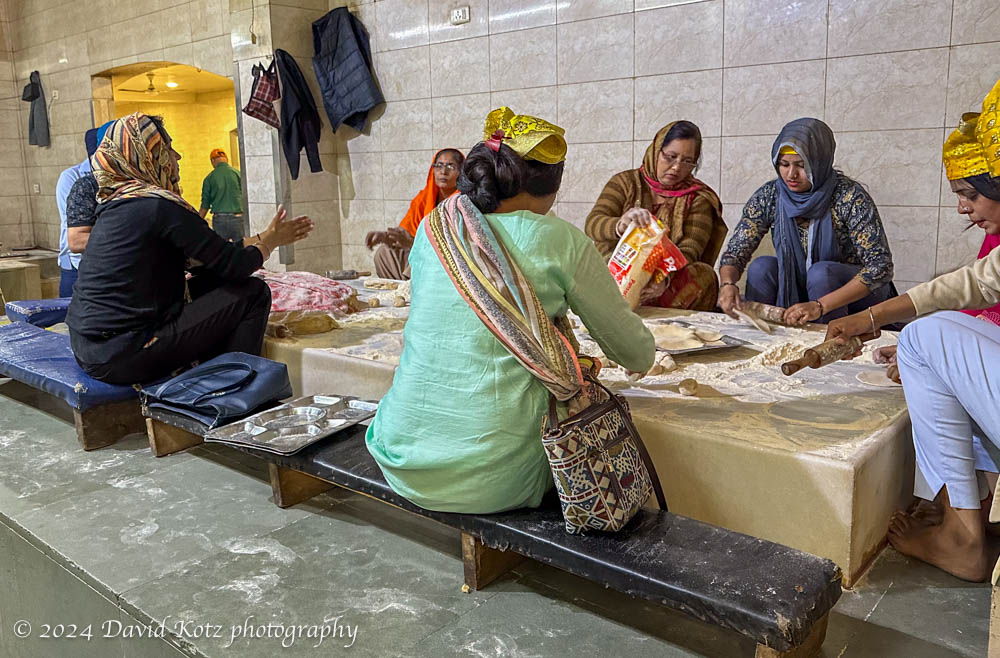
Inside the kitchen I saw meter-wide vats bubbling with dal, clusters of women rolling dough for chapatis, men grilling chapatis, volunteers filling buckets of rice and dal for distribution, and a bustling washroom where each dining tray passes through four phases of washing and sanitization. Truly impressive!
Back on the road, we made our way slowly through busy afternoon traffic. Raju said he was hungry and stopped at a place for a quick lunch. But his lunch spot happened to be another Indian-crafts store… where I suspect Raju earns a small commission. After Raju disappeared to seek out his lunch, the shopkeeper invited me inside to “just take a look.” The polite (but persistent) salesmen were quite sure I needed silk scarves, wooden carvings, or jewelry. I was equally polite (but determined) in my refusals. Sigh. But then I spotted a nice vest… and soon was choosing fabric and buttons and the staff were taking my measurements for a custom-tailored wool/silk vest that would be delivered to my hotel the next day.

That accomplished, Raju and I finally headed for Humayan’s Tomb. Stuck in traffic, he shut off his tuk-tuk, as do the other drivers around. “Red light on, Gaadi off,” as the government slogan says: the aim is to reduce pollution from vehicles idling at traffic lights. I’ve long noticed that these moments, in dense traffic, where everyone is close together, engines off, become time for conversation in this impromptu community. Over the background chatter, and interrupted by two Hijra weaving through the stalled traffic to seek a few rupees here and there, Raju told me about his family. He has “no sons,” he said disappointingly, “only a daughter”, but was clearly proud of being a grandfather. His health is good, he said, but at 65 with “no pension”, he is concerned about the next phase of life. Then, the light turns green, the engines roar into action, the community dissolves, and the honking resumes; we are off again, weaving through the chaotic Delhi traffic.
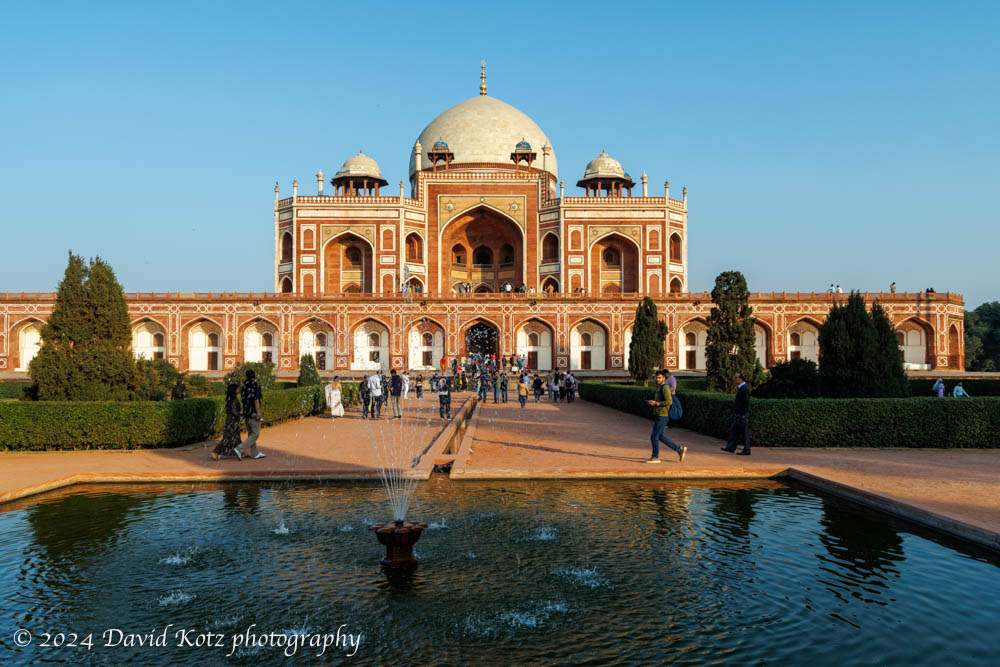
At the entrance to Humayan’s Tomb, I paid and thanked Raju for his time and his guidance. We agreed to meet the next morning. He quickly found another customer and I headed off to explore this well-known UNESCO world heritage site. Although I have visited at least three times before, it has been recently expanded absorb several other centuries-old historic buildings, now interconnected with expansive lawns and beautiful gardens. Someday I will have to return to explore the new areas, and the new museum, because today I had time only for the main site.
I spent a lot of time trying to photograph the architecture, because there were so many, many tourists that it was hard to get a good shot with no (or few) people. That’s the downside of this time of day; morning would be quieter. On the other hand, because the building faces west and the sun was only an hour away from sunset, the light was fantastic!
As I waited for the crowds to thin, I found another photographer standing next to me, eager for the same shot. We struck up a conversation, comparing cameras as photographers often do (he with the Sony DLSR, me with the Canon R5). A local man in his twenties, he is a commercial photographer – photographing anything that will earn him a living, he said, including product photos, events, weddings – though he was out today just for fun. Like me.

Inside the tomb – really a massive, majestic mausoleum that predates the Taj Mahal and which indeed inspired the Taj’s architecture – a security guard offered to show me around and explain the various inner chambers. In broken English he explained each tomb – for Humayan, his two wives, his children, his grandchildren – all of which was interesting and quite helpful. At the end of the tour he said, “will you give me something?” I should have seen that coming; clearly, he had marked me as a prospect for making a little money on the side. Sigh.
Sunset was approaching, and I wanted to walk back to the hotel before dark. Although it was only a kilometer away, the route is along a divided four-lane road bursting with traffic. Along the way I saw an interesting alleyway off to the left – filled with people and informal stalls with vendors selling every sort of wares… vegetables, fruits, shoes, silks, housewares, jewelry, meats, nuts, snacks, smartphone covers,… whatever. It was bustling with vendors and shoppers as the streetlights came on and the evening settled in. I love these places, so I abandoned the main road and dove into the crowd.

I passed men and women and families going about their evening business. Men stood in small groups, smoking. Women carried bundled babies. A couple paused at a street vendor, his table stacked with hundreds of pairs of shoes, while the woman tried on shiny new shoes. Stray dogs wrestled in the narrow street, while motorcycles and small cars tried to pass without hurting anyone. A fruit-juice stall, where a large spinning wheel was pressing juice out of raw sugar cane, while customers waited eagerly for a glass of sweet juice. An open-air butcher shop, with huge slabs of meet dangling from hooks; as I paused to watch, a young worker sat behind a wooden stump, using a large knife to chop meat into kabab-sized pieces and toss them into a bowl in front of the customers waiting by my side. Next door – not a coincidence? – was a kabab shop, with the chest-height brazier on the sidewalk, coals brilliant red, on which a man turned skewers of meat. He eyed me, hoping for a customer, but I declined. At a nearby kabob shop the grill-man and his onion-chopping partner were pleased to see me and agreed to pose for a photo.
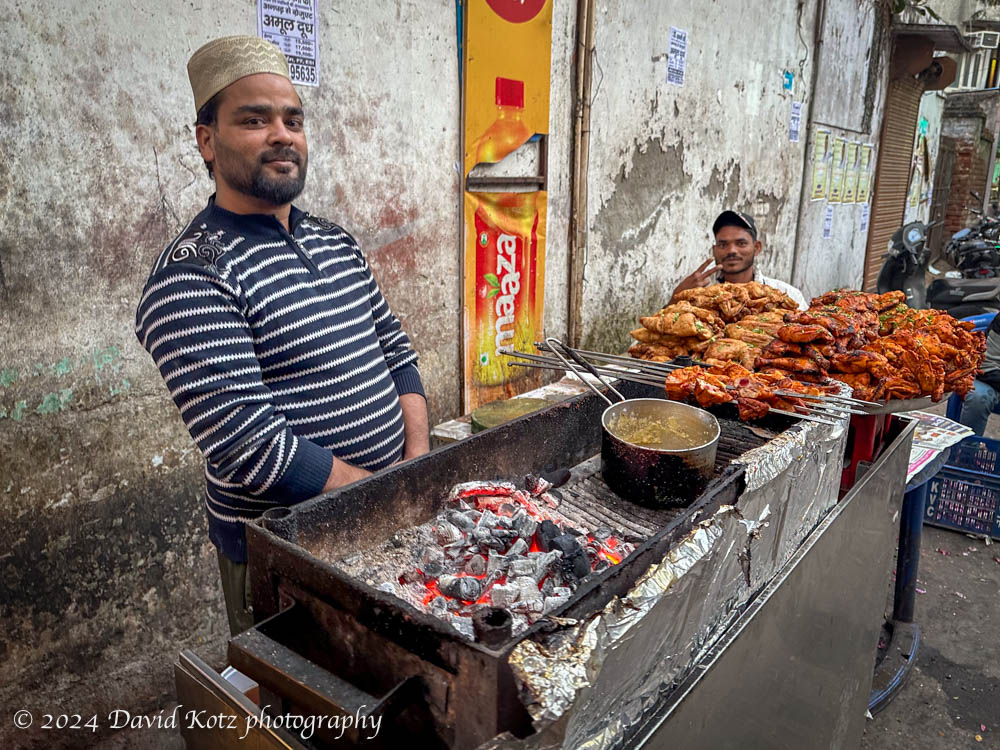
This alleyway was a feast for the eyes, ears, and nose. I took few photographs – I find street photography to be challenging, especially in close quarters; as fascinating as these scenes are, to me, these people are just going about their everyday life and I try to respect that.
I finally made my way home, along the dusty sidewalk… past the commuters waiting at a bus stand, past a street vendor selling drinking water by the glass, whose current customer was in a wheelchair; past the small children carrying large sacks – bigger than they are – of plastic bottles they had scrounged, to sell to a recycler; past shoeless toddlers playing in a dusty triangle between streets, where bushes served as their family home; past tired adults wrapped in blankets, settling in for a cold night’s sleep on the sidewalk. This opportunity to observe, at a slower pace, and in the open air, is why I like to walk or to ride in open-air rickshaws. It is an opportunity for me to learn, to appreciate, and to (attempt) to understand. There is much yet to learn. Delhi is a city of deep history and rich culture, of immense beauty and sad decay, of extreme wealth and dismal poverty, of great pride and intense challenges; in short, a place of stark contrasts. Most of all, though, I found it to be a place of kind, friendly people. I will head out again tomorrow, to find Raju and explore further.
Be sure to visit the photo/video gallery for more photos!
Postscript. While in Delhi I noted the smoggy air, and it was often a topic of conversation among the locals. It was bad (AQI 166), but bearable. I left Delhi on Tuesday 10 December. Less than a week later, I learned the air quality was really bad, and getting worse: “the Air Quality Index (AQI)… crossed the 450 mark late on 16 December. AQI levels in the [national capital region] are expected to worsen over the coming weeks due to adverse meteorological conditions. Expect disruption to flights, rail services and road journeys due to low visibility caused by heavy smog.”

 David Kotz
One thought on “Delhi – Saturday”