
Our trip around Japan has thus far been fascinating, as we experience the beauty of its landscape, the depth of its culture, and the friendliness of its people. Our afternoon visit to Hiroshima, however, was profoundly humbling and thought-provoking. Now a bustling metropolis of 1.2 million people sprawling across the broad delta of a river pouring into Japan’s inner sea, it was hard to visualize the day, just over 79 years ago in August 1945, when the Enola Gay dropped the world’s first nuclear weapon here – then a city of 350,000 souls. By the end of that year, 140,000 people had died. Please read on.

Although I was familiar with the broad outlines of the story, I was grateful today to visit the Hiroshima Peace Memorial Park and its associated museum. We began at the preserved ruins of a civic center now known as the Atomic Bomb Dome – the shell of a brick and concrete building, one of the few buildings left (partly) standing after the bomb blast, despite being only a hundred meters from ground zero. From there we crossed the bridge – the target chosen for the bombing – and walked along the paths through the grassy Hiroshima Peace Park to the Children’s Peace Monument. Inspired by the story of the brave survivor Sadako Sasaki, a 2-year-old who survived the bombing without a scratch only to die a decade later from leukemia, the monument includes thousands of paper cranes contributed by children from around the world.
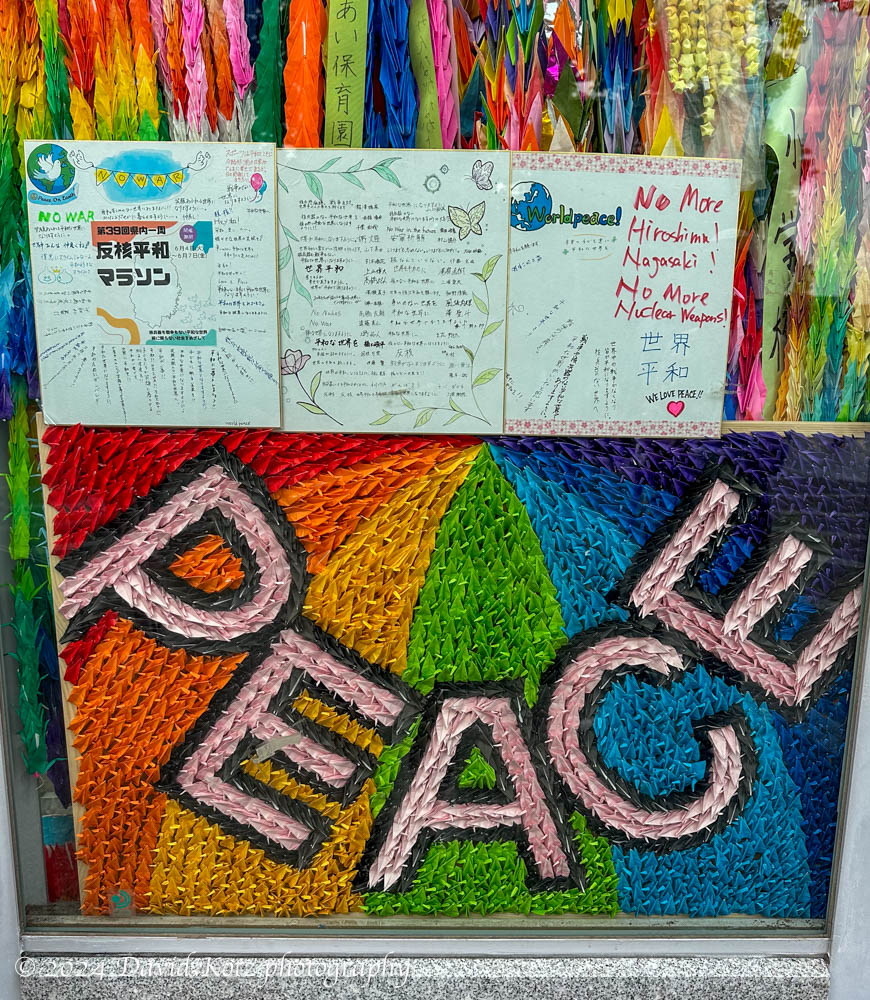
This mural is made of hundreds of tiny paper (origami) cranes, made by children.
We concluded our visit with a somber tour through the Hiroshima Peace Memorial Museum. The exhibits tell the story of that fateful day, often in graphic form. The crowd moved slowly through the darkened museum, reading the first-hand accounts of survivors, and poignant descriptions of tattered clothing and everyday items destroyed by the bomb and its aftermath – a ‘black rain’ that sprinkled radioactive water on the few survivors. The mood was somber, and tears were visible on the faces of many. The horror of atomic weapons was laid bare, and the message – never again – was patently clear.

I include a few more photos of the park – which is as beautiful as it is moving – in the gallery.
Postscript: a month later, the Nobel Peace Prize was awarded to Nihon Hidankyo, a collective of Japanese atomic bomb survivors, for “demonstrating through witness testimony that nuclear weapons must never be used again.” The collective represents survivors, known as hibakusha, or “the people affected by bombs,” of which more than a hundred thousand are still alive.

This post is part of a series about our Japan trip; the series starts here.

 David Kotz
I never made it to Hiroshima, but my understanding is that it’s not possible to visit and come back unchanged. Thank you for this.