
After leaving Machu Picchu we hopped on a train back to Cusco (Cuzco), a journey of several hours and passing through some of the most narrow ravines I’ve ever seen. In some places the train had to climb down switchbacks by going forward, backward, forward because there was no room for turns! Although we had only a few short hours in the city, it was fascinating. Read on!
Cusco is the largest city and the higher than most places we visited on this tour – several thousand feet higher than the mountaintop site of Machu Picchu. Cusco’s elevation is around 3,400 m (11,200 ft). “The city was the capital of the Inca Empire from the 13th century until the 16th-century Spanish conquest. … The Constitution of Peru (1993) designates it as the Historical Capital of Peru.” [Wikipedia]
We arrived in Cusco in the early afternoon. Our minibus and driver picked us up and drove us up to a rocky outcrop overlooking the city. This is Sacsayhuamán, “an Inca ceremonial fortress located two kilometers north from Cusco: the greatest architectural work by the Incas during their apogee.” [Wikipedia]

It is worth quoting more of Wikipedia, because it helps to appreciate this incredible site:
The stones used in the construction of these terraces are among the largest used in any building in pre-Hispanic America. They display a precision of cutting and fitting that is unmatched in the Americas. The stones are so closely spaced that a single piece of paper will not fit between many of the stones. This precision, combined with the rounded corners of the blocks, the variety of their interlocking shapes, and the way the walls lean inward, is thought to have helped the ruins survive devastating earthquakes in Cuzco. The longest of the three walls is about 400 meters. They are about 6 meters tall. The estimated volume of stone is over 6,000 cubic meters. Estimates for the weight of the largest Limestone block vary from 128 tonnes to almost 200 tonnes. These stones were moved an estimated 35 km (22 miles) from Rumicolca.
Wikipedia

Unfortunately, much of the site was torn down by the Spaniards, taking stones to build their new homes, offices, and cathedrals.

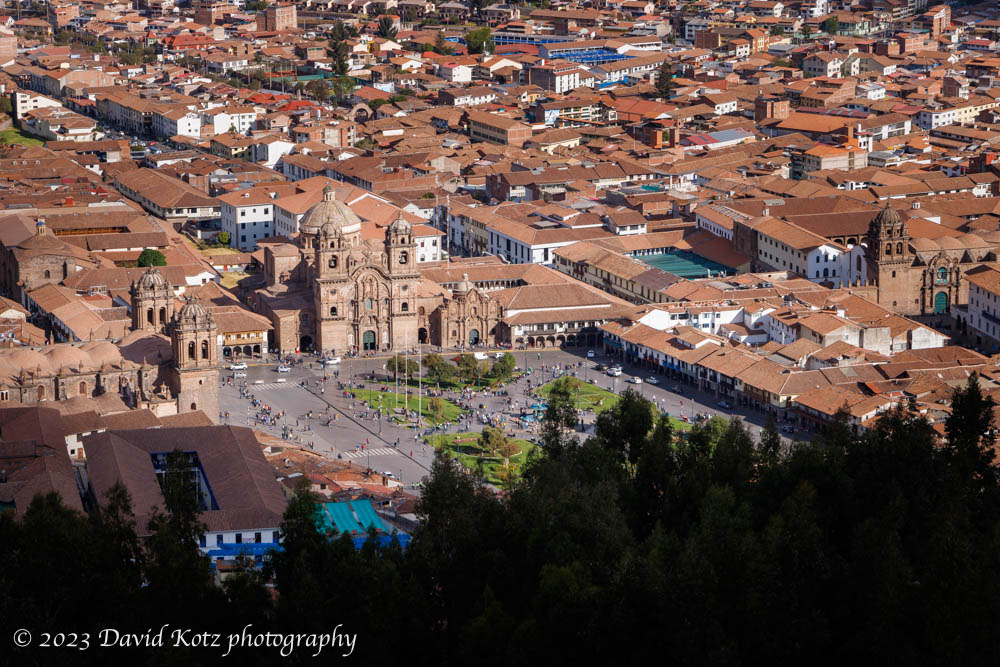
We enjoyed a panoramic view of Cusco from the hillside beside these historic walls, and then rode down into the city center for a visit to the cathedral. We had a fantastic dinner at MAP restaurant, and stayed overnight in the historic Palacio del Inka hotel. Check out the gallery for more photos!


 David Kotz