
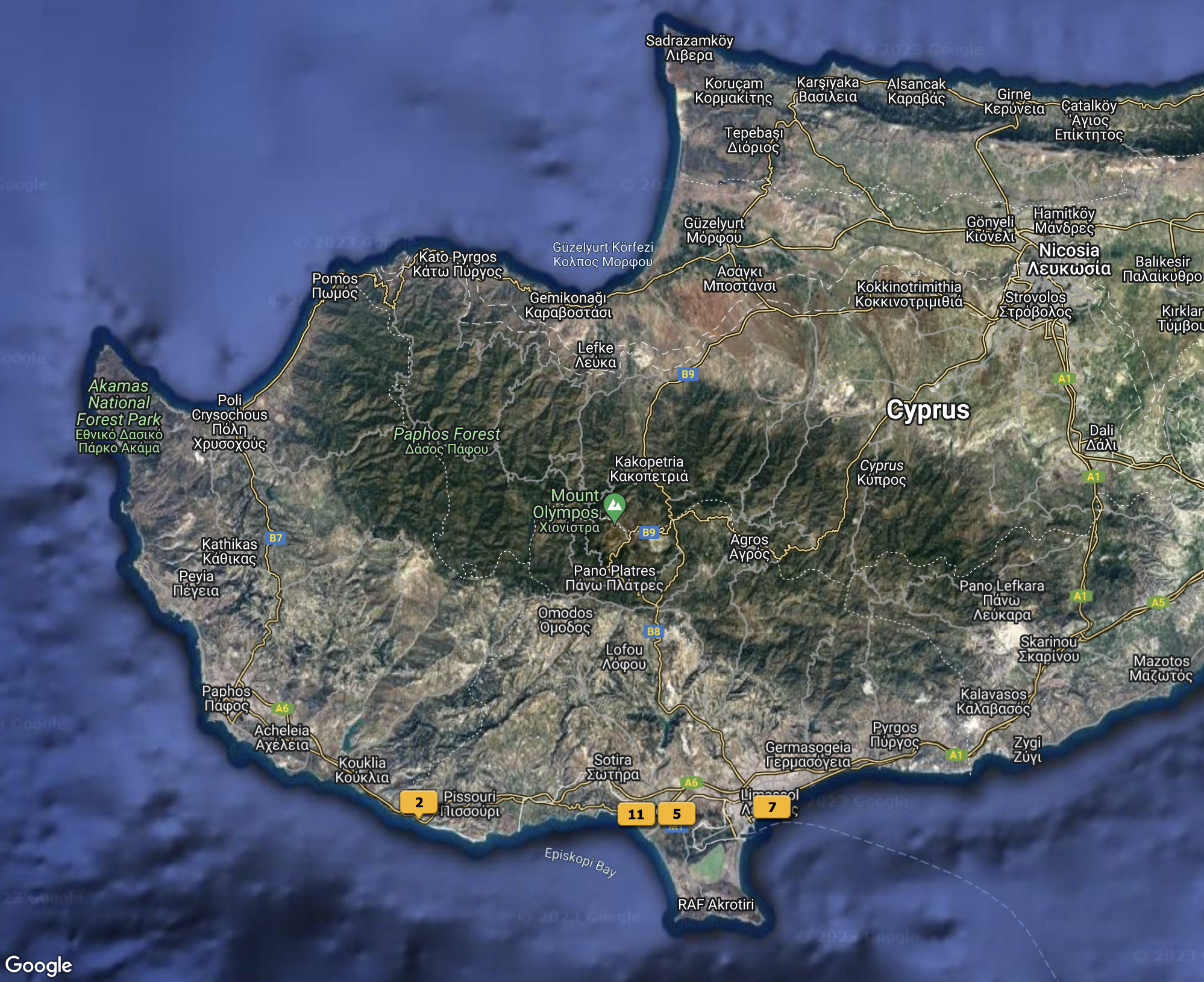
For our final day in Cyprus we signed up for a bus tour to the east, along the coastline, to the city of Limassol. Along the way we were able to visit the legendary birthplace of the goddess Aphrodite, the ancient Greek acropolis of Kourion, the medieval Kolossi Castle, and the medieval Limassol Castle. We enjoyed our lunch in a breezy café beside the old harbor of Limassol city. Read on, and check out the gallery of photos.
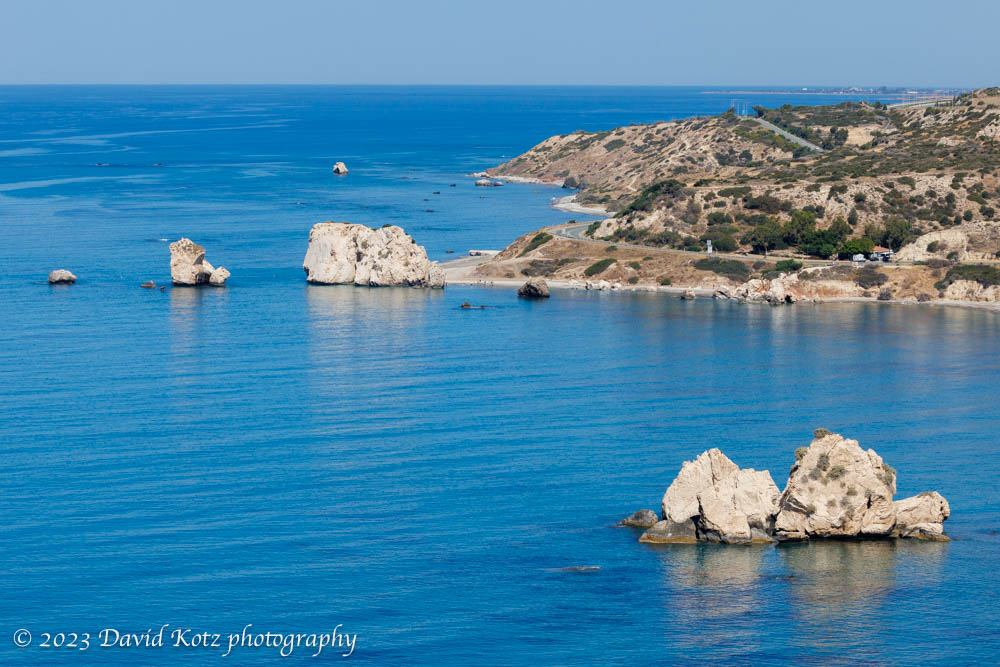
For millennia Cyprus has been known for the origin story of the Greek goddess Aphrodite, who according to legend was born from the foam of the Mediterranean Sea and arrived on land at this particular rock (the center of three rocks below). I read this story in various Cypriot tourist materials and heard it repeated by several guides, but Wikipedia provides a more nuanced telling. This legend is widely known today through the famous Botticelli painting, Birth of Venus. (Venus is the Roman name for the Greek goddess Aphrodite; I was fortunate to see this painting personally when I visited Florence.) In any case, there was a long-established worship of a goddess of fertility, in old Paphos, likely originating from Phoenicia; when the Greeks arrived centuries later, they attached the name Aphrodite to this history. Today, tourists like us flock to the site, encouraged by the opportunity to see this legendary site. (But, as one restaurant waiter reminded us with a shrug, “it is just a rock.”)

We spent only a few minutes at a viewpoint overlooking the rock – after all, it is just a rock – though we had heard the best way to visit is to visit the neighboring beach and swim three times around the rock, resulting in eternal beauty and youth. Not an option today, I suppose!
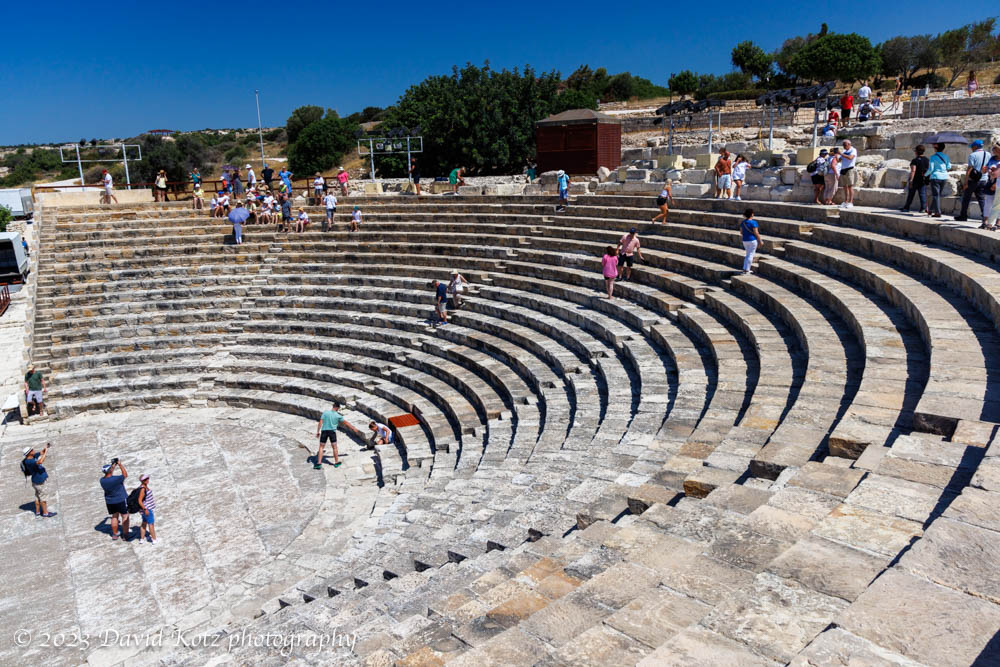
Onward, then, to the acropolis of Kourion, 13 km west of Limassol. Although this seaside valley has been occupied since the Neolithic era, the ruins we visited were primarily constructed during the Hellenistic and Roman eras. Most intact was the amphitheater – originally constructed in the 2nd century BCE, later revised and expanded by the Romans, and ruined during earthquakes of the 17th century – it has been reconstructed and hosts performances even today. Exploring further, we visited the House and Baths of Eustolios with its impressive mosaic floors, and the ruins of the nymphaeum and forum baths and the Episcopal cathedral. See the gallery for more of my photos.
Our next stop was the medieval Kolossi Castle, which oversaw lands that produced sugar (from sugar cane) and wine (still made today). Built in the 15th century on the ruins of an earlier 13th-century castle, it remains in good shape. When we visited, several busloads of tourists entered through the drawbridge to explore its now-empty rooms – a basement and two high-ceiling floors, and a defensive rooftop. It was amusing to see so many people trying to navigate the single narrow spiral staircase – barely wide enough for two medieval people to pass if one encountered someone going down while another was climbing up, this staircase was quite the challenge for modern tourists… many of whom are, shall we say, quite a bit wider than their medieval ancestors. I was stuck in one such traffic jam involving ten minutes gesturing and conflicting instructions shouted in Italian and Greek, to no avail. Ultimately, somehow, we escaped. See the gallery for more of my photos.

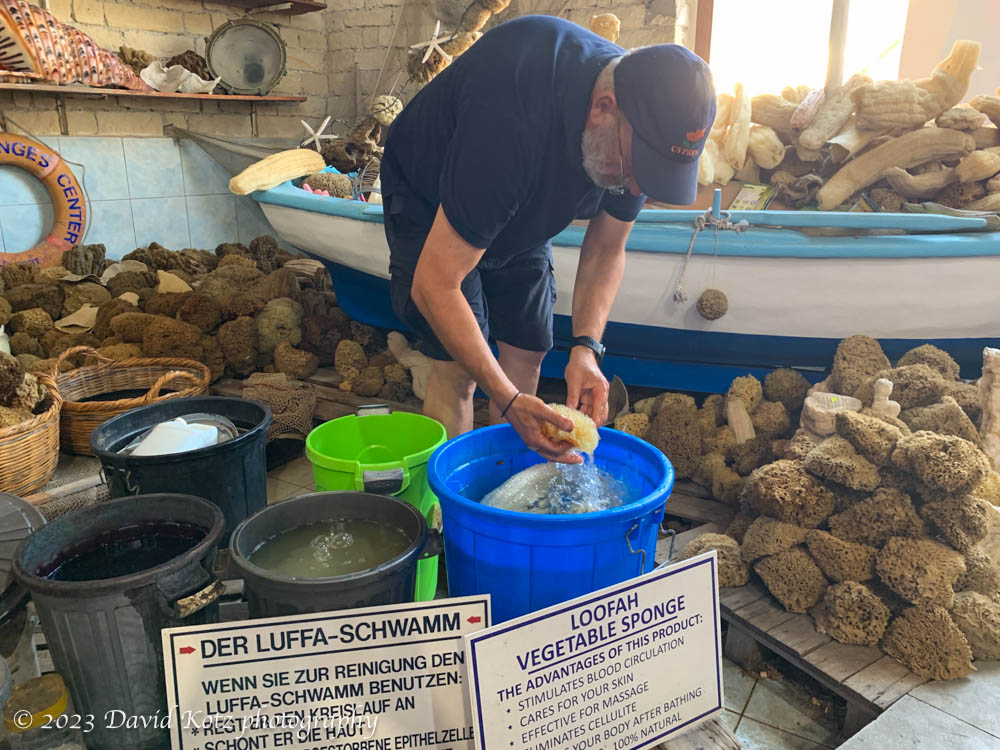
Onward to Limassol, the second-largest city in Cyprus and one of its most important ports. The British maintain sovereign terrain for a military base just outside the city, a result of the treaty that provided Cyprus independence from Britain in 1960. We were dropped off at a downtown shop, close to the old harbor and the historic district. At the shop – primarily an outlet for a sea-sponge factory – we received a brief demonstration about the processing of sea sponges harvested offshore, and a tasting of the sweet wine, Commandaria, the oldest form of wine on Cyprus and still produced today in the area of Kolossi Castle. It as very sweet and very strong!
After a delightful lunch beside the old harbor, we made a brief visit to Limassol Castle. Originally built in 1590, it was apparently “built over an Early Christian basilica (4–7th century CE) and a Middle Byzantine monument (10th–11th century CE)” [Wikipedia]. Destroyed and rebuilt several times, and used by the British in the 20th century as a prison, it is now the home to a museum with interesting artifacts; as a former coin collector, I was particularly impressed by the NOMI∑MATA (numismatic) coin display.

Overall, it was an interesting day, although we spent little time at each of the sites, and had almost no time to actually explore Limassol. It seems worth a longer visit! See the gallery for more of my photos.

 David Kotz