
The conference organizers kindly organized an afternoon tour of two local archaeological sites, now UNESCO World Heritage sites, on the outskirts of the ancient (and still thriving) city of Paphos. Read on and see the gallery!
The “Tombs of the Kings” is a sprawling seaside complex of tombs, a necropolis. “The underground tombs, many of which date back to the 4th century BC, are carved out of solid rock, and are thought to have been the burial sites of Paphitic aristocrats and high officials up to the third century AD (the name comes from the magnificence of the tombs; no kings were in fact buried here)” [Wikipedia]. Although no human remains have apparently been found here, archaeologists apparently have found artifacts. We were able to stroll the surface and, in a few cases, walk down into the underground tombs, some whose ceilings are still supported by two-thousand-year-old columns.

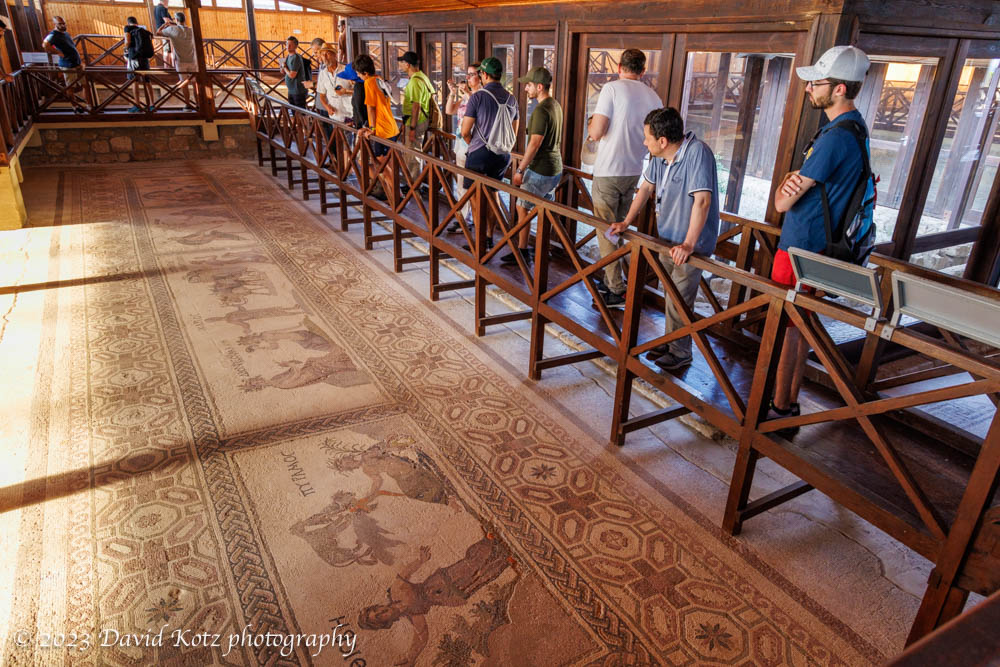
At the seaside in the heart of Paphos is the archaeological site of Nea Paphos, an even broader complex that contains the ruins of “new Paphos”, founded in the 4th century BC by a king who relocated the city from old Paphos; it was later occupied and expanded by Greek and then Roman rulers of Cyprus. “The most significant remains so far discovered are four large and elaborate Roman villas: the House of Dionysos, the House of Orpheus, the House of Aion and the House of Theseus, all with preserved mosaic floors” [Wikipedia]. These mosaics, most depicting scenes from Greek mythology, were artfully crafted from thousands of tiny pebbles. We spent most of our time in the House of Dionysos – extremely well preserved and now under cover, as shown at top of this post – with a quick look into the House of Aion and the House of Theseus (below). The artwork is spectacular and it’s incredible they have been preserved through two thousand years of wars, earthquakes, and weather.

I selected a few more photos of these amazing, multi-colored mosaics to share in the photo gallery.
Fun fact: Cyprus is the origin of cauliflower, according to 12th century Arab botanists; in Europe during the middle ages, it was known as Cyprus cabbage or Cyprus colewart [Wikipedia].


 David Kotz