
We’re off again, this time to the island nation of Cyprus in the Mediterranean. I needed to attend a computer-science conference (DCOSS-IoT) for a few days, so we decided to extend the trip by two days and explore this island that has been at the crossroads of history for millennia. We are staying at an oceanside hotel in Coral Bay, outside Paphos; on our first morning, I took a walk along the shore to a point (“Karst point”) that provided a lovely view back across the bay to the hotel. My first gallery of photos shares views of the hotel, the bay, and some of the lovely flowers blooming this time of year.
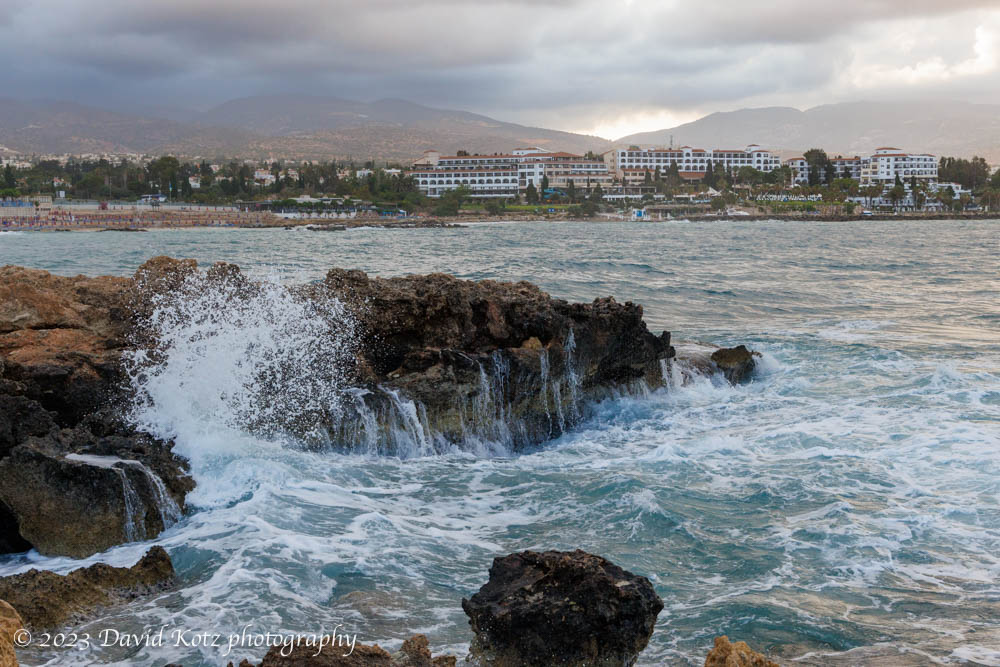
The entire island seems to be made of limestone and sandy conglomerates, leading to jagged shorelines where the pounding waves create jagged cliffs and deep sea caves. This karst leads to interesting coastline features and no doubt eased the construction of ancient cities and temples.
As Wikipedia notes, “The earliest known human activity on the island dates to around the 10th millennium BC. Cyprus was settled by Mycenaean Greeks in two distinct waves in the 2nd millennium BC. These waves of Greek settlement left a lasting impact on the island’s culture, language, and architecture.” (Hey, right next to our hotel is a place marked on the map as a museum of the mycenaean colonisation of Cyprus. Gotta check that out!)

The south/western portion of Cyprus is still deeply tied to Greek culture, and the local language is Greek… though they drive on the left side of the road, reflecting a century of British rule. (The other side of the island, after an uneasy truce from a 1974 conflict with Turkey, is under Turkish control.) Over time, this strategically-placed island has been part of the Assyrian, Egyptian, and Persian empires, under control of Alexander the Great, the Ptolemaic Kingdom, then the Roman empire; as part of the eastern Roman empire (aka Byzantine empire) “the Greek orientation that had been prominent since antiquity developed the strong Hellenistic-Christian character that continues to be a hallmark of the Greek Cypriot community.” After a thousand years under Roman control it was then controlled by the French, the Venetians, the Ottomans, and then the British in 1878. It was formally annexed into the UK in 1914, and granted independence in 1960. The island was divided in 1974 after a coup by Greek activists and an invasion by Turkey; the (Greek) Republic of Cyprus joined the EU in 2004 and the EuroZone in 2008. [All from Wikipedia.]
As I said: here Cyprus sits at the crossroads of history. Its culture, cuisine, language, and religion reflects the fusion (and conflict) of these many cultures over 10,000 years. We aim to spend the next few days exploring some of the cultural, natural, and archaeological history of this fascinating place. For now, we’re embedded in the booming tourist culture, surrounded by European tourists seeking a vacation in the sun and sand. Check out my gallery of photos.

Fun fact: Cyprus was an important source of copper in the ancient world. “Through overseas trade, the island has given its name to the Classical Latin word for copper through the phrase aes Cyprium, “metal of Cyprus”, later shortened to Cuprum.” [Wikipedia] That word, of course, led to the chemical symbol for copper, Cu.
Where is Cyprus?

https://commons.wikimedia.org/w/index.php?curid=8105074

 David Kotz
2 thoughts on “Cyprus – Coral Bay”