There are dozens of trees blooming on campus! I added a IISc nature photo album, featuring recent pictures.


The IISc campus is one big botanical garden.
There are dozens of trees blooming on campus! I added a IISc nature photo album, featuring recent pictures.
The BJP outlines their technology vision.
Today one of India’s leading political parties, the BJP, documented their vision for the use of Information Technology to “help India overcome the current economic crisis; create productive employment opportunities on a large scale; accelerate human development through vastly improved and expanded education and healthcare services; check corruption; and make India’s national security more robust.”
The list includes some pretty aggressive goals; I highlight some of the more interesting items in the quotation below. Please note that my quoting this information is in no way meant as an endorsement of the BJP. Although I’m skeptical of whether these goals could be achieved at the scale and in the timeframe they propose, such a pervasive use of technology would bring many exciting new opportunities – and new risks if the devices or the infrastructure was not secure. There is some press coverage here.
“The highlights of the 30-page IT Vision document are:
2. 1.2 crore (12 million) new IT-enabled jobs in rural areas.
3. 1 crore (10 million) students to get laptop computers at Rs 10,000 [$200]. Interest-free loan for anyone unable to afford it.
4. National Digital Highway Development Project to create India’s Internet backbone, and Pradhan Mantri Digital Gram Sadak Yojana for last-mile access even in the remotest of villages.
5. Broadband Internet (2 Mbps) in every town and village, at cable TV prices (less than Rs 200/month).
6.All schools and colleges to have Internet-enabled education.
7. 100% financial inclusion through bank accounts, with e-Banking facilities, for all Indian citizens. Direct transfer of welfare funds, preferably to the woman of the house.
8.Every BPL family to be given a free smart mobile phone, which can be used by even illiterate users for accessing their bank accounts.
9. Number of mobile subscribers to be increased from 40 crore at present to 100 crore in five years. Internet users to equal mobile subscribers. India to equal China in every IT parameter in five years.
10. Video conferencing to be made affordable and universally accessible.
11. Primary Health Centre in every village to be linked to the National Telemedicine Service Network.Basic health insurance scheme for every citizen, using the IT platform. Cashless hospitalisation.
12. India’s ranking in the United Nations’ Human Development Index, which is currently 128, to be improved to 50 in five years, with the long-term objective of bringing India within Top Twenty by 2020.
13. Massive expansion in the use of IT in agriculture, rural development, SMEs, retail trade, and informal and unorganised sectors of the economy.
14. National e-Governance Plan to cover every Government office from the Centre to the Panchayats. The ‘E Gram Vishwa Gram’ scheme, launched by Shri Narendra Modi in Gujarat, to be implemented nationwide.
15. Government spending to be made corruption-free. A former Prime Minister had once said, “If I put Rs. 100 in the pipeline in Delhi, only Rs. 15 reach the end beneficiary.” In contrast to Congress governments’ Leaky Pipeline, the BJP’s IT Pipeline will ensure 100% benefit to people. Those who misappropriate public funds will be punished.
16. All post offices to be converted into IT-enabled Multi-Service Outlets. All telephone booths to be upgraded to Internet kiosks.
17. Citizens will have a simple 1-800 BSNL Toll Free Number, which will be accessible 24x7x 365 days of the year, to contact their Member of Parliament.
18. Unlimited VoIP access to all
19. e-Bhasha: National Mission for Promotion of IT in Indian Languages.
20. Special focus to bring women, SC/STs, OBCs and other weaker sections of society within the ambit of IT-enabled development.
21. Use of IT for the protection of India’s priceless cultural and artistic heritage.
22. Government to standardise on ‘open standard’ and ‘open source’ software.
23. Domestic IT hardware industry to be aggressively promoted to minimise dependence on imports.
24. Domestic hosting industry to be promoted to minimise international bandwith [sic] charges.
25. An independent body, Digital Security Agency (DSA), to be set up for cyber warfare, cyber counter-terrorism, and cyber security of national digital assets.“
This post was transferred from MobileMe to WordPress in 2020, with an effort to retain the content as close to the original as possible; I recognize that some comments may now seem dated or some links may now be broken.
Mango season is here!
I’ve been a fan of mangos for years, but the ones we get in NH are nothing like the fresh mangos we get here! Mango season has arrived, and they are sogood. So ripe, so sweet, so tasty. We eat several kilograms a week, and have tried several different varieties. At first, the kids turned up their nose, but one day Mara decided that she’d have a little taste. Next thing you know, she devoured two and a half mangos. John and Andy dug into some too – things got a little messy!

This post was transferred from MobileMe to WordPress in 2020, with an effort to retain the content as close to the original as possible; I recognize that some comments may now seem dated or some links may now be broken.
IISc celebrates Holi.
Today is the main day of Holi, a Hindu festival of spring. Immensely popular in the north, but little known here in the south, it involves throwing a lot of colored powder and colored water at other people, and generally having a great time. Here at IISc, there are grad students from all over India, and they put on a series of Holi events… a sandpainting competition, a wild color/water/music bash, and a bonfire. Read on!


The kids play Holi.
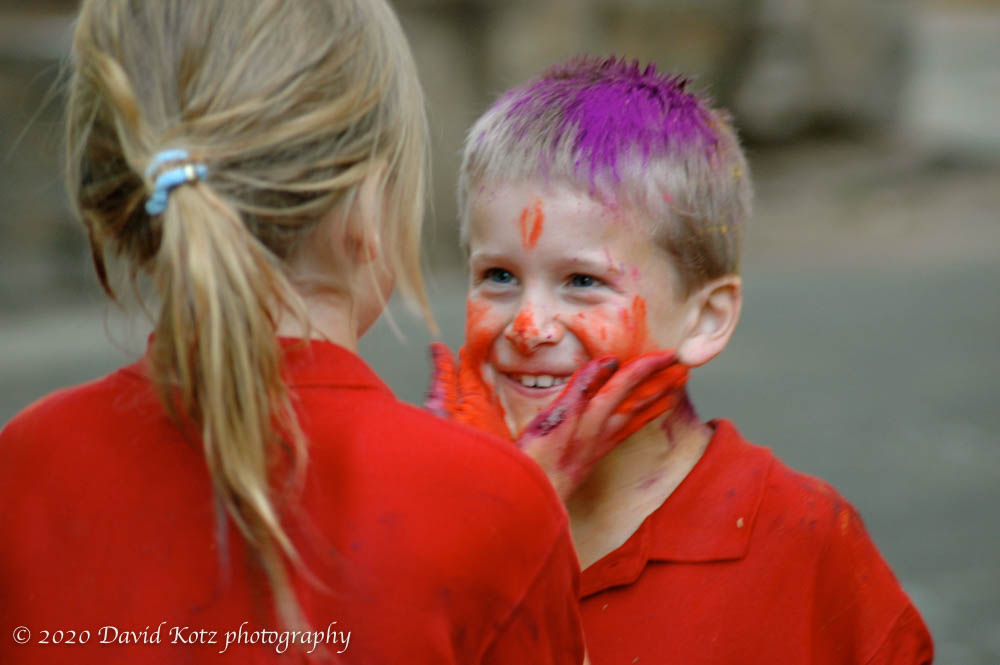
Andy and Mara got into the spirit of Holi, dashing each other with colored powder and water. Holi is not a local custom – it is more common in the north – so none of the other neighborhood kids were playing Holi. Their friends had fun watching, though!

Celebration of IISc centennial.

The Indian Institute of Science (IISc), my host (and our home) during this sabbatical, was founded in 1909 by J. N. Tata. Every year, on the occasion of his birthday, the Institute celebrates “Founder’s Day”. This year, the 100th anniversary of IISc, is of particular importance. We went to watch an early-morning ceremony at the main campus building, its courtyard decorated with several thousand flowering potted plants. Tata’s statue had earlier been decorated with a flower garland, and we arrived just in time to see various department heads delivering floral wreaths to the foot of the statue. Read on.
Continue reading “IISc Founder’s Day” David Kotz